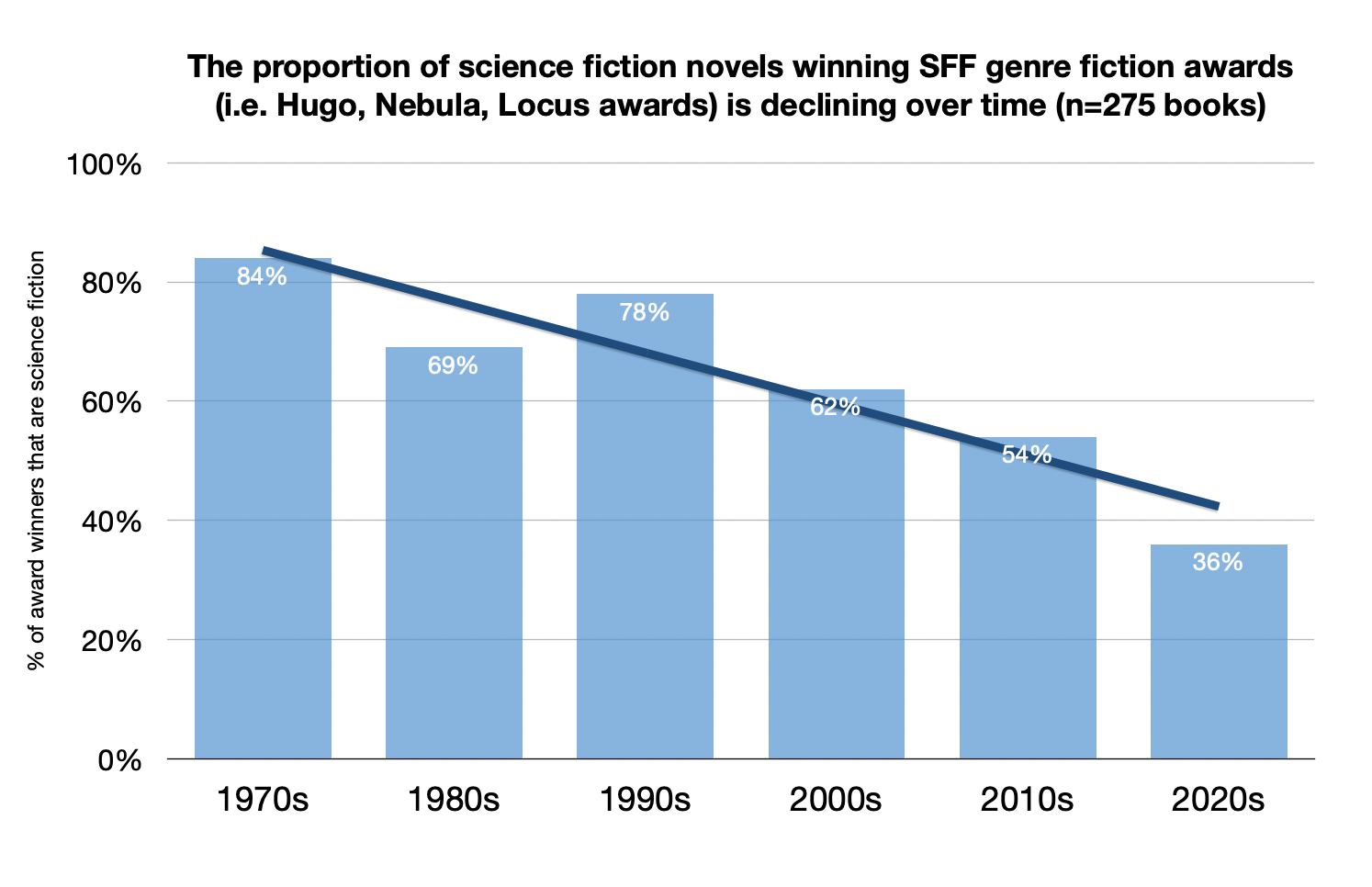
As part of an analysis I do every year of the science-fiction-fantasy (SFF) award circuit, I pulled together data on the 275 most celebrated novels to measure the change in popularity of science fiction over time.
If anyone has theories why science fiction is losing out to fantasy works more and more, I'm all ears! Cheers
Can read more about it here: https://medium.com/@cassidybeevemorris/the-greatest-science-fiction-fantasy-novels-of-2024-3de4c335979b
Posted by kern3three
21 comments
Now, what does that mean? Is technology optimism waning over the decades with people escaping into fantasy? Is this too easy? There should be other answers. It might be also not only a choice that readers make, but also a trend in themes and authorship, reflected in myriads of choices and complexities playing out.
Also, I suppose getting data from before 1970 is not trivial, or else you would have included it, right? Regardless I think the dataset is most interesting!
The source for this data is largely from: [https://www.sfadb.com/Awards_Directory](https://www.sfadb.com/Awards_Directory)
Which I describe how I pull all that together, and while a bit beyond the scope of this chart, use in a 50-year ranking model here: [https://medium.com/@cassidybeevemorris/determining-best-science-fiction-fantasy-novels-since-1970-e232ecbdc34d](https://medium.com/@cassidybeevemorris/determining-best-science-fiction-fantasy-novels-since-1970-e232ecbdc34d)
The “tool” for my chart is simply Keynote, apologies it’s not something fancier!
If there’s any other context I need to provide or questions you have, please don’t hesitate to ask. This is my first post here and would love to chat about it, riff on it, etc. with fellow data/sci-fi fans.
This is anecdotal, but it feels like Romantacy has really eaten up a huge portion of the book market in the past few years and so the fantasy related genre has been lifted as people branch out from there. My wife has gone from reading only Romantacy as a Fantasy genre to reading some of the Greek mythos retellings, staring some Brandon Sanderson series and generally developing her own taste beyond just what I recommend.
Because it’s easier to write material that isn’t required to be bound by the rules of reality than it is to write material that is firmly grounded in reality (absent the occasional cheat like FTL).
Because science fiction is perceived as geeky while in the past it might have been tied to the optimism and competition of the space race.
Because fantasy is ultimately escapist while science fiction is ultimately an exploration of what’s possible if we just put our minds to it. Even dystopian SF often contains an underlying set of assumptions that we figured out FTL travel, figured out AI, figured out all of these challenges (or overcame where we couldn’t, such as looking back at a drowned, burning, irradiated Earth from a successful colony). And life has been getting steadily worse over the last 50 years, leading to more of a desire for escapism and less optimism for what’s next.
Because of changing fashions.
**Edit:** These don’t reflect my views (except maybe the last one, which is the broadest and least satisfying). But OP asked for theories. I rattled off a few plausible ones, all of which tie back to changing market forces.
I think one possibility is because ‘hard’ science fiction is a lot harder to write, requiring some kind of technological or scientific knowledge to explain the advances in your book’s setting.
Fantasy is easier, you can just handwave and say it’s all magic. As the standards of education in this country continually decline, that’s what you end up with.
Or a completely alternative explanation: The 70’s were the heydey of huge blockbuster science fiction settings like star wars and star trek and dune, which made writing science fiction novels more popular. But as the years have rolled on, we’ve seen pretty impressive fantasy releases with massive cultural impacts, everything from lord of the rings to harry potter to game of thrones.
Has there been any science fiction TV series with the success of game of thrones? Or science fiction movies with the impact and reach of LOTR? Or new science fiction IP’s with the success and impact of harry potter?
Or even a third explanation. The fiction is the same but awards like the Hugo and Nebula are declining in quality.
TL;DR – More authors are writing Fantasy, because it’s easier and sells better. So with more books, more chances for a good one.
– – –
There’s a simple explanation that may or may not be true, but it’s usually useful to look at things backwards. Don’t think forwards: everyone is writing books, then there are a bunch of books, and then within SFF there are more awards to F than SF. Why?
Imagine instead the writers seeing that F sells better than SF. Let’s just say for the sake of comparison that it was 50/50 in 1970 and it’s 70/30 today. (You can probably find some actual numbers.) But let’s just say 500/500 and 1400/600 (F/SF).
In any case, they write more F. The more F that is written, the more of a chance an F book will be good. Pick seven books randomly. Now pick 100. There will be more good books in the 100, which seems obvious, and it is.
If only 3% of books are really good, then in 1970, there were 15 really good SF books and 15 really good F books. In 2024, 42 really good F, and 18 really good SF.
So what we would want to know is how many books are F vs. SF each decade.
I wonder if the turn to ‘hard’ science fiction isn’t a factor. Older SciFi often treats science like it will produce magical outcomes (it’s just presumed that technology will somehow make fantastical outcomes happen). With the turn toward more realistic SciFi, there’s a removal of what was essentially a fantasy element within the genre. If this is the case, people always preferred fantastical elements to stories, it’s just that this is clearer now.
Possibly the audience for fantasy is larger? The SOIAF effect?
There definitely has not been a lot of high quality sci-fi, and some of what does exist is vaguely fantasy as well, or more like warhammer 40k-style sci-fi.
A future lead by science and knowledge is becoming a fantasy anyway.
I feel like its because the government has known science fiction is not fiction for 80 years and spent a lot of time and money bashing the culture.
We just read the news now.
Because Scifi is like 90% space and space is fucking boring lol
Same with the movies. It’s a superhero nonsense flood now and no good scifi.
That *almost* looks like a trend, but I’d ike to see it unbucketed by decade to see how noisy it is.
I think maybe a lot of what could only be imagined in the mind has been able to be translated to TV and Movies, which might be a better format for this type of storytelling.
I have to imagine that as men read less and women make up more of the book market, SF will decline. It’s always been a male-heavy genre.
Hmm, while there are almost certainly other reasons which contribute to this trend, it’s interesting how no one has mentioned the elephant in the room. Namely, the recent (within the last 35 years) influx of women into the sci-fi genre, and the (innate) psychological sex differences that have been scientifically proven to exist between males and females.
1.) systemizing (S) vs. empathizing (E), the former being higher in males and the latter being higher in females, on aggregate.
2.) the “people” vs. “things” dimension, with females being higher in the former and males being higher in the latter, on aggregate.
And just to be clear, the consensus among researchers (evolutionary biologists, psychologists, neuroscientists, sexologists, geneticists, etc.) who study psychological sex differences in humans is indeed that these average differences are—at least largely—biologically determined, not socially or culturally determined.
If one tried to argue for largely (let alone exclusively) social influences, they’d be laughed at.
References:
1.) “*Empathizing and systemzing: What are they, and what do they contribute to our understanding of psychological sex differences?*” by Nettle, 2007 (British Journal of Psychology).
2.) “*How predictive are sex and empathizing-systemizing cognitive styles in for entry into the academic areas of social or physical sciences*” by Groen et al., 2018 (Cognitive Processing).
3.) “*Empathizing and systemizing cognitive traits in the sciences and humanities*” by Focquaert et al., 2007 (Personality and Individual Differences).
4.) “*Sex differences in two fundamental cognitive domains: Empathizing and systemizing in children and adults*” by Wakabayashi et al., 2012 (Journal of Individual Differences).
5.) ) “*Genome-wide analyses of empathizing and systemizing: Heritability and correlations with sex, education, and psychiatric risk*” by Warrier et al., 2016.
6.) “*The reality and evolutionary significance of human psychological sex differences*” by Archer, 2019 (Biological Reviews).
7.) “*Men and things, women and people: A meta-analysis of sex differences in interests*” by Su et al., 2009 (Psychological Bulletin).
I feel like I’m seeing a rise in a hybrid genre that could account for some of this. You have books like the Fifth Season, the Sunlit Man, the New Crobuzon books that approach fantasy from a sci-fi direction.
Sci-fi doesn’t have the same wonder and optimism that it did in the mid-century. I think people are tired of the techno-capitalist society we’re in and are turning to the fantasy genre for escapism.
The authors of scifi are less prolific to avoid giving distopic ideas to technobillonaries willing to make them real.
I think this illustrates the shifting values of the *awards themselves* as opposed to the quality of the literature that’s produced. In other words, the value and or quality of these awards has shifted over time.
Comments are closed.