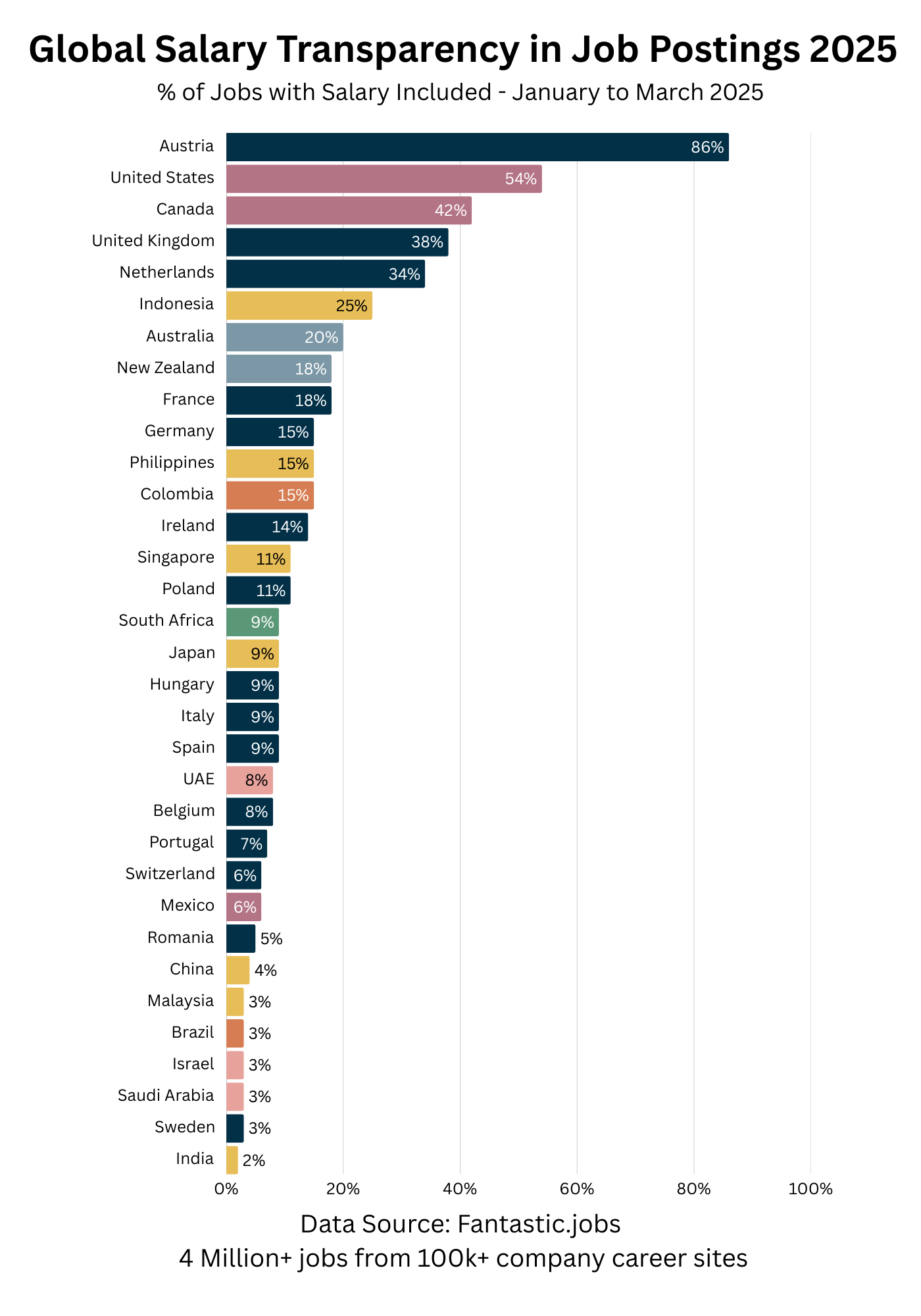
– My own dataset of job postings ([https://fantastic.jobs](https://fantastic.jobs)). All data from this analysis comes directly from company career sites hosted on 34 different ATS platforms. Aprox 100k companies / 4 million jobs from January, Frebruary, and March of this year.
– Jobs are classified as having a salary by displaying this in the JobPosting schema or by mentioning the salary in the job description. Salary mentioned in the job description is extracted using OpenAI 4o-mini.
Biases in the dataset:
– ATS platforms are typically used by: White collar, Large International Businesses, Tech businesses, Companies in the US and UK.
– Many of the companies in my dataset are US/UK, so while they have a lot of job postings in other countries, the company career sites might not necessarily comply with local laws and regulations while it comes to salaries
– A company might be more inclined to include a salary when posting on a job board like Indeed or Linkedin, instead of their own career site.
whoa red letter day for the united states not being shit at something about work
whoa red letter day for the united states not being shit at something about work
In Denmark your salary is usually negotiated by unions. So most postings just mention that you will recieve a union approved salary level, which can differ depending on your union. So its sorta transparent yet a figure is rarely posted.
In the USA, I frequently see job postings that mention “with the potential to earn $400,000 a year!!!!” for a sales job that’s entry level.
In the US the salary they advertise is almost always higher than what they’ll offer you. Showing a fake number is just as bad as showing no number.
Interesting data but could benefit from some pruning to make it clearer and more beautiful.
Comparing either the top 10 countries for job postings assessed or G20 may be more informative.
Or perhaps putting the points into a graph against economy size or such
In Austria, every company is legally required to include the salary range—or at least the minimum salary for the specific industry—on job postings
Crazy how different our neighbours are, Austria at the top and my country Switzerland near the bottom
This doesn’t account for how often the salary posted is a straight up lie.
Recently had an interview where the salary was half of what they advertised. The guy said “you’ll hit that number once you include overtime” and the hours posted were also a lie.
People forget that the US is made up of 50 states that are basically their own country, so this state varies based on location. A few states have laws that require employers to post accurate salary ranges, and others don’t have to even mention pay.
I’ve seen a lot more jobs with salaries posted (and LinkedIn’s AI estimating them well); however, sometimes the range is just massive. Like $100K to $250K (depending on location & experience). It needs to be within 25% otherwise, it’s just BS.
I wrote my masters thesis on this topic. Austria has such a high rate of pay transparency because they have a policy that requires a minimum pay amount for the role. The only national policy in the world.
Left leaning US states and NYC have introduced requirements for the full range. They’re almost all enforced on a reporting basis and applicants don’t have much initiative to report so compliance tends to cap out around 80-90%. See similar charts from Indeed, Glassdoor, Lightcast, and Revelio Labs – they all have economic research teams that write on this topic a few times a year.
Few other interesting observations on this topic:
– Zoe Cullen at Harvard has an interesting paper where she analyzed Right of Worker to Talk laws (protecting employees from retaliation by employers after discussing their salary with peers) and showed these laws drive down wages because there are a lot of outlier earning employees that the firm would rather let go of than raise everyone else’s wage to something comparable. Something similar could be occurring with these ranges.
– These job posting laws mostly affect lower and middle income roles. They don’t require disclosure on non salary / wage compensation, so equity or commission remains opaque and that tends to happen at higher income levels.
– These pay transparency laws are associated with a reduction in the gender wage gap (and that’s usually the political messaging) but it’s hard to tell if the pay range is reducing the gap or the increased liabilities for discriminatory pay packaged in the same legislation. It could also be that most of these laws were passed during the pandemic era when female labor force participation was low and when it rebounded it was mostly higher earning women that rejoined / stayed in the workforce which drove down the relative change in the gender wage gap.
As a hiring manager, I simply don’t get it. Interviewing SUCKS. The last thing we’d ever want to do is waste our time interviewing a person that wouldn’t take the job because of the pay. I have about 784 other things I have to do at work.
I welcome this trend. Without a clearly posted salary expectation, we’re just wasting everyone’s time – employer and applicant. That said, *every single* job posted on linked in at greater than 100k shows “over 100 applicants”, typically within no more than a few hours so I’m not sure as an HR manager, I’d enjoy weeding through all those drive-through employee resumes that just want to try their luck
Austrian here. Yes, true we have a law that requires salary information in the job posting. However, usually it is just the (industry specific collective bargaining) minimum salary and not the real actual salary.
Does it count as salary include in the job posting when it gives an extremely broad range?
Does this differentiate between actual Salary, vs a Salary Range?
For example a company might want to pay a $40k salary, but to avoid seeming below market value, they’ll claim the job is in the $40k – $80k range.
The point being that a job posting with no salary is timewasting for candidates.
But a salary with an inaccurate/skewed salary range is also equally misleading & timewasting for candidates
![[OC] Salary Transparency in Job Postings](https://www.europesays.com/wp-content/uploads/2025/04/i3bkx62y27ve1-1400x1024.png)
25 comments
You have no key for your colours
Source:
– My own dataset of job postings ([https://fantastic.jobs](https://fantastic.jobs)). All data from this analysis comes directly from company career sites hosted on 34 different ATS platforms. Aprox 100k companies / 4 million jobs from January, Frebruary, and March of this year.
– Jobs are classified as having a salary by displaying this in the JobPosting schema or by mentioning the salary in the job description. Salary mentioned in the job description is extracted using OpenAI 4o-mini.
Biases in the dataset:
– ATS platforms are typically used by: White collar, Large International Businesses, Tech businesses, Companies in the US and UK.
– Many of the companies in my dataset are US/UK, so while they have a lot of job postings in other countries, the company career sites might not necessarily comply with local laws and regulations while it comes to salaries
– A company might be more inclined to include a salary when posting on a job board like Indeed or Linkedin, instead of their own career site.
whoa red letter day for the united states not being shit at something about work
whoa red letter day for the united states not being shit at something about work
In Denmark your salary is usually negotiated by unions. So most postings just mention that you will recieve a union approved salary level, which can differ depending on your union. So its sorta transparent yet a figure is rarely posted.
In the USA, I frequently see job postings that mention “with the potential to earn $400,000 a year!!!!” for a sales job that’s entry level.
In the US the salary they advertise is almost always higher than what they’ll offer you. Showing a fake number is just as bad as showing no number.
Interesting data but could benefit from some pruning to make it clearer and more beautiful.
Comparing either the top 10 countries for job postings assessed or G20 may be more informative.
Or perhaps putting the points into a graph against economy size or such
In Austria, every company is legally required to include the salary range—or at least the minimum salary for the specific industry—on job postings
Crazy how different our neighbours are, Austria at the top and my country Switzerland near the bottom
This doesn’t account for how often the salary posted is a straight up lie.
Recently had an interview where the salary was half of what they advertised. The guy said “you’ll hit that number once you include overtime” and the hours posted were also a lie.
People forget that the US is made up of 50 states that are basically their own country, so this state varies based on location. A few states have laws that require employers to post accurate salary ranges, and others don’t have to even mention pay.
I’ve seen a lot more jobs with salaries posted (and LinkedIn’s AI estimating them well); however, sometimes the range is just massive. Like $100K to $250K (depending on location & experience). It needs to be within 25% otherwise, it’s just BS.
I wrote my masters thesis on this topic. Austria has such a high rate of pay transparency because they have a policy that requires a minimum pay amount for the role. The only national policy in the world.
Left leaning US states and NYC have introduced requirements for the full range. They’re almost all enforced on a reporting basis and applicants don’t have much initiative to report so compliance tends to cap out around 80-90%. See similar charts from Indeed, Glassdoor, Lightcast, and Revelio Labs – they all have economic research teams that write on this topic a few times a year.
Few other interesting observations on this topic:
– Zoe Cullen at Harvard has an interesting paper where she analyzed Right of Worker to Talk laws (protecting employees from retaliation by employers after discussing their salary with peers) and showed these laws drive down wages because there are a lot of outlier earning employees that the firm would rather let go of than raise everyone else’s wage to something comparable. Something similar could be occurring with these ranges.
– These job posting laws mostly affect lower and middle income roles. They don’t require disclosure on non salary / wage compensation, so equity or commission remains opaque and that tends to happen at higher income levels.
– These pay transparency laws are associated with a reduction in the gender wage gap (and that’s usually the political messaging) but it’s hard to tell if the pay range is reducing the gap or the increased liabilities for discriminatory pay packaged in the same legislation. It could also be that most of these laws were passed during the pandemic era when female labor force participation was low and when it rebounded it was mostly higher earning women that rejoined / stayed in the workforce which drove down the relative change in the gender wage gap.
As a hiring manager, I simply don’t get it. Interviewing SUCKS. The last thing we’d ever want to do is waste our time interviewing a person that wouldn’t take the job because of the pay. I have about 784 other things I have to do at work.
I welcome this trend. Without a clearly posted salary expectation, we’re just wasting everyone’s time – employer and applicant. That said, *every single* job posted on linked in at greater than 100k shows “over 100 applicants”, typically within no more than a few hours so I’m not sure as an HR manager, I’d enjoy weeding through all those drive-through employee resumes that just want to try their luck
Austrian here. Yes, true we have a law that requires salary information in the job posting. However, usually it is just the (industry specific collective bargaining) minimum salary and not the real actual salary.
Does it count as salary include in the job posting when it gives an extremely broad range?
Does this differentiate between actual Salary, vs a Salary Range?
For example a company might want to pay a $40k salary, but to avoid seeming below market value, they’ll claim the job is in the $40k – $80k range.
The point being that a job posting with no salary is timewasting for candidates.
But a salary with an inaccurate/skewed salary range is also equally misleading & timewasting for candidates
[From 2026 all EU countries must adopt transparent rules](https://www.morganlewis.com/pubs/2025/03/eu-pay-transparency-directive-the-current-status-and-how-to-prepare)
LOL “salary included”
The salary range listed on the job post: $1-1,000,000
I’m in the US and this has been such a welcome change over the past few years.
Does this include listings that say “Salary range: $1 – $1,000,000”?
That’s really funny. Because in Austria there is this myth going around that we don’t like to talk about our salary
The data on this chart is as useful as it is beautiful.
Comments are closed.