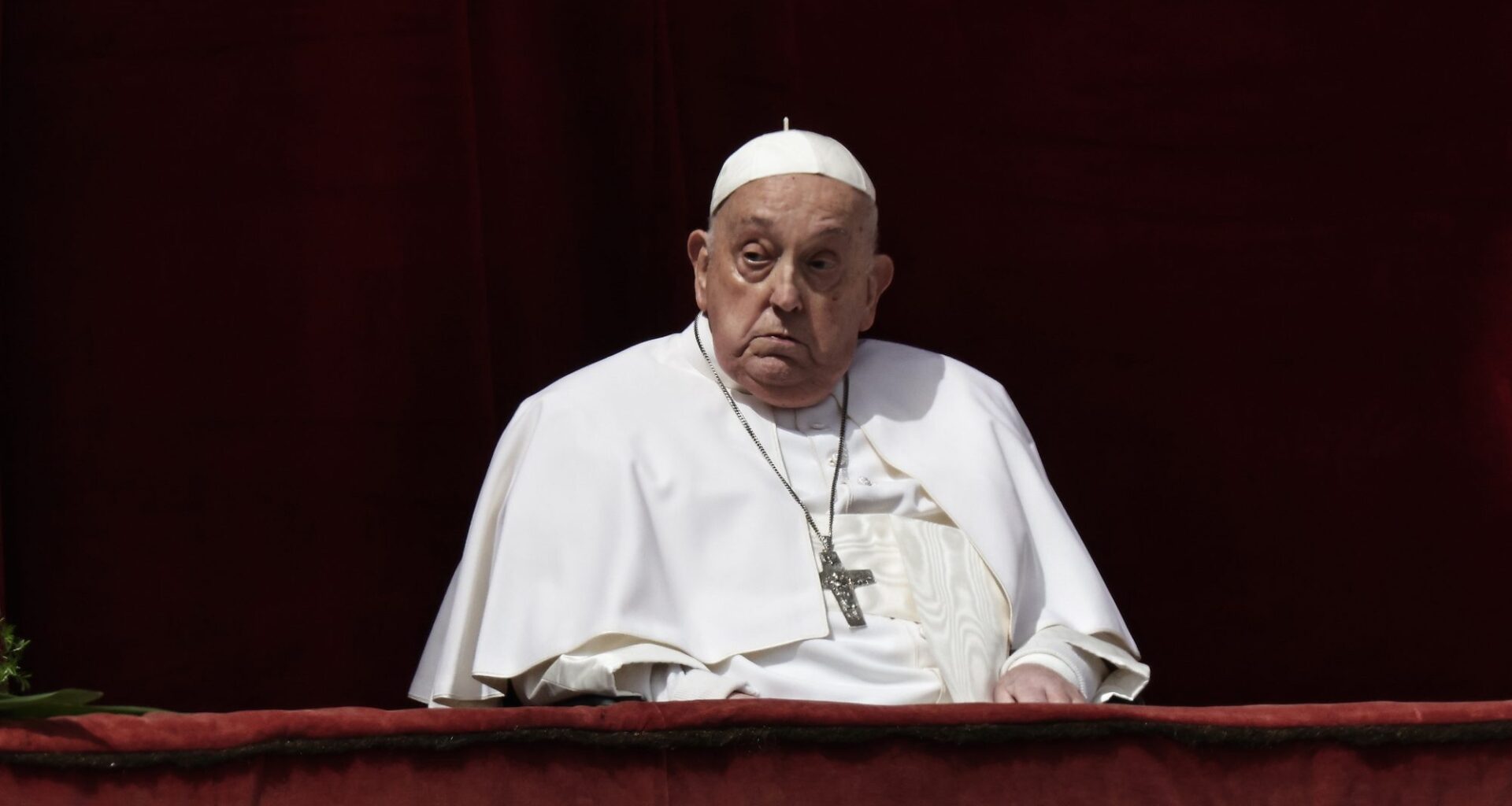
Pope Francis has died at the age of 88, the Vatican has announced.
The news was announced by the Chamberlain of the Roman Catholic Church, Cardinal Kevin Farrell, in a statement released by the Vatican, who said: “Dearest brothers and sisters, with deep sorrow I must announce the death of our Holy Father Francis. At 7.35am this morning, the Bishop of Rome, Francis, returned to the house of the Father.�
So, what happens now that the Pope’s death has been announced – and when will the next Pope be chosen?
FactCheck takes a look.
What happens now the Pope has died?
The Chamberlain of the Roman Catholic Church has confirmed the Pope’s death in the presence of the Papal Master of Ceremonies and a number of other members of the Papal Household.
The Chamberlain has also locked the Pope’s apartment – because historically people would loot it – and has arranged for the Pope’s ring to be broken.
He’s also in charge of making arrangements for the burial. If Pope Francis made a will and named an executor, that executor will give an account of his activities only to the new Pope.
When will the Pope be buried?
Nine days of official mourning will now take place, with the burial happening between the fourth and sixth day after death (except for special reasons).
Pope Francis’ body will lie in state in St Peter’s Basilica for people to come and pay their respects. The burial of Pope Francis will break with tradition – he will be laid to rest in Rome’s St. Mary Major Basillica and not St. Peter’s in the Vatican.
How is a new Pope chosen?
The most recent count shows there’s currently 252 cardinals. All of these will now be summoned to Rome.
The Papal election, called the Conclave, will then be held to determine the next Pope. A conclave cannot begin until 15 days have elapsed since the Pope’s death. This delay can be extended to 20 days.
The Conclave sees the cardinals lock themselves in the Sistine chapel – disconnected from the rest of the world – where they will vote on the potential Popes over and over again until one candidate receives two thirds of the final vote. Only those under the age of 80 can participate in the vote.
If the voting carries on for 12 days, then a candidate only needs 51 per cent of the votes to be selected.
Twice a day, after each vote, the outside world is kept updated via the ancient practice of burning ballots.
If black smoke appears, then a decision has not been reached, while if it is white smoke then a new Pope has been elected.
The new Pope will be asked to choose which name he would like to be known as and he will be announced to the world shortly after on the balcony overlooking St Peter’s Square.
Correction: The burial of Pope Francis will break with tradition – he will be laid to rest in Rome’s St. Mary Major Basillica and not St. Peter’s in the Vatican.
(Image credit: Evandro Inetti/ZUMA Press Wire/Shutterstock)