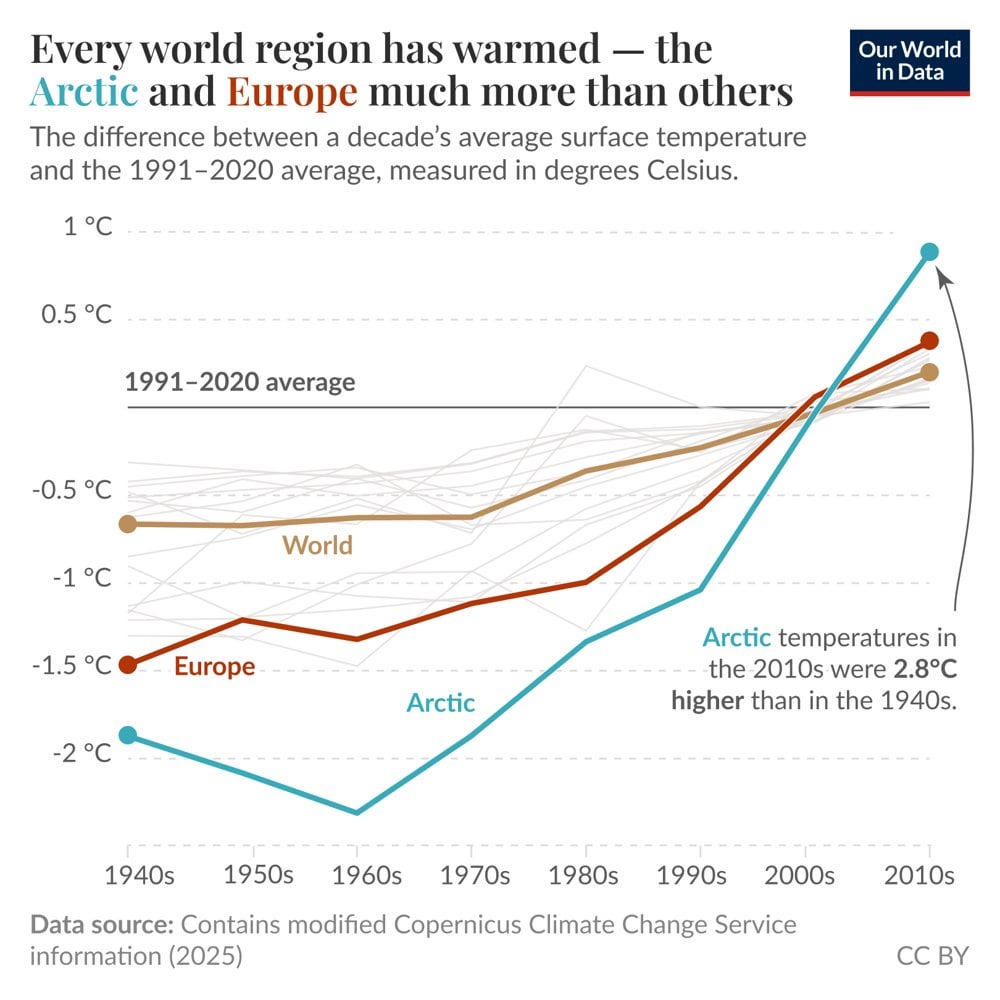
>The world is heating up. By the 2010s, the global average temperature of the air above the surface was about 1°C higher than in the 1940s. But some regions are warming much faster.
>The chart shows how average surface air temperatures have changed each decade across continents and oceans compared to historical averages.
>The Arctic warmed more than any other region — by the 2010s, it was 2.8°C hotter than in the 1940s.
>Europe was in second. Since land heats up faster than water, its mostly land-based geography has increased its rate of warming. It has also seen a rapid reduction in aerosols from air pollution. These [improvements in air quality](https://ourworldindata.org/grapher/so-emissions-by-world-region-in-million-tonnes) can inadvertently increase temperatures because there are fewer aerosols to reflect sunlight.
Why on earth are temperatures rising so quickly in Europe?
Yes, this is pretty much as expected.
But what effect will this have on our flat earth?
I mean duh, heat rises. Obviously the top of the map will be most affected.
Ultimately this will never slow down unless unsustainable overpopulation and rampant industrialization in the former third world (africa/asia specifically) is reversed. The answer that progressives don’t want to hear. Banning straws will do nothing, taxing poor farmers in West Virginia will do nothing, selling over processed plant chemical/salt goo burgers will do nothing.
6 comments
Quoting the accompanying text from the author:
>The world is heating up. By the 2010s, the global average temperature of the air above the surface was about 1°C higher than in the 1940s. But some regions are warming much faster.
>The chart shows how average surface air temperatures have changed each decade across continents and oceans compared to historical averages.
>The Arctic warmed more than any other region — by the 2010s, it was 2.8°C hotter than in the 1940s.
>In the Arctic, melting sea ice [has amplified this temperature increase](https://climate.nasa.gov/news/927/arctic-amplification/): ice reflects sunlight, so having less of it leads to more warming.
>Europe was in second. Since land heats up faster than water, its mostly land-based geography has increased its rate of warming. It has also seen a rapid reduction in aerosols from air pollution. These [improvements in air quality](https://ourworldindata.org/grapher/so-emissions-by-world-region-in-million-tonnes) can inadvertently increase temperatures because there are fewer aerosols to reflect sunlight.
>[You can explore how temperatures in each continent, ocean, and country have changed over time](https://ourworldindata.org/grapher/decadal-temperature-anomaly) →
Why on earth are temperatures rising so quickly in Europe?
Yes, this is pretty much as expected.
But what effect will this have on our flat earth?
I mean duh, heat rises. Obviously the top of the map will be most affected.
Ultimately this will never slow down unless unsustainable overpopulation and rampant industrialization in the former third world (africa/asia specifically) is reversed. The answer that progressives don’t want to hear. Banning straws will do nothing, taxing poor farmers in West Virginia will do nothing, selling over processed plant chemical/salt goo burgers will do nothing.
Comments are closed.