Date of closing the survey: 2024.07.06
Number of respondents: 167
Survey TooL: SurveyMonkey
*Majority of the respondents are from the USA
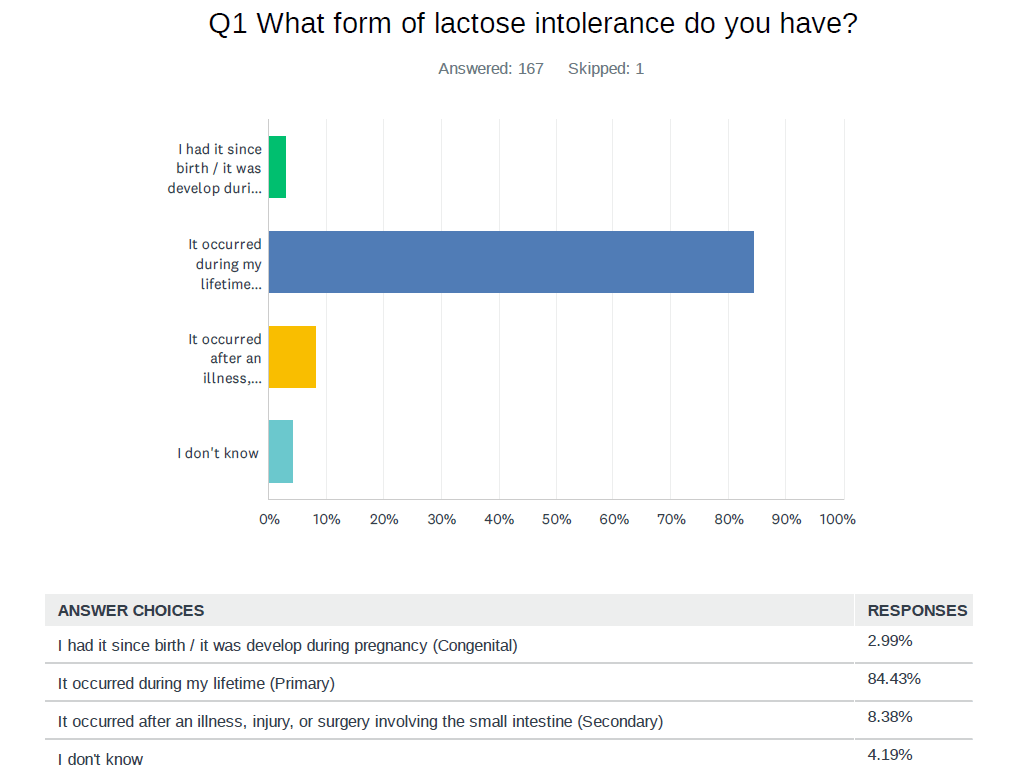
Q1: What form of lactose intolerance do you have?
· 84.43%: It occurred during my lifetime (Primary)
· 8.38%: It occurred after an illness, injury, or surgery involving the small intestine (Secondary)
· 4.19%: I don't know
· 2.99%: I had it since birth / it was developed during pregnancy (Congenital)
Q2: Are lactose-free products part of your regular diet?
· 73.65%: Yes
· 26.35%: No
Q3: Which of the following symptoms do you experience after consuming lactose-containing foods?
· 93.41%: Gas – Increased flatulence
· 88.62%: Diarrhea – Loose, watery stools occurring more frequently than usual
· 85.63%: Stomach cramps – Painful sensations or cramping in the abdominal area
· 85.03%: Bloating – Feeling of fullness or swelling in the abdomen
· 46.71%: Fatigue – Increased tiredness or reduced energy levels
· 41.92%: Nausea – A feeling of wanting to vomit
· 23.95%: Constipation – Less frequent bowel movements and difficulty passing stools
· 21.56%: Headaches – Persistent pain in the head or neck area
· 14.37%: Other symptoms
· 12.57%: Vomiting – Expelling contents of the stomach through the mouth
· 0.00%: None of the above
Q4: Have you ever consulted a medical professional about your lactose intolerance?
· 51.50%: Yes
· 48.50%: No
Q5: Have you been diagnosed with any of the following health condition that you believe may be related to your lactose intolerance?
65.45%: No other health conditions diagnosed
· 19.39%: Irritable Bowel Syndrome (IBS) – A disorder involving abdominal pain and changes in the pattern of bowel movements without any evidence of underlying damage
· 12.12%: Other
· 4.24%: Malnutrition – Due to restrictions in diet or poor absorption of nutrients. Vitamin D Deficiency – Often related to malabsorption issues and dietary restrictions
· 2.42%: Osteoporosis – A condition characterized by weakened bones, increasing the risk of fractures
· 2.42%: Calcium Deficiency – Potential for inadequate calcium intake if dairy is avoided without appropriate substitutes
· 0.61%: Leaky Gut Syndrome (LGS) – A condition thought to be linked to increased intestinal permeability
Q6: Do you know how lactose intolerance differs from lactose allergy?
· 58.93%: Yes
· 41.07%: No
Q7: How eager are you to find a permanent solution for your lactose intolerance?
· 53.29%: A great deal
· 20.36%: A lot
· 16.77%: A moderate amount
· 7.19%: A little
· 2.40&: None at all
Q8: Have you ever been prescribed any medications or treatments for your lactose intolerance?
· 84.34%: No
· 15.66%: Yes
Posted by Fit_Ad3058
11 comments
This is neat! As one of the few people in my friend group who are NOT lactose intolerant, I find myself curious about it sometimes and this scratched some of that itch.
Notably it would be interesting to understand more about when lactose intolerance begins for most, and now I am personally very curious about the difference between lactose allergy and lactose intolerance. 🧐
Actually, for 100% of the people with lactose intolerance, it occurred within their lifetime.
I found it very interesting. I’m curious what treatments have been prescribed to treat the intolerance though. I would hop on a cure or treatment immediately if it existed.
OP For what it’s worth there was a 1 year stretch when I was in college that I was lactose intolerant but I’m fine now. /shrug
When I escaped the denial about my lactose intolerance as an adult I told my parents. Their response was “No, you’ve just always had a bad stomach”. And you never wondered why?! Anyway, I don’t touch dairy now and it turns out, it’s not normal to be ill all the time.
Even as a young child I remember not liking milk, so I’m guessing I was either born with it or developed it very young.
I became lactose intolerant in my mid 20s after I chugged a gallon of chocolate milk.
you need to attach demographics of who you asked. I believe symptoms are somewhat correlated with gender. Also race: the “since birth option” would be well over 50% if everyone you asked was Chinese
Man this is an ugly presentation
I had always had mild stomach issues, not knowing it was from dairy. I remember the cramps and stomach pain at school from eating a bowl of cereal each morning. As a kid, my parents would make me go to church camp, and they didn’t really have any dairy one year. It clicked when I realized I wasnt having any stomach pain. After that moment, a full week of no dairy, my lactose intolerance got 10x worse.
Holy hell, q3 is grim. I am definitely not lactose intolerant
I’m curious what percentage of the population in question do or don’t have lactose intolerance
Comments are closed.