![American whiskey production grew 160% since 2012, bottling stayed flat. [OC]](https://www.europesays.com/wp-content/uploads/2025/04/l45oy3dchhxe1-1080x1024.png)
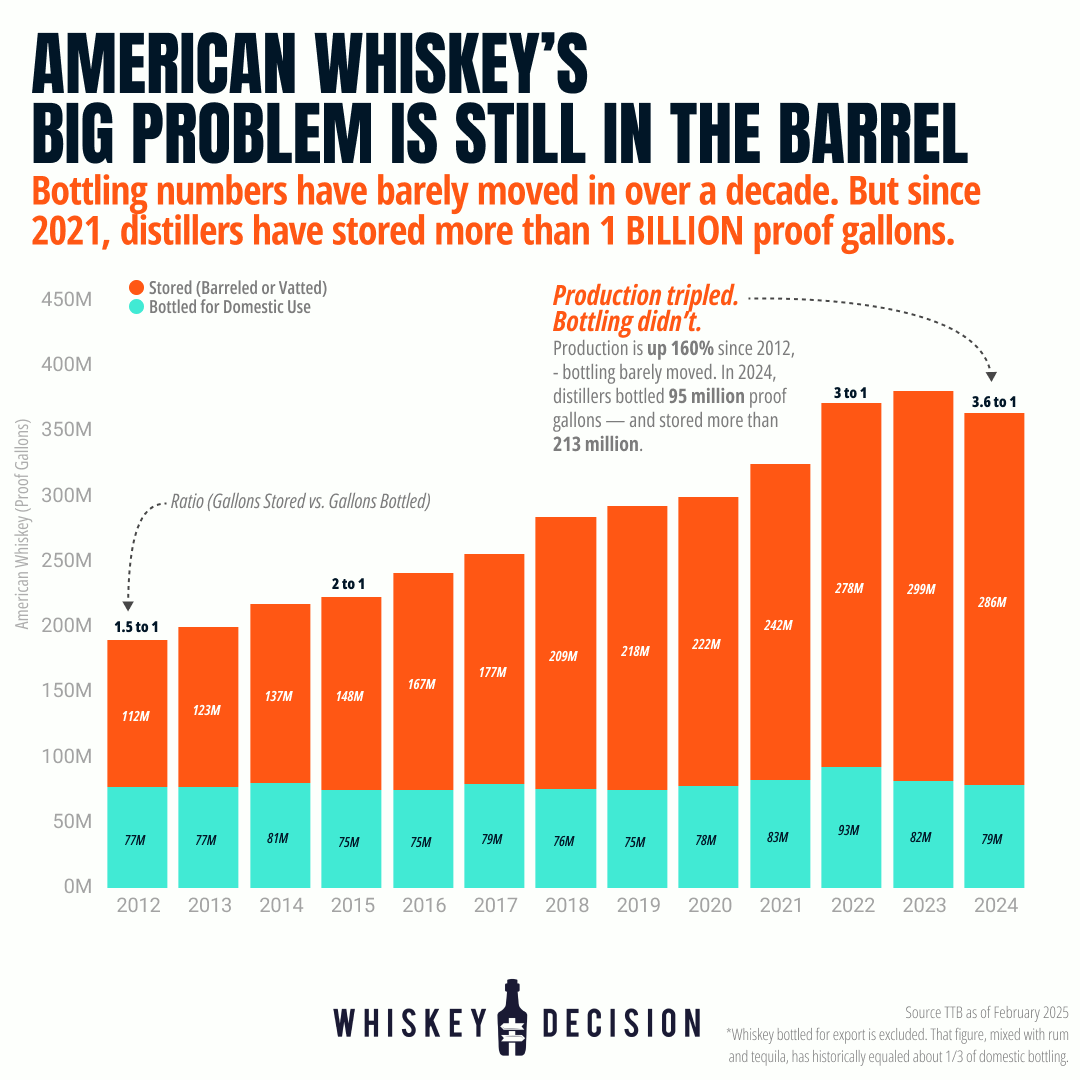
From 2012 to 2024, U.S. whiskey production increased from approximately 190 million to over 308 million proof gallons, based on TTB data.
Domestic bottling volumes over the same period remained largely unchanged, averaging between 75 million and 95 million proof gallons annually.
As a result, the ratio of proof gallons stored to proof gallons bottled has increased from approximately 1.5:1 in 2012 to 3.6:1 in 2024.
Since 2021, more than 1 billion proof gallons have been stored for aging.
Data source: U.S. Alcohol and Tobacco Tax and Trade Bureau (TTB), February 2025.
Notes: Bottling for export is excluded from these figures. Export data is reported jointly for whiskey, rum, and tequila and historically adds about 33% to domestic bottling volumes.
Visualization created using Figma.
Posted by whiskeydecision7
29 comments
Okay but why is it a problem to store more?
So are you saying whiskey should be cheaper in the future?
Anyone know why that is that happening/what the ramifications are?
I mean control the number of bottles control the price, seems pretty simple
I’m confused, the stored amount is the total amount stored each year or is the total amount in storage?
The shitgibbon has to be gone before I will buy Jack Daniels again.
And then the Canadians said no more.
Barrel aging. More aged stock in the next few decades.
What you are seeing is an increase in the average age of bourbon.
“Proof gallons stored� is aka “proof gallons aged�
IMO, this data is good for consumers.
Well, of course it stayed flat, who wants carbonated whiskey?
Will it get inexpensive enough to run in my flex fuel SUV?
Time for all of us to get “Government Whiskey�!
Why hoard all that whiskey?
This will pay off. They have the storage space and will be able to significantly mark up 12, 15, 18 and even 25 year + aged barrels. Just go look at the price discrepancy of any brand between unaged and ones at least 18+. Scotch has been doing it since forever. Now the Americans want to capitalize on it. Even if a brand can take a simple $25 bottle and turn it into a $50 bottle, so long as their storage is costing them less, it’s worth it. But I would say the bottle will become closer to $100.
Manufactured scarcity… to be released when the economic need/opportunity exists.
Translation: sit on the juice until you can sell it for a premium, or need to dump it to survive.
They do this to keep supply stable and to have better control over different ages I think.Â
The post above this one shows what a drop of whiskey does to millions of bacteria. Nice
How risk-free is that volume un-bottled? Can’t whiskey stay in the barrel and become premiumized due to aging?
Like, what proportion of this Whiskey stored is strategically meant to be stored? What is the cost of storage and can it be simply amortized into future sales of a more premium product with greater margins? Is this even a problem, or did you stumble upon a strategic move?
We have lots of whiskey. Beautiful data. What is the problem.
A lot of good whiskeys are 8 to 12 years old. This chart is only 12 years. Isn’t part of what this chart not telling you is they only need enough bottles for what they were making 12 years ago
I know more about whisky than whiskEy but isn’t it a problem with bourbon in that it’s in first fill casks which can impart too much wood taste if stored too long (as well as losing higher angels share). In brief, older doesn’t mean better for bourbon as it (generally) does with Scotch, or?
So they are making X year whiskeys for the far future.
Most new distilleries use barrels from older supplier distilleries in the first 5 years of operation. They are distilling and barreling their own brand but it won’t be ready for at least 4-5 years. The liquid they bottle is all from elsewhere.
Why would you not just measure this in gallons? I’m not saying this isn’t concerning but proof gallons is a made up measurement to inflate the number by at least 80X
are they trying to go the way of the US dairy industry?
I’ve been working in a distillery in the heart of Bourbon production in Kentucky for the past 5 years, and I have friends and family in nearly every major distillery and bottling plant besides Buffalo Trace. Something is really off with this data, as across the line we’ve all been ramping up our bottling lines. My plant has personally been slowly speeding up our bottling line over the past few years. Given, this is only for Bourbon.
Another considering factor: Covid brought a lot of growth to the industry leading us increasing output from the stills, because we’re trying to predict how much more we’re going to sell 4+ years from now. Now that the growth turned out to be a bubble, distilleries are slowing down the stills to compensate. You can see that already from last year’s report in this graph.
Take my anecdote with a grain of salt though; I know Jim Beam recently had layoffs and there are other American Whiskey sectors I’m not as privy to. If it really is true that bottling numbers aren’t increasing now, I know for sure whiskey sales in the industry are increasing, and a lot of it is in part to a shift from consumers demanding more premium craft products, and I’m seeing bottles released in the $100-$250 range selling out everywhere.
What you’re saying is, we’re soon going to get a lot of delicious whiskey for cheaper when they realize they have to offload their excess. Maybe this is why they were so upset over the collapse of the international market.
Only industries doing well in America right now: drugs, stimulants, gambling, insurance, online services. We have such a bright future ahead.
Couldn’t this also be associated with the rise in more distillers entering the market? I mean I know a couple near me that started selling 3 yr but were touting their forthcoming 7-10 year stock. They were always planning to be a 7+ year brand and only sold the shorter stuff to help fund the business in the short term. Or they started doing rum/vodka and were aging out their whiskey on the side.
Comments are closed.