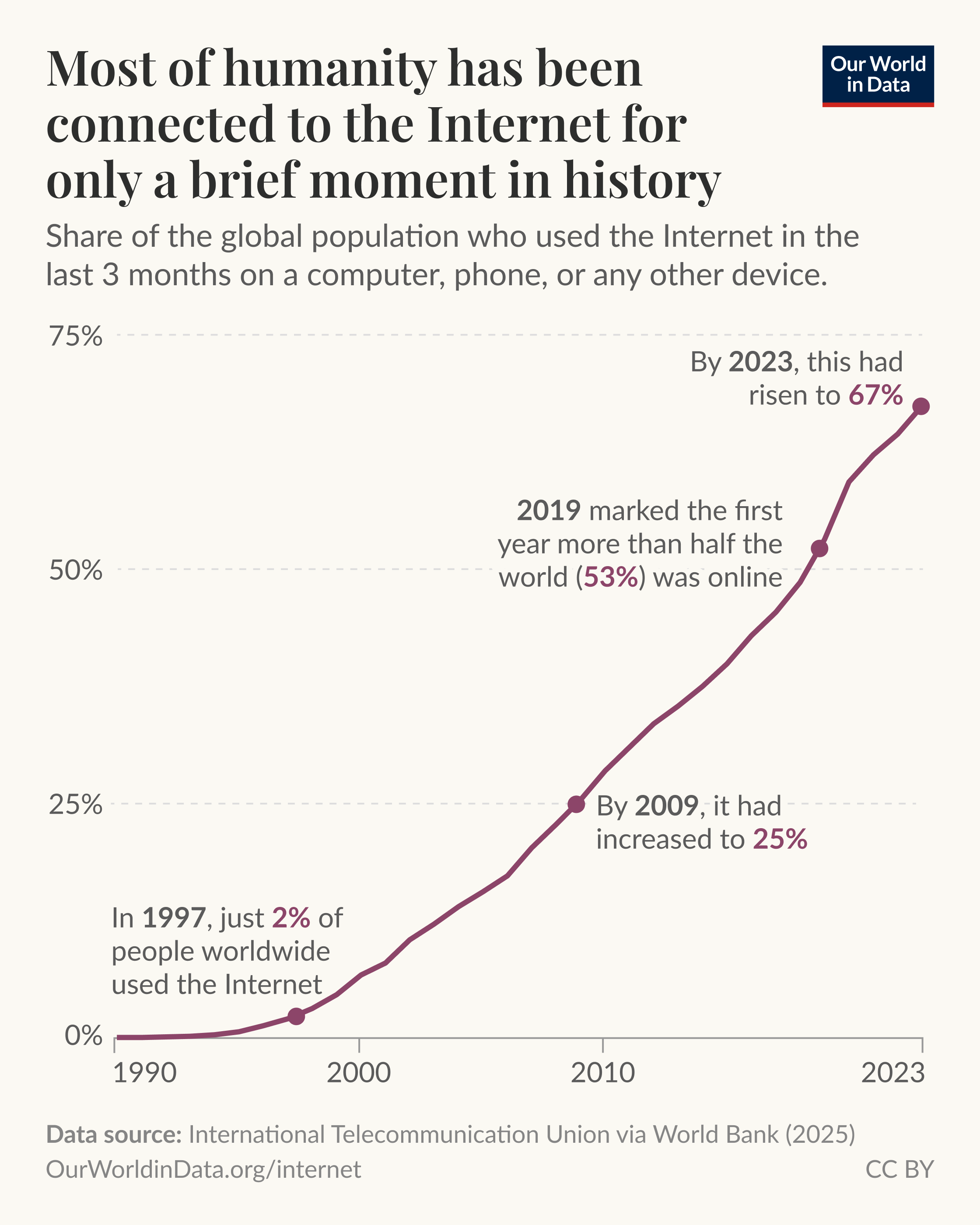
>For many readers in high-income countries, the Internet might no longer feel revolutionary. But when I was born in 1997, only 2% of the world’s population used the Internet. By 2019, that number had risen to over 50%; today, two-thirds of the global population is online.
Nitpicking, but isn’t internet in general available only for a brief moment in the history? I assume you mean history of mankind, so the last decades in comparison are a very brief moment.
It’s freaky to me that my professional career as a software developer completely encompasses the lifespan of the internet and that there is still crappy code of mine out there propping up shit that’s older than my kids.
Been on the internet since 1992. Thanks dad!
God, I miss the internet from the 1990s.
Never really realized as a kid in 1997 how privileged we were to have access to the internet. We weren’t wealthy or anything just lucky to live where we could get it.
![[OC] Most of humanity has been connected to the internet for only a brief moment in history](https://www.europesays.com/wp-content/uploads/2025/04/fd0zxnvjuxxe1-1920x1024.png)
7 comments
Data source: International Telecommunications Union via the World Bank (2025)
Tools used: I made this along with [my colleague Simon](https://ourworldindata.org/team/simon-van-teutem) using the [Our World in Data Grapher tool](https://github.com/owid/owid-grapher) and finishing touches in Figma.
Here is the text Simon wrote along with it:
>For many readers in high-income countries, the Internet might no longer feel revolutionary. But when I was born in 1997, only 2% of the world’s population used the Internet. By 2019, that number had risen to over 50%; today, two-thirds of the global population is online.
>It’s worth taking a moment to appreciate the novelty and speed of this change for two reasons. First, much of the potential progress enabled by the Internet is still unfolding, from expanding educational opportunities through free online resources to [reducing the cost](https://ourworldindata.org/great-global-redistributor-money-sent-brought-back-migrants-remittances?tab=t.0) of sending money home for migrants.
>Second, it’s good to remember that in 2023, a third of people still didn’t use the Internet. Accelerating connectivity could give these individuals greater freedom and access to new opportunities. The United Nations [aims to get more than 90% of people online ](https://www.un.org/digital-emerging-technologies/sites/www.un.org.techenvoy/files/general/Universal_Connectivity_Summary_PDF.pdf)by 2030. Some regions are still far from universal access, with just [43% of South Asia and 37% of Sub-Saharan Africa](https://ourworldindata.org/grapher/share-of-individuals-using-the-internet) connected.
>[Explore more data on Internet use, country by country](https://ourworldindata.org/grapher/share-of-individuals-using-the-internet?tab=map) →
Where’s that dial-up map when ya need it…?
Nitpicking, but isn’t internet in general available only for a brief moment in the history? I assume you mean history of mankind, so the last decades in comparison are a very brief moment.
It’s freaky to me that my professional career as a software developer completely encompasses the lifespan of the internet and that there is still crappy code of mine out there propping up shit that’s older than my kids.
Been on the internet since 1992. Thanks dad!
God, I miss the internet from the 1990s.
Never really realized as a kid in 1997 how privileged we were to have access to the internet. We weren’t wealthy or anything just lucky to live where we could get it.
Comments are closed.