![[OC] Politics, obesity and exercise in the US](https://www.europesays.com/wp-content/uploads/2025/05/6cffy1x7m8ye1-1920x754.png)
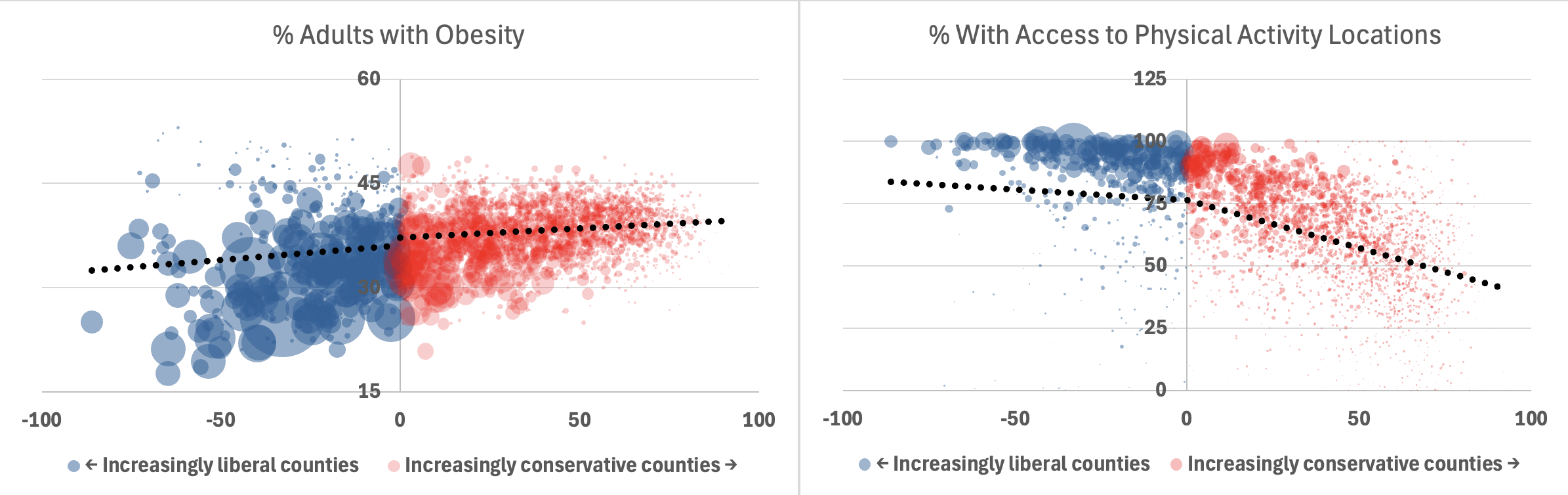
The more conservative a county's population is, the more likely its residents are to be obese — possibly because they are also less likely to live near places conducive to physical activity. The opposite is true for liberal counties.
I came to that conclusion after combining county-level results of the 2024 presidential election with county-level measures of health compiled by the Wisconsin Health Rankings and Roadmap. I consider a population to be increasingly conservative or liberal based on its ideological homogeneity, which I derive from the magnitude of the gap separating the 2024 presidential candidates. Subtracting Trump's percent of the vote from Harris' produces either a positive or negative number between one and 100. I claim that a larger absolute value signifies a population’s politics are more extreme, while a lower absolute value indicates a more politically moderate population.
Each county marker is sized according to its population. The Y axis on the chart showing access to physical activity locations runs to 125% in order to show the size of many markers which would otherwise be cut in half.
This was done in Excel.
Posted by JaraSangHisSong
35 comments
This was made in Excel and the source data comes from:
* County-level[ results of the 2024 presidential election](https://github.com/tonmcg/US_County_Level_Election_Results_08-24/blob/master/2024_US_County_Level_Presidential_Results.csv)
* County-level [measures of health](https://www.countyhealthrankings.org/health-data/methodology-and-sources/data-documentation) compiled by the Wisconsin Health Rankings and Roadmap
If you’re basing the scale on presidential candidate preference, you might as well say that rather than extrapolating into a different measurement. The right scale going up to 125 is also a bit suspect when it’s out of 100. Likely these are the same graphs as median household income
What does it mean by % with access to physical activity locations? A lot of conservative counties are in the Midwest with access to national parks, hiking trails, nature. Or am I overthinking it?
My guess is that density is the confounding factor here. People living in denser areas tend to be more liberal, and also tend to have more access to exercise facilities, and also tend to walk more as a mode of transportation.
Hear me out. Federal grant, build something akin to a planet fitness in every town. Like a community center.
relevant: [https://www.reddit.com/r/NationalPark/comments/sxzt26/us_states_ranked_by_their_state_and_national_park/#lightbox](https://www.reddit.com/r/NationalPark/comments/sxzt26/us_states_ranked_by_their_state_and_national_park/#lightbox)
Is it appropriate to draw two trend lines on one data set in this way if the ideological difference between e.g. a slightly liberal county and a slightly conservative one isn’t any more meaningful than an equal difference between two varyingly liberal counties?
I may be misunderstanding.
Your conclusion is quite a stretch.
So of course there are all kinds of correlative things here, things that can be interpreted differently, etc., but as someone who has spent about 40% of my life in very conservative rural locations, 40% in very liberal urban locations, and 20% in fairly mixed locations, there is kind of an overall note here:
Conservative places like OP is hinting at tend to be more rural, and one way that is impacted is less access to physical activity locations (rural areas have them, but they tend to be the kind of stuff that can be done with no facilities and little money: Fishing, for example, rather than things that require publicly accessible facilities or things like maintained trails). But beyond that is an oft-rife feeling of being ignored by the government. Bad roads aren’t fixed because the state won’t fund repairs for low population areas, and the local government can’t afford it, buildings are run down, parks aren’t funded, anything that relies or benefits from government funding is often in very poor condition.
On the other hand, politicians often run on policies saying that they’ll make sure to fund X or Y or Z project, almost always centered on urban areas. This makes sense: More people have access to those places, and so the politicians can both help those people, if they care to, while also getting the most concentrated votes. But this has the knock-on effect of making people in rural areas feel like they’re being taxed for the good of a society that they are effectively excluded from. They pay taxes and never see the results, even more than people in urban areas might feel that way.
Democrats in the US have worked very, very hard since the postwar years to depict themselves as the urban party. They’re the party of minorities (overwhelmingly urban due to a large number of historical reasons), the party of the educated (again, urban), the party of the middle and upper middle class (the same). Their economic policies do not make much attempt to appeal to rural people. Their social policies either don’t appeal to them (rural populations even in countries that have a strong agrarian left wing tend to be socially conservative) or at best don’t have any kind impact on them, so they tend to feel like Democrats either don’t care about them, or often disdain them (a feeling Democrat politicians often pursue, using rural conservative voters as a target for rhetoric pretty regularly).
All that to say, there’s a pretty strong relationship we see here and in lots of other data that people who directly experience the benefits (environmental, social, etc.) of a strong community and strong governmental funding and support of those kind of government policies. People who are excluded from those policies, on the other hand, tend to be more opposing of them. It may be wise, if we want to shift attitudes, to help people without access to these benefits to experience the benefits.
You might as well just not even include obesity at all and compare population size to its political alignments. This is why AI is going to take all of the data jobs
I appreciate the effort but no graph where an axis is a percentage should go beyond a hundred. This data is not beautiful
I’m surprised at the lack of physical activity locations for Republicans. I would think rural would have a lot of nice hiking but maybe not in corn land. Suburbia I can see.
Is that a regression discontinuity graph??
https://preview.redd.it/av63ttjhs8ye1.png?width=594&format=png&auto=webp&s=c57a9f19156a666324b85911e09952cffa6181a4
these bubbles are where reddit Mods live
It’s the South. It’s almost always the South. Poverty, crime, drugs, obesity, etc.
https://www.maxmasnick.com/2011/11/15/obesity_by_county/
The only problem with this is that lack of physical activity does not cause obesity, nor does exercise cure obesity. Obesity is primarily driven by diet, not exercise. Research into what is known as the “exercise paradox” has shown that the key to losing weight is diet, not exercise.
You found a correlation, which is not causation. I bet the true cause is that people in more red areas are poorer and eat worse quality food and a lot more fast food. The super liberal areas are probably much more wealthy and people are eating much higher quality food.
Rural people tend to be more obese and less fit than city dwellers as studies shows (always transit in a car instead of other more active modes of transportations, less access to sport facilities and food varieties, etc). Rural america tends to lean more Republican and be poorer (another factor that can lead to an unhealthy lifestyle).
In other words, im pretty sure a good chunk of the data here is more of a rural/urban health comparison than a democrat/republican one. Meaning, a correlation, not necessarly a cause.
Plot obesity rates over time next to the proportion of adults who smoke.
I’m not sure what the coloration adds.
The reason is likely liberal people often live in urban areas. Places that aren’t food deserts, have higher incomes, education levels, and a culture of fitness and healthy eating. However, this isn’t 100% the case. Even in liberal areas, there’s still vast income inequality. Containing areas where people do suffer from obesity due to historical redlining, lack of access to healthy food, little to no gyms or outdoor spaces, and bad air quality which can have other health issues.
Can you separate California from that? I’d like to see both ca stats and the rest of the country.
What on god’s polluted industrial hellscape is a location without access to physical activity? Is it a superfund sight or something?
add education on top of that and you see the real reason
This is genuinely interesting following up the New York Times piece on Hassan Piker saying he has a “MAGA body”
Um, no. This is a textbook “correlation does not equal causation”. It is true that people who live in cities are more likely to hold Democratic views. It is also true that Democratic cities are more likely to fund programs like parks and recreation centers. But this ends up claiming Republican voting/rural countries have fewer opportunities to exercise and that is just wrong. Republican/rural counties contribute more of our military forces. Many residents of cities go to Republican/rural counties to exercise (hunting, mountain biking, dirt bikes and ATVs, 4×4 trails, camping, reservoirs for boating and water skiing, fishing, golf, hiking, and camping are all active pastimes that need cheap land.) Just because there are fewer buildings does not mean people are heavier.
I think this is a great experiment.
It shows very clearly a hypothesis extracted from data that is showing a pattern. From the results, it insights thought, questions, and further data collection revolving around the data and results you’ve revealed.
From what I see, these graphs are doing exactly what they are meant to do.
Thank you.
Physical activity is 1. Something you can do in your own home. 2. Not actually *that* helpful for weight loss. Often exercising and giving attention to one’s diet are connected, but diet is by far the more important factor in weight loss.
Wtf is a physical activity location? You mean like … Outside?
Regression lines should be be weighted by population
What is a physical activity location? You mean like a park? Or outside? Or a defined gym? I don’t think poor or rural areas would have as many gyms, tennis clubs, or rock climbing gyms….
I’m begging you folks to stop using counties as the unit of analysis.
Signed,
Poli Sci Prof
I did notice when I was in Louisiana there were tons of people so big they were using mobility scooters to shop, while here in Washington State most people are still obese or overweight, the sort of extreme obesity that requires mobility scooters is something I rarely ever see.
Man live out in open country and u telling me they have less access to physical activity? Man lazy
Gotta put some basic trendline confidence on there.
Might as well have included a third plot to demonstrate counties with percentage of people capable of correctly interpreting these charts…I wonder if there’s a correlation…
Comments are closed.