Im a bit surprised. I thought the percentage would be higher but I guess it was a privilege of the wealthier landowners
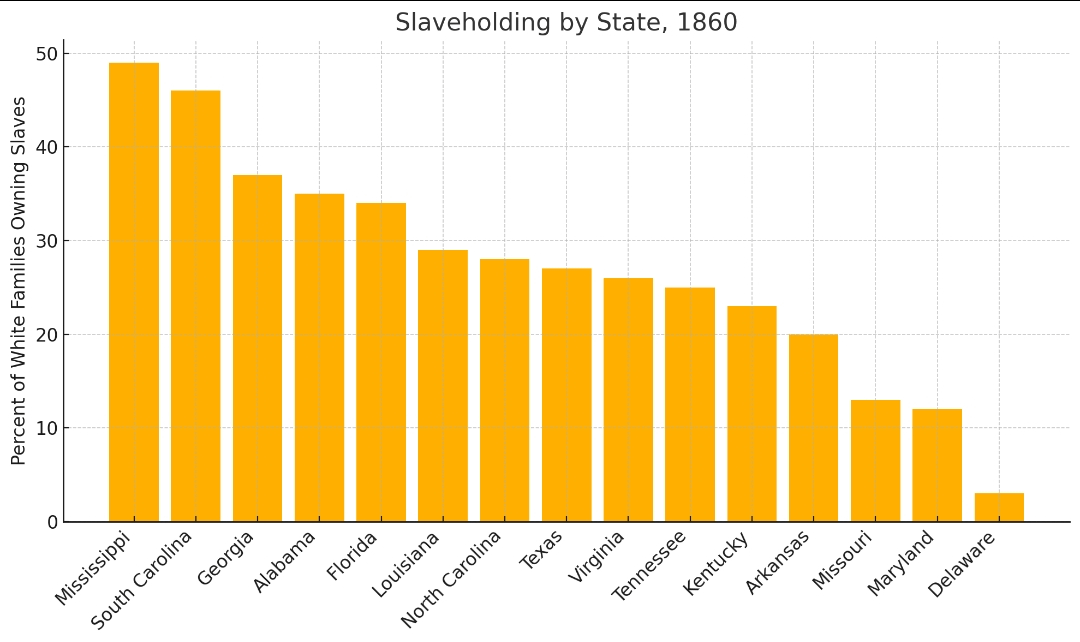
Note: There were a total of 33 states in 1860, so there are 18 states with zero
Unsurprisingly Mississippi and South Carolina were the first two states to express their Ordinances of Secession.
This is interesting. I’ve seen several times that only ~3% of Americans ever owned slaves. This doesn’t seem to square with that?
Not surprisingly, Mississippi was the wealthiest state in the union at the time.
It’s hilarious that Mississippi and South Carolina are also the most culturally unreformed of the former confederate states. Folks down there love them some Lost Cause Mythology
9 comments
The data comes from the 1860 U.S. Census.
Slaveholding families were calculated by dividing the number of slaveholding households by the total number of white households in each state.
Census Report: [census.gov](https://www2.census.gov/library/publications/decennial/1860/population/1860a-02.pdf)
IPUMS historical datasets: [ipums](https://usa.ipums.org/usa/slave/slave_data.shtml)
Visualization tool: Excel
Honestly I didn’t realize. Makes me sick.
Im a bit surprised. I thought the percentage would be higher but I guess it was a privilege of the wealthier landowners
Note: There were a total of 33 states in 1860, so there are 18 states with zero
Unsurprisingly Mississippi and South Carolina were the first two states to express their Ordinances of Secession.
This is interesting. I’ve seen several times that only ~3% of Americans ever owned slaves. This doesn’t seem to square with that?
Not surprisingly, Mississippi was the wealthiest state in the union at the time.
It’s hilarious that Mississippi and South Carolina are also the most culturally unreformed of the former confederate states. Folks down there love them some Lost Cause Mythology
Because they couldn’t afford it?
Comments are closed.