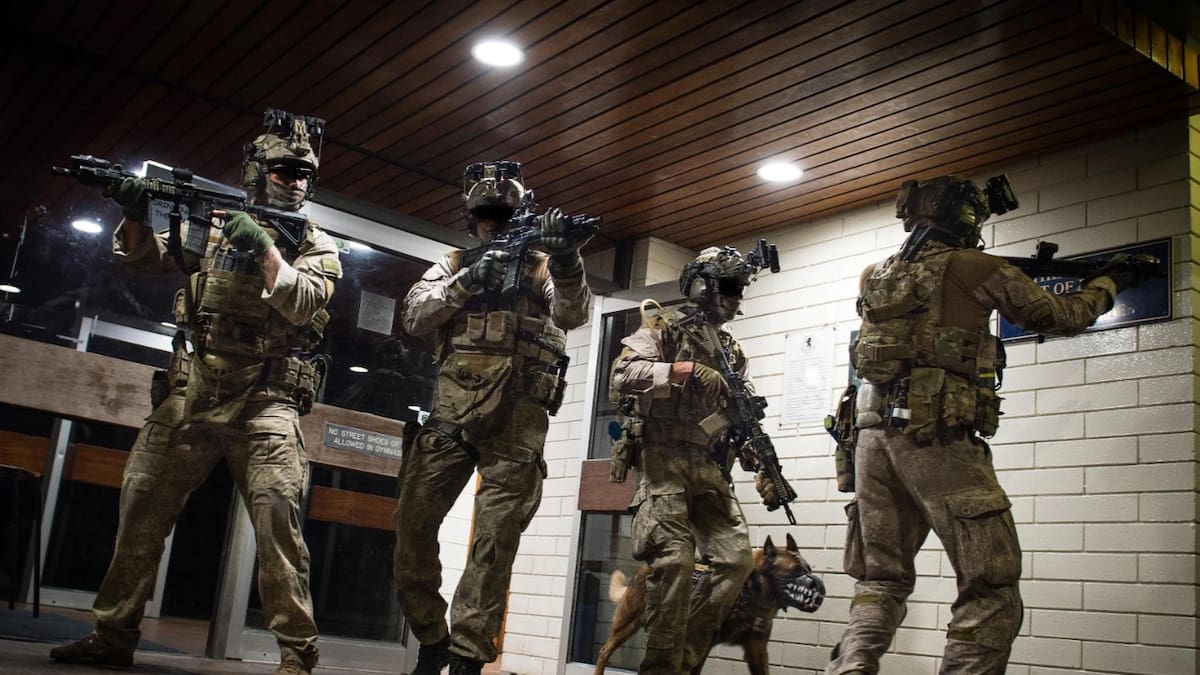
Previously those squadrons were entirely focused offshore.
The alleged move follows a sharp drop in experience and numbers at the NZSAS in recent years.
What is the NZSAS D Squadron?
The D Squadron was created in 2005, initially called the Counter Terrorist Tactical Assault Group.
It offered a shorter selection course than that faced by NZSAS aspirants, offering a more direct pathway to special forces that met NZDF’s domestic counter-terrorism requirements without the expansive set of skills taught to fully-badged NZSAS operators.
It was praised two years later by then Minister of Defence Phil Goff as a part of an important and “robust counter-terrorism response” in an “uncertain security environment”.
Goff highlighted the unit as evidence of NZDF “significantly upgrading its counter-terrorism capabilities”.
The Commando unit was distinctive within the NZSAS, with its own badge. Rather than the famous winged daggers of the NZSAS, the Commandos badge was two crossed fighting daggers across a taiaha, intended to represent the three branches of the military and “readiness for action”.
It was also distinctive for the black belt worn by those who had been accepted into the unit.
There is very little public information about the secretive Commandos, but in 2020, an Army News piece quoted one of the team as saying: “NZ Commandos are self-motivated operators who are thinkers before shooters.”
He said the motto of the unit was “ready to strike” and its “chosen values” were being a teammate, mission focus, accountability and “win everything”.
“The job of the D Squadron Commandos is to respond to domestic, no-notice call outs and solve the problem regardless of circumstance.”
What will replace the elite SAS unit?
While the SAS has declined in numbers, police have reinforced their premier armed response unit, the Special Tactics Group (STG).
Information obtained through the Official Information Act has shown that the Special Tactics Group had a large funding boost in 2019 – the year of the Christchurch terror attack – and baseline funding then increased from $8.2m in 2020 to $9.4m last year.
It is understood that the number of people in the STG also increased over that time period.
The STG’s role goes beyond counter-terrorism. It also provides police with a flexible, highly-trained armed response to dangerous incidents.
The Herald understands the STG had faster access to helicopters, integrated communications networks rather than separate military communications, and better integration with other domestic agencies.
Police tactical operations acting head Inspector Freda Grace said revealing the numbers of STG personnel would place the public and those officers at risk by revealing their “specific operational capability”.
“STG plays an important role in the strategy to keep people safe using highly trained officers with specialist skills that can be called upon at short notice to resolve situations quickly and safely.”
Police use the group in dozens of call-outs each year.
Does D Squadron still exist?
NZDF has refused to confirm or deny whether the Commandos still exist, even though it no longer carries recruitment information in its publications.
Police are similarly tight-lipped on detail about the STG.
A spokeswoman for Minister of Defence Judith Collins said she was confident the NZSAS remained capable of fulfilling its domestic role.
The Herald has been told by those connected to the NZSAS that the Commandos ceased to exist as a designated counter-terrorism unit about two years ago.
The arrival of Covid 19, the posting of NZSAS operators to guard 501 deportees from Australia, and the fall of Kabul reducing future deployment opportunities led to some of the elite unit’s most experienced non-commissioned officers (NCOs) leaving.
The NZDF was so concerned it began offering up to $30,000 bonuses to those who stayed. Defence bosses internally spoke of the NZSAS as “near collapse”.
The Herald understands the problem was compounded as attrition also hit the wider defence force, severely cutting numbers enlisting in traditional NZSAS “feeder” units.
At the time, the NZSAS was placing even greater focus on working with foreign partners, particularly the United States, with a focus on what is called “expeditionary” – or offshore – missions.
The Herald has been told that led to a focus on ensuring NZDF could field a fully-operable A Squadron and B Squadron at the cost of the Commando unit. Even so, the Herald understands it has struggled to maintain even a full B Squadron complement.
The Herald has been told that those who were in the Commandos were given a choice: go through the full NZSAS selection process to advance into A Squadron and B Squadron, or to return to the units from which they came.
NZDF told the Herald it would not share information about specific units and their roles due to “operational security” and risk to national security.
A NZDF spokesman said: “The New Zealand Special Air Service (NZSAS) Regiment continues to provide a government-directed output for a domestic counter-terrorism response in support of New Zealand Police and other agencies.”
The spokesman said the NZSAS had been “organised in many different ways to best suit the operating environment of the time” over its 70-year history and “that continues to this day”.
“This has not resulted in any reduction or change to the regiment’s output. It remains ready to provide the Government with effective military options.”the
Who’s in charge of counter-terrorism?
Police were and remain the lead agency for terrorist incidents in New Zealand, with an agreement between it and NZDF that allows for the NZSAS to be called on if required.
The NZSAS has had a supporting counter-terrorism role since the late 1970s when terrorist incidents increased in New Zealand.
The Regiment – then known as “the Unit” for its smaller size – was facing an uncertain future after Vietnam but the detonation of a bomb outside the Commonwealth Heads of Government Meeting in Sydney in 1978 assured it continued.
Sir Robert Muldoon, who was present at the CHOGM meeting, lent his political might to lobbying by the NZSAS within NZDF which saw its elite soldiers take on the counter-terrorism “black role” (as distinct from the “green role” of special forces working offshore).
Around the same time, police developed its own counter-terrorism response with the Anti-Terrorist Squad, renamed in 1991 as the Special Tactics Group – a part-time role until the early 2000s when it was made full-time in response to growing terror incidents internationally.
New Zealand’s counter-terrorism response was further bolstered with the creation of NZDF’s Commandos in 2005, initially called the Counter Terrorist Tactical Assault Group.
It offered a shorter selection course than that faced by NZSAS aspirants and those who succeeded went on to four months of training in combat assault and marksmanship skills.
The intent was to offer a more direct pathway to special forces that would meet NZDF’s domestic counter-terrorism requirement without the expansive set of skills taught to fully-badged NZSAS operators.
In 2009, the team was rebranded as D Squadron as the NZSAS set its course for the future with the recently-created Explosive Ordnance Team rounding out the expansion of highly-trained units under Special Operations Command.
Those who passed selection for D Squadron still retained the option of undertaking the gruelling, extended selection process for operators in A Squadron and B Squadron.
History of NZSAS counter-terrorism
Muldoon‘s championing of the NZSAS into a counter-terrorism space ensured its survival and led to a close and famous connection to the regiment. The Herald reported in 2017 on Muldoon taking a seat in a darkened training room with former NZSAS commander Graye Shattky, the pair playing the part of “hostages”, when the elite soldiers burst in with explosions and weapons blazing.
After, Muldoon said to Shattky: “I suppose on occasion you practice with live ammunition.” Those with Muldoon recalled he paled when Shattky pointed to the holes in the targets that had surrounded the men: “That was live ammunition, Prime Minister.”
One former operator recalled visiting Muldoon at the Beehive with other NZSAS members. “I remember sitting in his chair in Parliament. I had my feet up on his desk and had my guys around. He walked in and says ‘hello boys, how are you?’.”
Muldoon then closed his office door, revealing a photograph of himself with the NZSAS. The operator remembered Muldoon‘s cackle as he pointed to the image: “There you are,” he said. “You’re my gang.”
David Fisher is based in Northland and has worked as a journalist for more than 30 years, winning multiple journalism awards including being twice named Reporter of the Year and being selected as one of a small number of Wolfson Press Fellows to Wolfson College, Cambridge. He joined the Herald in 2004.
Sign up to The Daily H, a free newsletter curated by our editors and delivered straight to your inbox every weekday.