[OC] Still The Best Entertainment Investment: Examining How Video Game and Console Prices Have Dropped, and Gaming Content Has Increased Over Time
Posted by ILoveHeavyHangers
![[OC] Still The Best Entertainment Investment: Examining How Video Game and Console Prices Have Dropped, and Gaming Content Has Increased Over Time](https://www.europesays.com/wp-content/uploads/2025/05/1748096257_e591jlo88b2f1-1920x1024.png)
[OC] Still The Best Entertainment Investment: Examining How Video Game and Console Prices Have Dropped, and Gaming Content Has Increased Over Time
Posted by ILoveHeavyHangers
17 comments
Damn, don’t show this to gamers. they’ll rip it apart based on vibes.
well done on the chart though. Informative and attractively laid out.
Also worth noting how self sabotaging gamers are as a group. of course they’re not monolithic, but the terminally online ones love to complain about everything and setup absurd expectations for themselves and others that inevitably cause them to hate their hobbies and the people making stuff for it.
But that is in part modern (social) media is driven by the algorithms of negativity… engage engage engage, until were up to our ears in noise​.
having said that, I’m certain that the price per max quality frame has gone up sharply in the last few years. hahaha.
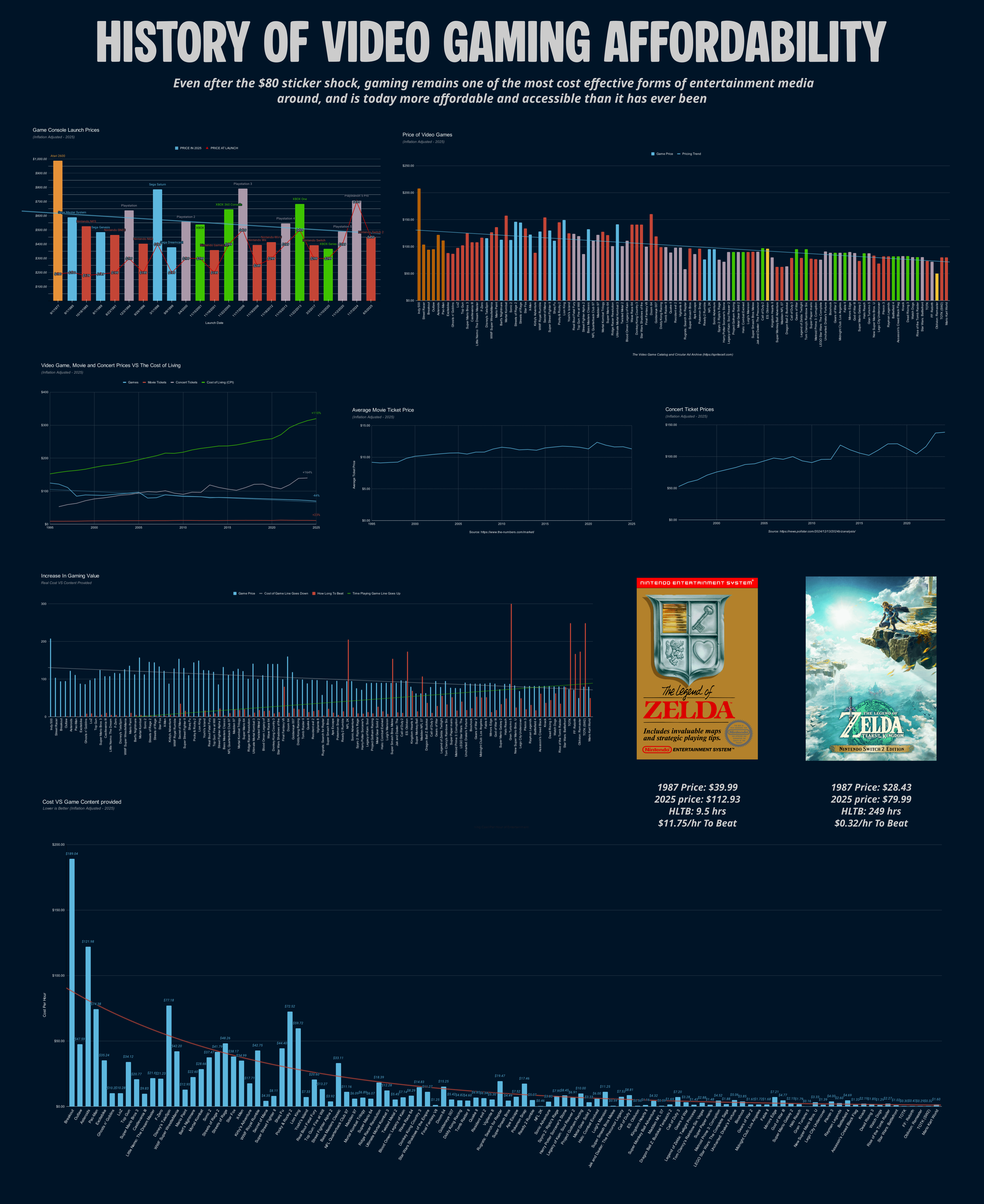
After seeing all the furor online over modern game prices i decided to go back and look at the real history of gaming prices. First I started with console prices. For the sake of simplicity and fairness I tried to limit this to what I believed most people would consider to be the “Major Players” in this space.
As we can see, with the adjustment for inflation there is a clear downward trend in Video Game Console prices.
I then went through decades of gaming prices via newspaper periodical advertisements. This was a good source for “real world” prices that customers actually paid for games in their respective times. I limited choices to games that were advertised at regular retail MSRP, or at that stores standard retail price for new release games, omitting anything that was clearly priced for discount, clearance, or seasonal sales. ([Data Collected](https://docs.google.com/spreadsheets/d/e/2PACX-1vRyRa0gnsw0hcszBkqT3oMmZp__38VmWLlmoHhox_MuQtyULxYygmhSPOAjW1Gkx89EowcQcoJrz0Hv/pubhtml?gid=230957564&single=true))
Again, a very clear trend in the real cost of games coming down over time.
Yeah but the cost of living!!!
There are lots of options when it concerns hobbies and entertainment, including abstaining entirely. But if you were to engage in gaming, even with an $80 price tag, it remains one of the most cost effective forms of entertainment media around, and is today more affordable and accessible than it has ever been.
Most other major entertainment sources haven’t been able to make the same claims. Take for example Movie and Concert tickets. Matinee ticket prices have rose, it’s far less than most people realize, but they rose all the same, while concert tickets have run away in prices and fees associated. While the cost of living has only grown, the cost of gaming, including AAA has not only remained stable relative to the cost of living for almost 50 years, it’s actually dropped over time. Not many other things can make this claim in the face of inflation.
In almost every other sector of necessity or luxury the line goes up. Furthermore, many modern games provide way more meaningful content than they ever have. Forgetting that multiplayer games can occupy players for hundreds of hours themselves, even single player experiences now come routinely with 50-200 hours worth of designed playable content. Even something as simple as a racing game like Mario Kart, that once derived it’s replayability to the self-challenge of high scores are now designed with unlockables and progression mechanics that require dozens of hours to accomplish. So much content even further extends the value vs cost proposition of modern gaming.
We are simply getting more game for less price than ever before. This isn’t even accounting for the affordability and value in the Indie space. If the $80 price tag is a bridge too far for you, that’s fine. It’s normal to recoil at a price you personally find unaffordable. There were probably lots of people that thought $35 was too much for Legend of Zelda on the NES in 1987 too. The difference really is that LoZ in 1987 had 9.5hrs of content for a real 2025 cost of $112, and LoZ in 2025 has 250 hours of content for $80. Meaning it cost you 40% more to play 3.8% as much Zelda in 1987 as you can in 2025.
Counting hours played as “content” is a pretty pisspoor metric. Look at games like Oblivion, where people will spend hours leaving the game on to auto-grind while they’re not playing. Then linear games like Doom where the whole point is to move as quickly as possible and shoot as many people/demons/whatever you can. Just doesn’t add up properly.
the problem isnt that games are more expensive. the problem is AAA developers and publishers who release a half baked game for 80-100 usd that you can play for 30-40 hours, while there are literally free or way cheaper games that offer more interesting gameplay loop, more interesting story and an overall better experience.
The problem isnt game price…its AAA value proposition. Sure there are some exceptions like kingdom come deliverance 1-2, elden ring, baldurs gate 3 etc.
~~Also saying you made statistics about video game affordability without accounting for the cost of living and inflation is strange imo.~~ Never mind, i missed the “inflation adjusted” part in one graph. it would have been better to do it on PPP though
This data seems neat and engaging.
Unfortunately I can’t engage with it since it’s so tiny, and blurry when I zoom in.
US market prices only. Last time i spent less than 15$ for a movie in a theatre was a few decade ago.
Also, did you know that Steam does adapt the game price to your nationality ?
Finally. Try to include StarCitizen in this chart. You’ll need log axis.
Overall thought: it’s a good place to start thinking about games, prices, and value. I think it’s difficult, if not impossible, to account for everyone’s different tastes and values in a single graph, so the choices you’ve made (to stick to the retail price of mainstream games and not include DLC) make sense.
A couple of things I was thinking about.
For older arcade games, was the playtime value calculated from average game length per inflation-adjusted quarter? That would definitely skew the graph. Or did you use some calculation from home versions of those games? An average game of Asteroids doesn’t last very long, but you’re supposed to be playing a lot of them.
Related, I’m on the fence about including any arcade games at all. I’d worry about them in the same way I’d worry about how to account for mobile games, live service games, and in general any game that relies on microtransactions and / or gambling.
I don’t see some games in there that I expected to, notably Starcraft. What were your criteria for selecting games to include?
Question about pricing: how would you account for things like DLC, season passes, cosmetic purchases, &c.? There are people who’ve spent $4000+ on League of Legends skins, for example. And even more on Star Citizen. I’m not judging, I’m just saying. I wonder if there’s a meaningful way to assess those.
Where did you get your HLTB numbers from? 249 hours for TotK, for example, seems a little high– my completed file has about 140 hours on it and I spent a lot of time doing pointless farming. I’m on the fence about counting something like getting all Korok Seeds in BotW as content, either.
Related to that: I don’t think there’s an easy answer to this question, but value gets a little tricky to qualify, so I completely understand why you decided to just quantify it. My 900 hours in Destiny 2 feel a lot less valuable than my 25 playing and re-(re-…)playing the Titanfall 2 campaign, for an example of what I mean.
There are people who’ve played some older games for thousands and thousands of hours, especially speedrunners and competitive gamers, but also people who just love a single game. If it’s possible to get statistics for Minecraft, I’d love to see how wild the playtime numbers are.
Another related question is about multiplayer games. I don’t see many recent shooters (Codblops / BF1 come to mind) that have pitifully short campaigns but are focussed on multiplayer.
Once again, it’s a complex set of questions to deal with, and I understand why you made the choices you did. I’m curious about the decisions you made regarding your data and how you’d handle the question of qualifying value in gaming and game time.
Only one important data point on here
How are prices inflation adjusted? I remember in the early 90s going to Walmart with my parents and they compared the NES at $100 to the SNES at $200 when they were choosing for me.
Considering how many games there are, and that there aren’t many triple A games on here.. I bet you I could cherry pick a statistic claiming the clear opposite. You need more data. Way more data. Include two more metrics, regarding quality of content and how polished / riddled with bugs each game is. Maybe a third, how much of the game was added after release.
N64 at $199 retail on 1996?
That seems off
Xbox series s is such a good deal
I straight up bought daggerfall for $90 Canadian in like 1996. Which is about 166 dollars inflation adjusted. So yea.
This is more like “everything else has been jacked up so hard by artificial inflation, that in comparison the increase in game prices isn’t so bad.”
Really like being on a boat that’s going underwater and your worried about drowning, and then someone says “don’t be so afraid – odds are the fire will get to us long before we drown!”
op wasting time trying to defend mega corps taking more money to keep their profits ever soaring. Forgetting the most important metric on purpose to push a false narrative. There are 20-50x as many videos game buyers as there were 40 years ago (depending on definition and including mobile). Games sell several times more on average than they did even in the early 2000s. This info would have been obvious but conveniently ignored by OP to make this chart. Switch has 40 titles with 4 million sales. GameCube has 4. With near 9x as many releases on switch, so more games to choose from, yet still more large sellers. If Sony/ms released data as easy for 2006 an onward it would be the same trend.
Lmao, if “gamers” were capable of comprehending this data, they’d be very upset, and prolly still yell “something something but big evil corpo!”
249h to beat TOTK? I’m not sure a 100% run is a good way to compare games…
Comments are closed.