
Both National and Labour have slid in the latest 1News/Verian poll, while New Zealand First have moved to their strongest position in eight years.
If an election were to be held today the right bloc of National, ACT and New Zealand First would have 63 seats — enough to form a coalition, while the left bloc of Labour, the Greens and Te Pāti Māori would have 58 seats.
This is a small change from the last Verian poll in April, where the coalition had 64 seats.
Winston Peters’ party moves up to 8%, according to the survey of 1002 eligible voters from May 24 to May 28.
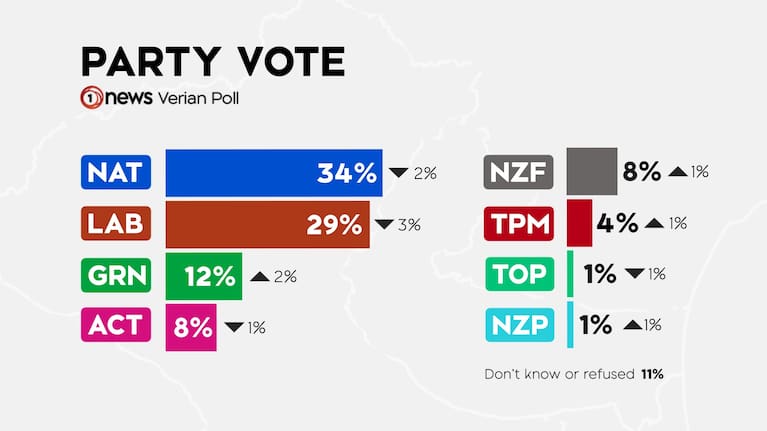
National has fallen by 2%, down to 34%. That ties with their worst result since they were elected, matching February’s result.
The poll was taken just after Finance Minister Nicola Willis announced her second Budget, which included Kiwisaver changes and used savings from stopping pay equity negotiations to help balance the books.
Labour is also going backwards with the party dropping by 3% since April, down to 29%.
This is their worst result since December — the party had been as high as 33% at one stage this year.
The biggest risers in the poll are the Greens, who are up by 2% to 12%.
New Zealand First is up by 1% to 8%, its highest result since September 2017.
ACT has fallen by 1%, down to 8%, and is now level with New Zealand First.
Te Pāti Māori have regained 1% to move back to 4%. They were as high as 7% in December.
Few sweet moments for political parties to relish from the latest polling of public opinion. (Source: 1News)
Meanwhile, the public’s positive perception of the economy is growing.
Economic optimism is up by 2% to 41% on the last poll, while economic pessimism has remained steady on 21%.
Today’s numbers mean National would have 43 seats in Parliament, down 6 on their current allocation, Labour would have 37, up 3. The Greens would have 15 the same number as at present, while ACT would have 10 down by 1.
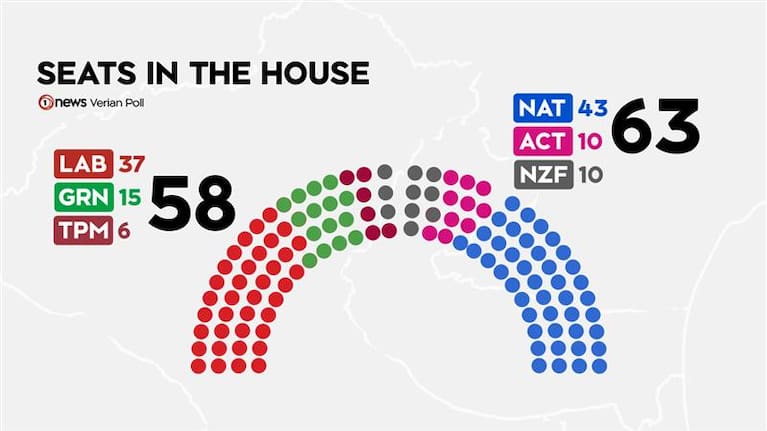
New Zealand First would have 10, up 2, and Te Pāti Māori would also have 6, as they do at present. There would be an extra seat in a 121 seat Parliament as a result of an overhang — assuming that Te Pāti Māori held on to their six electorate seats.
‘Elected to do a job’
NZ First leader Peters said, despite his party’s strong showing: “We’ve never believed in the polls in this country.”
Asked why Labour and National had a drop-in support, Peters said: “I know why it is, but I think I should keep it to myself.”
Prime Minister Christopher Luxon said: “There’s lots of different polls doing lots of different things. I am focused on delivering for New Zealanders and that means making sure we drive more economic growth into this country.”
When asked why his popularity hasn’t shifted in the polls, he said: “I was elected in 2023 to do a job.” He added: “I have three years, I have 12 quarters to get things done for New Zealanders. They’ll make that decision at the next election, that’s all I care about.”
Labour leader Chris Hipkins said: “We expect the polls to bounce around a bit at this point in the electoral cycle. We’re focused on making sure we’re building our support as we head towards next year’s election.”
Preferred for the top job
In the preferred prime minister stakes, neither Christopher Luxon or Chris Hipkins are proving particularly popular.
Luxon is steady on 23%, while Hipkins has fallen by 1% to 19%.
Winston Peters is the third preferred option, falling by 1% to 6%.
Chlöe Swarbrick moves up slightly by 1% to 5% and David Seymour is also up 1% to 4%.
Rounding out the honourable mentions on 1% are former PM Jacinda Ardern, Te Pāti Māori’s Hana Rawhiti Maipi-Clarke, Finance Minister Nicola Willis, and two new entrants – Greens Co-Leader Marama Davidson and Housing Minister Chris Bishop.

The poll comes after Nicola Willis revealed the Government’s budget. It included changes such as the investment boost, cuts to Kiwisaver contributions and the tightening of jobseeker for 18- and 19-year-olds who can get assistance from their parents.
But the most significant change was the scrapping of 33 pay equity claims under urgency to save $12.8 billion dollars. The changes resulted in protests outside Parliament and MPs’ electorate offices.
It also comes after the privileges committee’s recommended suspending Te Pāti Māori co-leaders Rawiri Waititi and Debbie Ngarewa-Packer from Parliament for 21 days and Hana-Rawhiti Maipi-Clarke for seven days for performing a haka in the House last year.
The poll was taken just days before David Seymour took over the Deputy Prime Minister reins from Winston Peters.
Party vote
National – 34% (down 2% since April)
Labour – 29% (down 3%)
Green – 12% (up 2%)
ACT – 8% (down 1%)
New Zealand First – 8% (up 1%)
Te Pāti Māori – 4% (up 1%)
The Opportunities Party (TOP) – 1% (down 1%)
New Zeal – 1% (up 1%)
NZ Outdoor and Freedoms Party – 1% (steady)
Aotearoa Legalise Cannabis Party – 1% – (up 1%)
Don’t know / refused to say – 11% (down 1%)
Seats in the House
National – 43
Labour – 37
Green – 15
ACT – 10
New Zealand First – 10
Te Pāti Māori – 6
Preferred prime minister
Christopher Luxon – 23% (steady)
Chris Hipkins – 19% (down 1%)
Winston Peters – 6% (down 1%)
Chlöe Swarbrick – 5% (up 1%)
David Seymour – 4% (up 1%)
See the full results and methodology here
Between May 24 and May 28 2025, 1002 eligible voters were polled by mobile phone (500) and online, using online panels (502). The maximum sampling error is approximately ±3.1%-points at the 95% confidence level. Party support percentages have been rounded up or down to whole numbers, except those less than 4.5%, which are reported to one decimal place. The data has been weighted to align with Stats NZ population counts for age, gender, region, ethnic identification and education level. The sample for mobile phones is selected by random dialling using probability sampling, and the online sample is collected using an online panel. Undecided voters, non-voters and those who refused to answer are excluded from the data on party support. The results are a snapshot in time of party support, and not a prediction.