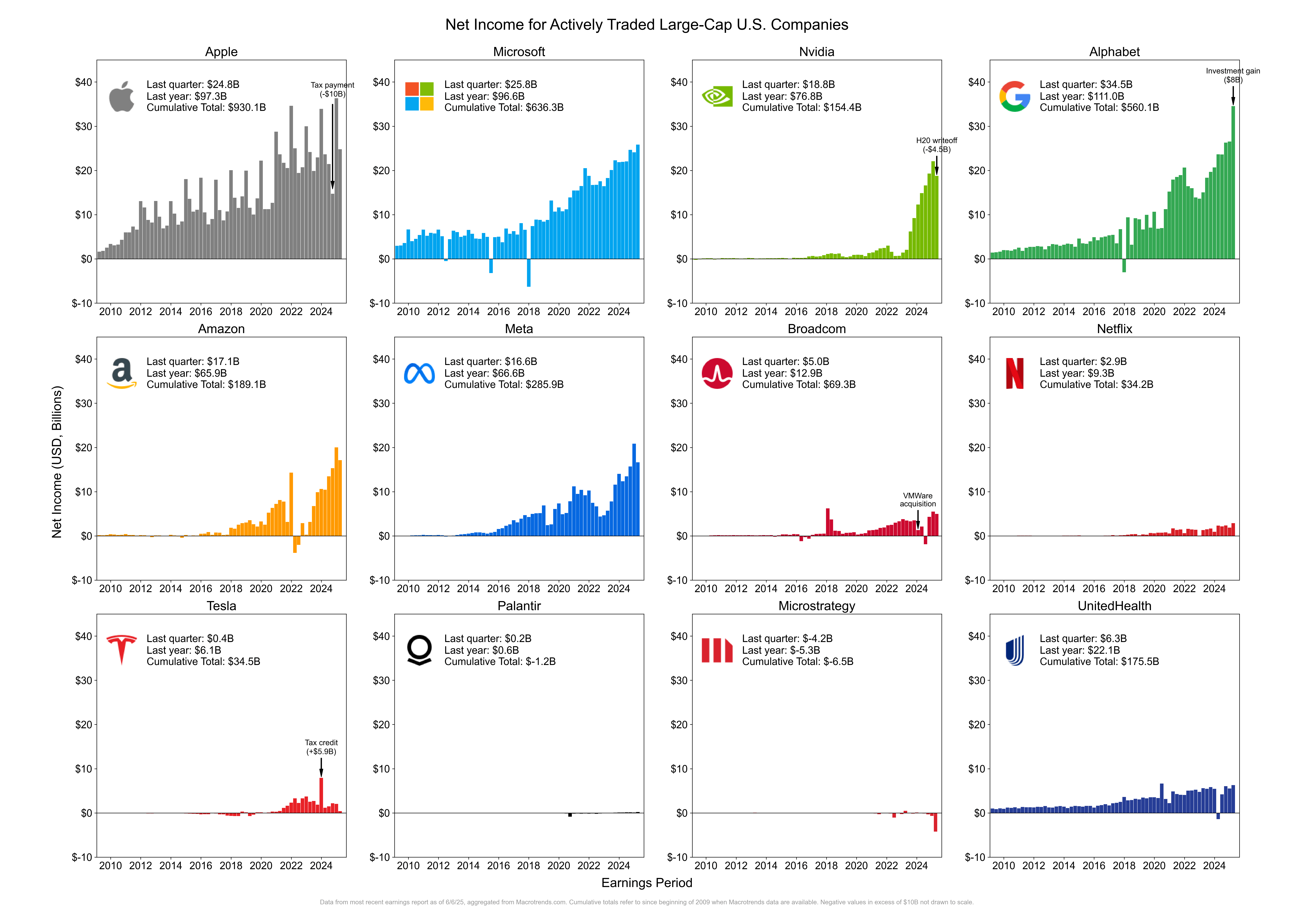
Here are a set of subplots depicting the net income history for various U.S. companies. These include the entire “Magnificent Seven”, which represent seven of the largest U.S. companies by market capitalization as well as some of the most frequently traded.
Since seven does not allow these companies to be neatly arranged in a grid, in previous iterations after prior earnings seasons, I have included the likes of Broadcom (as it fits the tech theme and would be 7th by market cap) and Netflix (tech and FAANG). I’ve also included less non-tech like Berkshire Hathaway, Exxon-Mobil, and Walmart when going pure market cap, but Berkshire and Exxon have broken the scale with incredibly negative quarters in the past.
Broadcom has now reported for the quarter. This time, to make an even 12, I’m including [high activity (daily trading volume)](https://www.tradingview.com/markets/stocks-usa/market-movers-active/) stocks with one caveat–it needs to have a reasonable enough market cap, so this excludes the likes of CoreWeave, Robinhood, Circle, etc. Welcome Palantir, Microstrategy, and UnitedHealth to the party.
Note that the scale of the y-axis is the same for each subplot to allow a fair comparison of net income across companies.
Graphs were generated with Python Matplotlib. Data was obtained from Macrotrends aggregated data, or from Broadcom’s most recent earnings report since it hasn’t been updated on Macrotrends yet.
This really shows it’s more of a magnificent 6. There are some other names that eventually could join the top ranks, but Apple, Microsoft, Alphabet, Nvidia, Amazon, and Meta really operate in a league of their own.
Love it, and so good that you kept the scale fixed for comparison. Very insightful!
Guess it’s all about those green numbers at the end of the day.
Reason for huge negative value of MSFT in 2018? I’m not seeing this in reports IINM
Can someone chart Oracle (ORCL) for comparison? They’re accelerating their cloud build out and are winning large deals at a fast clip.
How do I get a billion dollar tax credit?
It’s striking that Apple’s income is so seasonal, because phones. And it looks like that seasonality doesn’t start until 2012 – I guess that’s when they started making a Big Deal out of the launches.
This is a beautiful chart. The comparative data is very illuminating.
This chart is misleading when it comes to MicroStrategy. GAAP accounting forces them to mark down Bitcoin when it drops but doesn’t let them mark it up when it rises so their net income looks terrible even if their BTC holdings are way up. It makes them look like a money-losing tech company, when in reality they’re basically a leveraged Bitcoin ETF with a small software biz attached. Net income just doesn’t capture their actual strategy or value.
Otherwise tho, this is a beautiful presentation of data indeed 🔥
Bro just really prefers bars vs lines, even though direct comparisons would be clearer
11 comments
Here are a set of subplots depicting the net income history for various U.S. companies. These include the entire “Magnificent Seven”, which represent seven of the largest U.S. companies by market capitalization as well as some of the most frequently traded.
Since seven does not allow these companies to be neatly arranged in a grid, in previous iterations after prior earnings seasons, I have included the likes of Broadcom (as it fits the tech theme and would be 7th by market cap) and Netflix (tech and FAANG). I’ve also included less non-tech like Berkshire Hathaway, Exxon-Mobil, and Walmart when going pure market cap, but Berkshire and Exxon have broken the scale with incredibly negative quarters in the past.
Broadcom has now reported for the quarter. This time, to make an even 12, I’m including [high activity (daily trading volume)](https://www.tradingview.com/markets/stocks-usa/market-movers-active/) stocks with one caveat–it needs to have a reasonable enough market cap, so this excludes the likes of CoreWeave, Robinhood, Circle, etc. Welcome Palantir, Microstrategy, and UnitedHealth to the party.
Note that the scale of the y-axis is the same for each subplot to allow a fair comparison of net income across companies.
Graphs were generated with Python Matplotlib. Data was obtained from Macrotrends aggregated data, or from Broadcom’s most recent earnings report since it hasn’t been updated on Macrotrends yet.
This really shows it’s more of a magnificent 6. There are some other names that eventually could join the top ranks, but Apple, Microsoft, Alphabet, Nvidia, Amazon, and Meta really operate in a league of their own.
Love it, and so good that you kept the scale fixed for comparison. Very insightful!
Guess it’s all about those green numbers at the end of the day.
https://preview.redd.it/eopxrn8a2a5f1.png?width=1058&format=png&auto=webp&s=7730d5c74b7e76e6a9b98be8129ceae6248e11ca
Reason for huge negative value of MSFT in 2018? I’m not seeing this in reports IINM
Can someone chart Oracle (ORCL) for comparison? They’re accelerating their cloud build out and are winning large deals at a fast clip.
How do I get a billion dollar tax credit?
It’s striking that Apple’s income is so seasonal, because phones. And it looks like that seasonality doesn’t start until 2012 – I guess that’s when they started making a Big Deal out of the launches.
This is a beautiful chart. The comparative data is very illuminating.
This chart is misleading when it comes to MicroStrategy. GAAP accounting forces them to mark down Bitcoin when it drops but doesn’t let them mark it up when it rises so their net income looks terrible even if their BTC holdings are way up. It makes them look like a money-losing tech company, when in reality they’re basically a leveraged Bitcoin ETF with a small software biz attached. Net income just doesn’t capture their actual strategy or value.
Otherwise tho, this is a beautiful presentation of data indeed 🔥
Bro just really prefers bars vs lines, even though direct comparisons would be clearer
Comments are closed.