Ok, now do what people are actually earning. Only 1.1% of hourly workers are actually being paid the minimum wage.
The x axis for this is literally just 2000 and 2023.
Important information. Lackluster visualization.
The U.S. doesn‘t rank at the bottom of *all OECD* countries, as some OECD countries, for example Austria, do not have a minimum wage set by law.
Couldn’t that just mean that our average workers are making way more?
Any sort of “median income by country” will show you the US is doing just fine. Even looking at median equivalent disposable income ([source](https://en.wikipedia.org/wiki/Median_income)) shows that when you take everything into account, the US is doing far better than any other large country.
This is just a graph that shows that the United States no longer really has a federal minimum wage which it very much does not. If you exclude tipped workers and people being paid under the table significantly less than 1% of workers make federal minimum.
I assume this is the federal minimum wage of $7.25/hour, which hasn’t been updated in a long time and hence has lost a lot to inflation (hence the downward trend in the red line in the graph).
However, most US states (iirc over 30 of them) have state-level minimum wages substantially above the federal one, including many of the most populous states (e.g. California $16.5, Florida $14, New York $16.5, Illinois $15, Ohio $10.7, Michigan $12.5). So while there are still many states where the minimum wage is still $7.25, a big chunk of the population lives in a state where it’s higher than that.
I’m gonna be honest, while the US minimal wage is clearly a joke this metric in itself is crap.
Where I live for instance, while the minimum wage sort of increased regularly to keep up proportionnally with the cost of living, most of the other wages didn’t follow the same trend.
Jobs that used to pay 2 to 3 times the minimal wage in the 90s now barely pays 20% more…
The result is a minimum wage now at 67% of the median income but only because everyone else got poorer, not because minimal wage situation improved.
Gray scale isn’t beautiful
Almost no one makes min wage. This is a wasted exercise.
And the majority of our elected representatives are just fine with this and do nothing to fix it.
All this focus on minimum wage when it should be on maximum wage. USA’s gross national income divided by the number of workers is ~$150,000 per person. If we split the income evenly 90% of workers’ wages would go up.
Who cares what minimum wage is? The market bottom is what sets minimum wage. Nobody gets paid minimum wage outside of highschool jobs or mentally handicapped jobs.
Minimum wage tells nothing about the economy or the quality of wages.
It can even be counter productive: set it too high and you are pushing many jobs to the black market. It will also lower higher skilled job’s wages because companies will turn less profitable or even unprofitable. If you also don’t move up income tax brackets, you got yourself a nice way of taxing more and being a popular politician (as well as damn populistic).
High ratio is not necessarily a sign of prosperity. The two top countries with highest ratios are Costa Rica and Colombia.
Add in the percentage of workforce that earns minimum wage.
How does a country operate with the minimum wage at 90% of median wage? That means 50% of workers make within a 10% band.
I’m for raising the US minimum wage, but this is one point where the extremes on either end seem unwise.
This is a beautiful example of how to lie with statistics.
As an American, 61, I am so tired of the worship of money here. No one should have more than 10 million dollars. No one should make less than 100k. Quit the awe over hoarders
This chart is useless if only a few % of people get paid a minimal wage. Median wage shows that USA is ahead of most OECD countries.
This is what happens when we let the ultra rich run things, they take all and leave very little for the rest of us.
Share of wage and salary workers in the United States paid hourly rates at or below the prevailing federal minimum wage from 1979 to 2023
Give them some credit, the ratio did increase around 2008.
What happened between 2009ish and 2012ish that made the US ratio go up?
Or is that the effect of the 2008 economic troubles?
Forget the minimum wage. We need a Maximum Wage. Bob Iger is paid $112,000 per DAY by Disney while none of the hourly wage employees at Disney’s parks could even afford to bring their families there. He is basically paid 1000x more than CA minimum wage.
I’m not opposed to CEOs being well paid, but the ratio needs to be lower. You can still buy your yacht if you are limited to a ratio of 250:1 over your lowest paid workers. If you want to pay yourself more go ahead, as long as you give everyone else at the company a raise too
What matters more is the equilibrium wage that’s set be the free market, not the mandatory minimum.
I’m sure the USA is much higher than almost all OECD countries using that metric.
meanwhile Russia:
__________________________
(our minimum wage is calculated as % of median to begin with)
Minimum wage in the US is not real for all intents and purposes. Something like 1% of people actually make minimum wage or below and the vast majority of these are tipped servers etc
Many states and even cities have their own higher minimum wage.
This is essentially deeply conservative states punishing their poor for some reason.
The true definition of winning.
But 100% would mean the minimum is also the median? So 50% of population at least is at minimum wage ?
Or am I speaking nonsense ?
federal minimum wage law was one of the 20th century’s most nonsensical policy choices
According to the US Bureau of Labor Statistics, 82,000 workers are paid minimum wage. That’s less than 1% of the US work force. In 1979, that percent was over 13%. The truth is that a minimum wage is largely irrelevant in a market that is competitive and needs labor. Having a minimum wage that is too high is more damaging to an economy than a minimum wage that is “too low”.
The only conclusion one should draw from this is that the US is wealthy enough that few people make the minimum wage.
That’s because in the US the actual minimum wage is set by states, the federal minimum wage is low in order to allow states to set minimum wages that match their conditions
Is this federal minimum wage? Because the US is big and a single minimum wage is impractical. Many states have $15 an hour which is double federal. But too many jobs would be killed if you implemented it in other states.
This means absolutely nothing
This is dumb.
The US federal wage is not the only minimum wage in the US so unless they’ve weighted the ratio at a state level and worked out the average.
Correct me if I am interpreting this wrong, but isn’t this what you want for the US??…an incentive to get a higher education or trade to lift up from “minimum wage”. The closer the gap, the less incentive to grow. Did they post how they also got their data for making the relationships?
Data is beautiful, but this garbage is ugly.
So, as I understand, if you have a low minimum wage, a larger percentage of your population makes more money than minimum wage but if you have a higher minimum wage, most people make just the minimum wage.
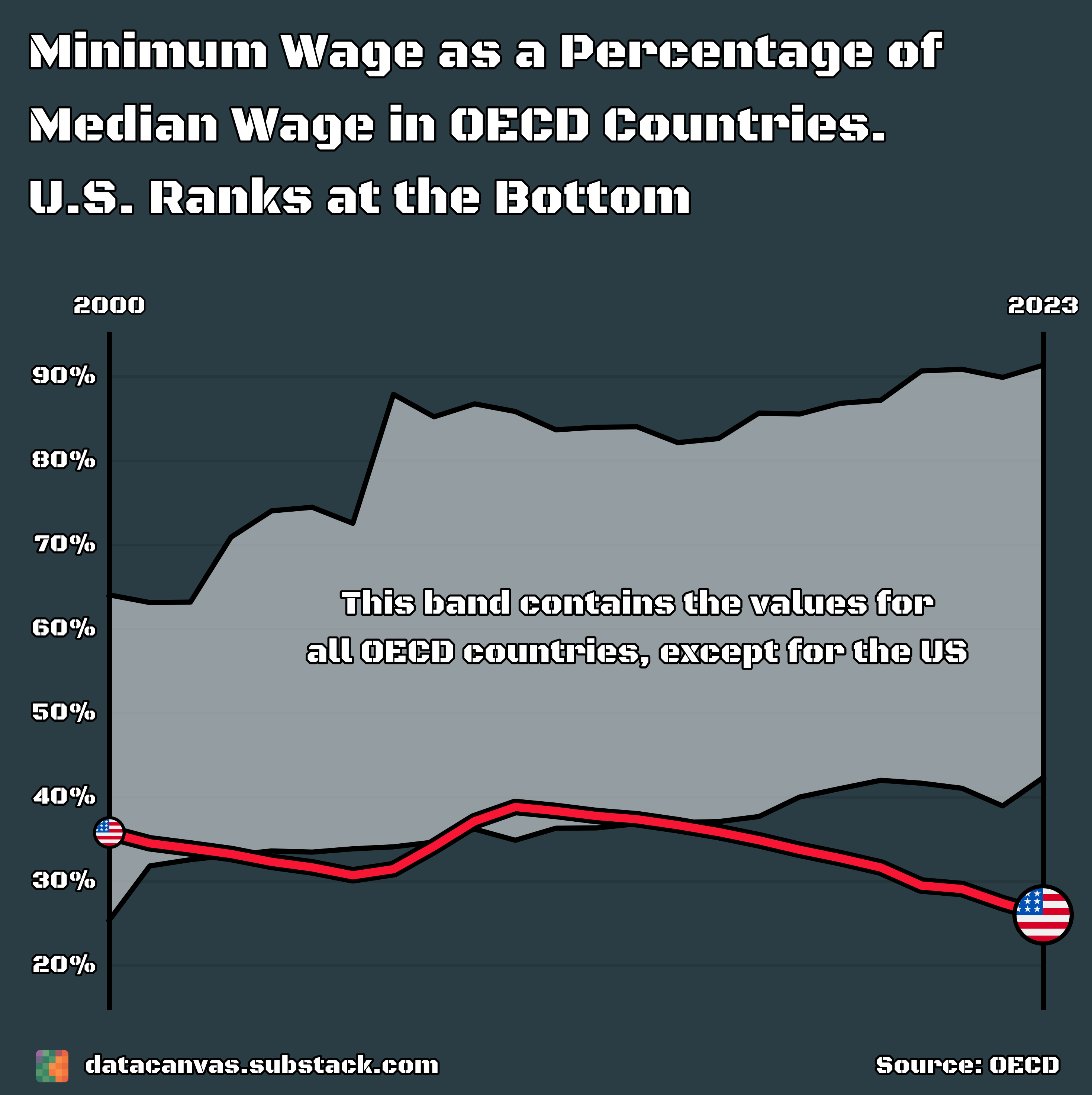
![[OC] Minimum Wage as a Percentage of Median Wage in OECD Countries: U.S. Ranks at the Bottom](https://www.europesays.com/wp-content/uploads/2025/06/cqpuocx83h9f1-1920x1024.png)
42 comments
Ok, now do what people are actually earning. Only 1.1% of hourly workers are actually being paid the minimum wage.
The x axis for this is literally just 2000 and 2023.
Important information. Lackluster visualization.
The U.S. doesn‘t rank at the bottom of *all OECD* countries, as some OECD countries, for example Austria, do not have a minimum wage set by law.
Couldn’t that just mean that our average workers are making way more?
Any sort of “median income by country” will show you the US is doing just fine. Even looking at median equivalent disposable income ([source](https://en.wikipedia.org/wiki/Median_income)) shows that when you take everything into account, the US is doing far better than any other large country.
This is just a graph that shows that the United States no longer really has a federal minimum wage which it very much does not. If you exclude tipped workers and people being paid under the table significantly less than 1% of workers make federal minimum.
I assume this is the federal minimum wage of $7.25/hour, which hasn’t been updated in a long time and hence has lost a lot to inflation (hence the downward trend in the red line in the graph).
However, most US states (iirc over 30 of them) have state-level minimum wages substantially above the federal one, including many of the most populous states (e.g. California $16.5, Florida $14, New York $16.5, Illinois $15, Ohio $10.7, Michigan $12.5). So while there are still many states where the minimum wage is still $7.25, a big chunk of the population lives in a state where it’s higher than that.
I’m gonna be honest, while the US minimal wage is clearly a joke this metric in itself is crap.
Where I live for instance, while the minimum wage sort of increased regularly to keep up proportionnally with the cost of living, most of the other wages didn’t follow the same trend.
Jobs that used to pay 2 to 3 times the minimal wage in the 90s now barely pays 20% more…
The result is a minimum wage now at 67% of the median income but only because everyone else got poorer, not because minimal wage situation improved.
Gray scale isn’t beautiful
Almost no one makes min wage. This is a wasted exercise.
And the majority of our elected representatives are just fine with this and do nothing to fix it.
All this focus on minimum wage when it should be on maximum wage. USA’s gross national income divided by the number of workers is ~$150,000 per person. If we split the income evenly 90% of workers’ wages would go up.
Who cares what minimum wage is? The market bottom is what sets minimum wage. Nobody gets paid minimum wage outside of highschool jobs or mentally handicapped jobs.
Minimum wage tells nothing about the economy or the quality of wages.
It can even be counter productive: set it too high and you are pushing many jobs to the black market. It will also lower higher skilled job’s wages because companies will turn less profitable or even unprofitable. If you also don’t move up income tax brackets, you got yourself a nice way of taxing more and being a popular politician (as well as damn populistic).
High ratio is not necessarily a sign of prosperity. The two top countries with highest ratios are Costa Rica and Colombia.
Add in the percentage of workforce that earns minimum wage.
How does a country operate with the minimum wage at 90% of median wage? That means 50% of workers make within a 10% band.
I’m for raising the US minimum wage, but this is one point where the extremes on either end seem unwise.
This is a beautiful example of how to lie with statistics.
As an American, 61, I am so tired of the worship of money here. No one should have more than 10 million dollars. No one should make less than 100k. Quit the awe over hoarders
This chart is useless if only a few % of people get paid a minimal wage. Median wage shows that USA is ahead of most OECD countries.
This is what happens when we let the ultra rich run things, they take all and leave very little for the rest of us.
Share of wage and salary workers in the United States paid hourly rates at or below the prevailing federal minimum wage from 1979 to 2023
https://preview.redd.it/negn3g1adh9f1.jpeg?width=1179&format=pjpg&auto=webp&s=eec9a6234f68e1805080f421b4b31e35b676acff
[https://www.statista.com/statistics/188206/share-of-workers-paid-hourly-rates-at-or-below-minimum-wage-since-1979/](https://www.statista.com/statistics/188206/share-of-workers-paid-hourly-rates-at-or-below-minimum-wage-since-1979/)
[deleted]
Give them some credit, the ratio did increase around 2008.
What happened between 2009ish and 2012ish that made the US ratio go up?
Or is that the effect of the 2008 economic troubles?
Forget the minimum wage. We need a Maximum Wage. Bob Iger is paid $112,000 per DAY by Disney while none of the hourly wage employees at Disney’s parks could even afford to bring their families there. He is basically paid 1000x more than CA minimum wage.
I’m not opposed to CEOs being well paid, but the ratio needs to be lower. You can still buy your yacht if you are limited to a ratio of 250:1 over your lowest paid workers. If you want to pay yourself more go ahead, as long as you give everyone else at the company a raise too
What matters more is the equilibrium wage that’s set be the free market, not the mandatory minimum.
I’m sure the USA is much higher than almost all OECD countries using that metric.
meanwhile Russia:
__________________________
(our minimum wage is calculated as % of median to begin with)
Minimum wage in the US is not real for all intents and purposes. Something like 1% of people actually make minimum wage or below and the vast majority of these are tipped servers etc
Many states and even cities have their own higher minimum wage.
This is essentially deeply conservative states punishing their poor for some reason.
The true definition of winning.
But 100% would mean the minimum is also the median? So 50% of population at least is at minimum wage ?
Or am I speaking nonsense ?
federal minimum wage law was one of the 20th century’s most nonsensical policy choices
According to the US Bureau of Labor Statistics, 82,000 workers are paid minimum wage. That’s less than 1% of the US work force. In 1979, that percent was over 13%. The truth is that a minimum wage is largely irrelevant in a market that is competitive and needs labor. Having a minimum wage that is too high is more damaging to an economy than a minimum wage that is “too low”.
The only conclusion one should draw from this is that the US is wealthy enough that few people make the minimum wage.
That’s because in the US the actual minimum wage is set by states, the federal minimum wage is low in order to allow states to set minimum wages that match their conditions
Is this federal minimum wage? Because the US is big and a single minimum wage is impractical. Many states have $15 an hour which is double federal. But too many jobs would be killed if you implemented it in other states.
This means absolutely nothing
This is dumb.
The US federal wage is not the only minimum wage in the US so unless they’ve weighted the ratio at a state level and worked out the average.
Correct me if I am interpreting this wrong, but isn’t this what you want for the US??…an incentive to get a higher education or trade to lift up from “minimum wage”. The closer the gap, the less incentive to grow. Did they post how they also got their data for making the relationships?
Data is beautiful, but this garbage is ugly.
So, as I understand, if you have a low minimum wage, a larger percentage of your population makes more money than minimum wage but if you have a higher minimum wage, most people make just the minimum wage.
Comments are closed.