I’m a scientist concerned about the effects of the brain drain from the United States. Her ability to benefit from this effect in other countries in the post-World War II era has been evident in prior data from [Jurgen Schmidhuber](https://people.idsia.ch/~juergen/nobelshare.html) (last updated in 2010), and I’d been hoping to update this for data through 2024. Credit to u/alexmijowastaken, whose recent post on birthplaces showed me it was possible to query Wikidata.
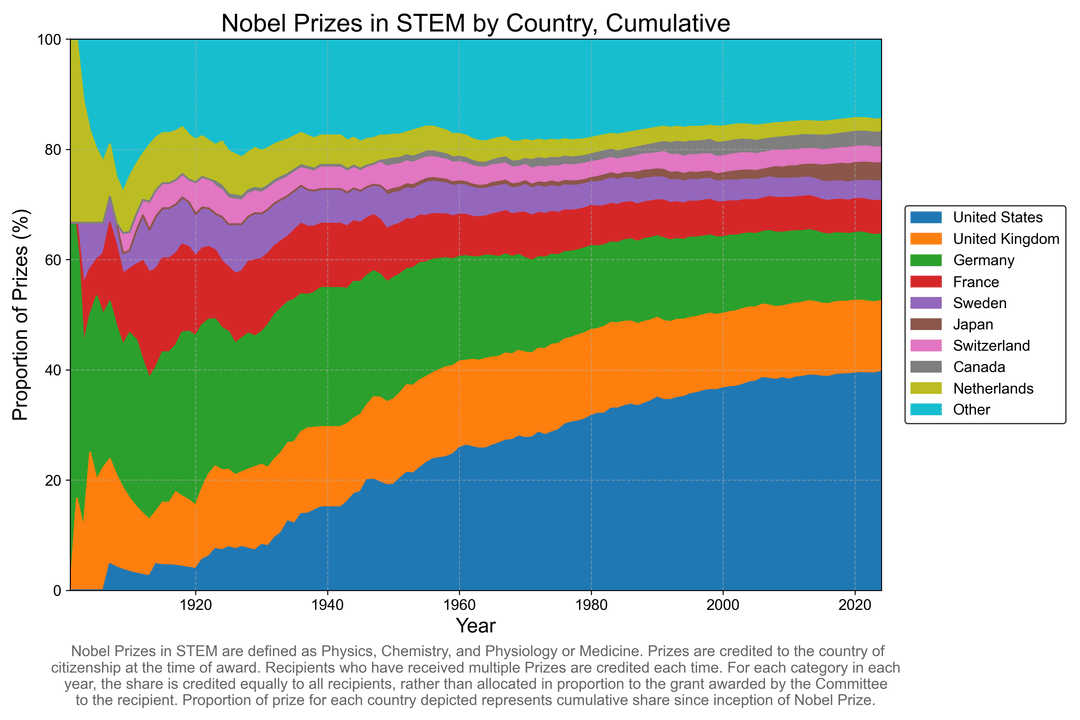
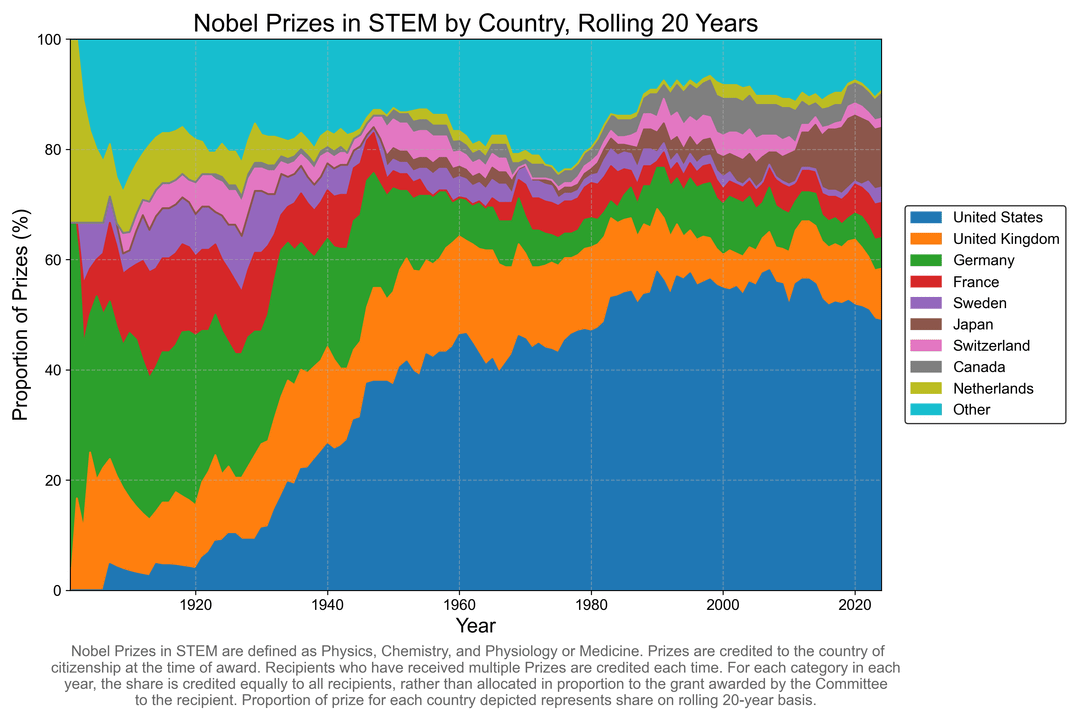
For the purposes of these plots, I’m focusing on just the STEM Nobel Prizes, which I define as Physics, Chemistry, and Physiology or Medicine, as the effect of these are more pronounced. Because I had no way to cleanly extract the share of Nobel Prizes awarded to each recipient, I assumed each recipient for each year/category received an equal category–in other words, this would incorrectly treat a 1/2-1/4-1/4 split as a 1/3-1/3-1/3 split, but the effect is minor.
The wikiquery code is below. I had to reclassify some countries (i.e. Soviet Union and Russian Empire as “Russia”, British Raj as “India”; Kingdom of Prussia, German Empire, Nazi Germany, German Reich, West Germany all as “Germany”). Graphs generated using Python matplotlib.
The first graph shows cumulative proportions of Nobel Prizes in STEM. Germany had a disproportionately share of the Prizes through the 1930s, and then due to a combination of war and brain drain, it ceded its dominance to the United States and the UK. This is even more evident in the second graph showing rolling 20-year proportions, rather than cumulative–a huge spike in American Laureates starting in the 1930s which continued in the post-World War II era, reflecting that it has remained the most attractive destination for talented immigrant scientists.
The cumulative graph still indicates that a disproportionately high number of Laureates were German, but the rolling 20-year graph shows that German science has never recovered its former glory, more than 3 generations later.
Edit: This query is supposed to take countries of citizenship, but upon further inspection, this appears to actually grab the country of affiliation.
SELECT
?itemLabel
(SAMPLE(?countryLabelVal) AS ?countryLabel) # Use SAMPLE to pick one country label
(YEAR(?when) as ?date)
(YEAR(?dob) as ?doby)
?prizeFieldLabel
WHERE {
?item p:P166 ?awardStat .
?awardStat ps:P166 ?prize .
# Limit to specific Nobel Prize fields
VALUES ?prize {
wd:Q44585 # Nobel Prize in Chemistry
wd:Q38104 # Nobel Prize in Physics
wd:Q80061 # Nobel Prize in Physiology or Medicine
}
?awardStat pq:P585 ?when .
OPTIONAL { ?item wdt:P569 ?dob . } # Date of birth
# Get the country QID and its label (optional)
OPTIONAL {
?item wdt:P27 ?country_qid . # P27 is ‘country of citizenship’
SERVICE wikibase:label {
bd:serviceParam wikibase:language “en” .
?country_qid rdfs:label ?countryLabelVal . # This label will be aggregated
}
}
# Get other labels (item and prize field)
SERVICE wikibase:label {
bd:serviceParam wikibase:language “en” .
?item rdfs:label ?itemLabel .
?prize rdfs:label ?prizeFieldLabel .
}
}
# Group by the desired “primary key” to ensure one row per unique prize-person combination
GROUP BY ?item ?itemLabel ?when ?dob ?prizeFieldLabel
Super interesting. Do you know how much China makes of it? I always thought that since 10 years china is really going forward with innovations and noble prizes although this chart shows that’s not the case at least yet
Huh. So the biggest recent trend is the growth of science in Japan. Interesting!
Can you do one for others that have 1+ ?
India and China with a third of the global population produce hardly any breakthrough science. Sad.
6 comments
I’m a scientist concerned about the effects of the brain drain from the United States. Her ability to benefit from this effect in other countries in the post-World War II era has been evident in prior data from [Jurgen Schmidhuber](https://people.idsia.ch/~juergen/nobelshare.html) (last updated in 2010), and I’d been hoping to update this for data through 2024. Credit to u/alexmijowastaken, whose recent post on birthplaces showed me it was possible to query Wikidata.
For the purposes of these plots, I’m focusing on just the STEM Nobel Prizes, which I define as Physics, Chemistry, and Physiology or Medicine, as the effect of these are more pronounced. Because I had no way to cleanly extract the share of Nobel Prizes awarded to each recipient, I assumed each recipient for each year/category received an equal category–in other words, this would incorrectly treat a 1/2-1/4-1/4 split as a 1/3-1/3-1/3 split, but the effect is minor.
The wikiquery code is below. I had to reclassify some countries (i.e. Soviet Union and Russian Empire as “Russia”, British Raj as “India”; Kingdom of Prussia, German Empire, Nazi Germany, German Reich, West Germany all as “Germany”). Graphs generated using Python matplotlib.
The first graph shows cumulative proportions of Nobel Prizes in STEM. Germany had a disproportionately share of the Prizes through the 1930s, and then due to a combination of war and brain drain, it ceded its dominance to the United States and the UK. This is even more evident in the second graph showing rolling 20-year proportions, rather than cumulative–a huge spike in American Laureates starting in the 1930s which continued in the post-World War II era, reflecting that it has remained the most attractive destination for talented immigrant scientists.
The cumulative graph still indicates that a disproportionately high number of Laureates were German, but the rolling 20-year graph shows that German science has never recovered its former glory, more than 3 generations later.
Edit: This query is supposed to take countries of citizenship, but upon further inspection, this appears to actually grab the country of affiliation.
SELECT
?itemLabel
(SAMPLE(?countryLabelVal) AS ?countryLabel) # Use SAMPLE to pick one country label
(YEAR(?when) as ?date)
(YEAR(?dob) as ?doby)
?prizeFieldLabel
WHERE {
?item p:P166 ?awardStat .
?awardStat ps:P166 ?prize .
# Limit to specific Nobel Prize fields
VALUES ?prize {
wd:Q44585 # Nobel Prize in Chemistry
wd:Q38104 # Nobel Prize in Physics
wd:Q80061 # Nobel Prize in Physiology or Medicine
}
?awardStat pq:P585 ?when .
OPTIONAL { ?item wdt:P569 ?dob . } # Date of birth
# Get the country QID and its label (optional)
OPTIONAL {
?item wdt:P27 ?country_qid . # P27 is ‘country of citizenship’
SERVICE wikibase:label {
bd:serviceParam wikibase:language “en” .
?country_qid rdfs:label ?countryLabelVal . # This label will be aggregated
}
}
# Get other labels (item and prize field)
SERVICE wikibase:label {
bd:serviceParam wikibase:language “en” .
?item rdfs:label ?itemLabel .
?prize rdfs:label ?prizeFieldLabel .
}
}
# Group by the desired “primary key” to ensure one row per unique prize-person combination
GROUP BY ?item ?itemLabel ?when ?dob ?prizeFieldLabel
Super interesting. Do you know how much China makes of it? I always thought that since 10 years china is really going forward with innovations and noble prizes although this chart shows that’s not the case at least yet
Huh. So the biggest recent trend is the growth of science in Japan. Interesting!
Can you do one for others that have 1+ ?
India and China with a third of the global population produce hardly any breakthrough science. Sad.
Legend is upside down.
Comments are closed.