Hamas says it has agreed to release 10 Israeli captives as part of continuing efforts to reach a ceasefire in the besieged and bombarded Gaza Strip, but warned that ongoing talks for a truce were “tough” due to Israel’s “intransigence”.
The Palestinian group said on Wednesday that the ceasefire talks, spearheaded by key mediators Qatar and the United States and held in the Qatari capital Doha, have several sticking points, including the flow of desperately needed aid, withdrawal of Israeli forces from Gaza, and “genuine guarantees for a permanent ceasefire”.
Hamas official Taher al-Nunu said the group agreed to the latest truce proposal and “offered the necessary flexibility to protect our people, stop the crime of genocide, and allow the free and dignified entry and flow of aid to our people until we reach a complete end to the war”.
He added that the areas Israeli troops should withdraw to as part of the first phase of a ceasefire had to be drawn up in a way that does not affect Palestinian lives and “paves the way for the second phase of negotiations”.
The comments come as Israeli forces continued to pound various parts of the enclave, killing at least 74 people on Wednesday, eight of whom died while waiting for GHF aid.
“Unfortunately, this has become the norm: characterised by the ongoing bombardment and forced starvation and dehydration. People are getting killed trying to get food,” Al Jazeera’s Hani Mahmoud, reporting from Gaza City, said.
The number of Palestinians killed at the US- and Israeli-backed GHF sites has surpassed 770, according to Gaza’s Health Ministry.
“From day one of GHF operations there’s been an orgy of killing either by the Israeli military or the documented incident of GHF officers opening fire.”
The killings also come as health officials once again plead for the entry of much-needed fuel as hospitals are on the verge of collapse and patients’ lives are at risk.
Nasser Hospital, the main health facility in southern Gaza, issued a desperate warning as its fuel supplies run dry, saying it has entered “the crucial and final hours”.
“With the fuel counter nearing zero, doctors have entered the battle to save lives in a race against time, death, and darkness,” the hospital said in a statement.
“They work in operating rooms without air conditioning, the boiling heat, their faces are sweating, their bodies are weary of hunger and fatigue. But their eyes are still burning with hope and determination.”
Gaza’s already battered healthcare system has repeatedly come under Israeli attack throughout the assault. Hospitals and clinics have been bombed or damaged, medical staff killed or forced to flee, and vital supplies cut off.
‘Quake bombs’
The World Health Organization (WHO) says there have been more than 600 attacks on health facilities in Gaza since the conflict began in 2023.
The besieged health sector is “on its knees” with severe shortages of fuel and medical supplies, and the constant influx of mass casualties.
Just 18 of Gaza’s 36 general hospitals are partially functioning, according to the UN agency.
Meanwhile, US President Donald Trump, who has met Israeli Prime Minister Benjamin Netanyahu in the White House, said there is a “very good chance” of a ceasefire in Gaza this week or next.
Earlier, Israel’s military chief Eyal Zamir said in a televised speech that “conditions have been created” for the advancement of a deal that is set to see the release of 10 captives – and the bodies of nine others.
Despite the prospects of a possible ceasefire, Israel has launched a barrage of missiles targeting densely populated residential areas in Gaza City.
Al Jazeera’s Mahmoud said an estimated 20 bombs were dropped on buildings in the Tuffah neighbourhood.
“These were ‘quake bombs’, they shook the buildings,” he said.
Israeli forces also launched another major assault in battered northern Gaza, specifically Beit Hanoon, after five Israeli soldiers were killed in a surprise Hamas attack on Tuesday.
The army has in recent days issued numerous forced evacuation orders for residents of northern Gaza, an area that has come under repeated ground and aerial assault throughout this deadly war.
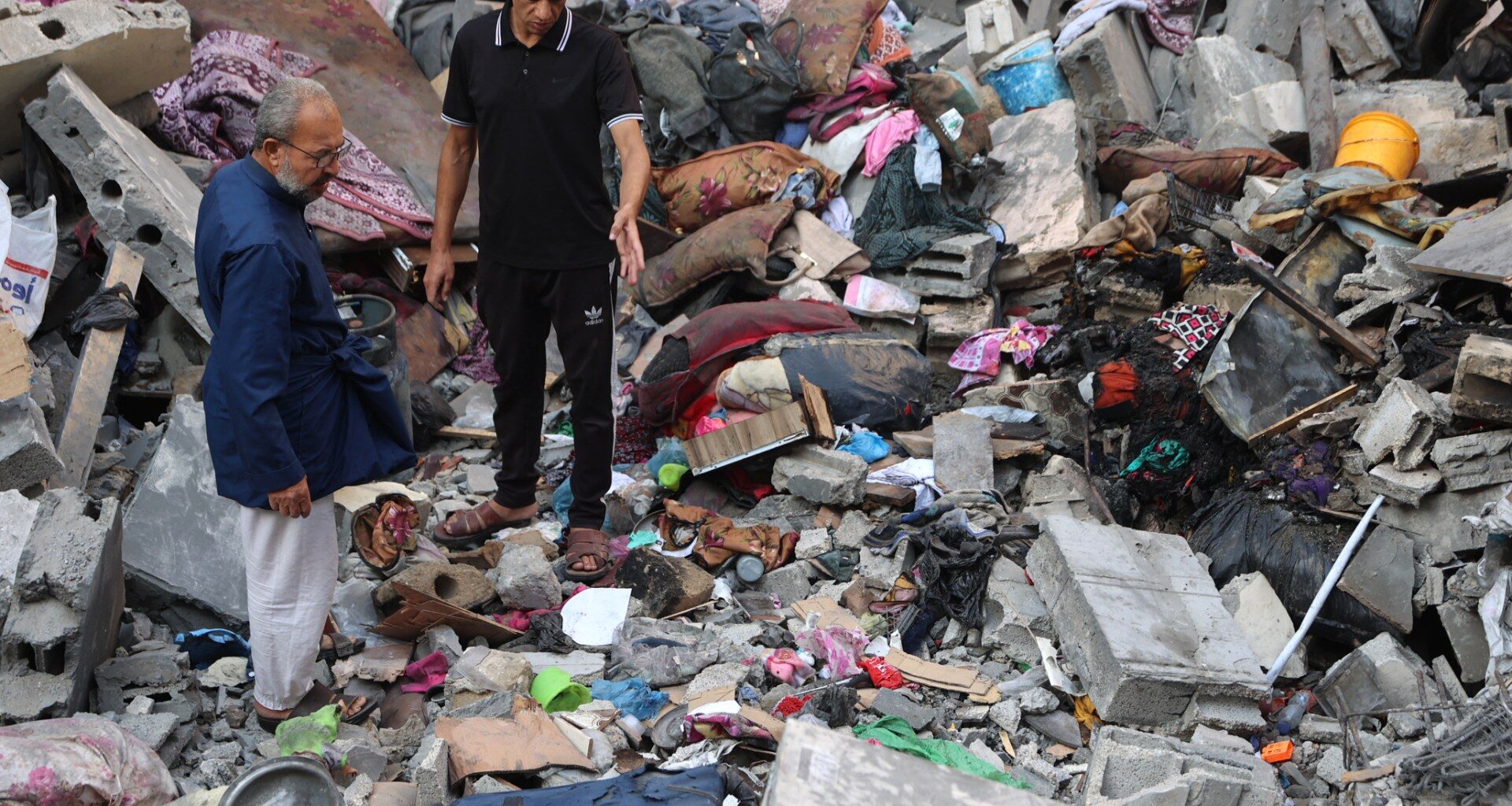
This includes Shati refugee camp, an area in the north of Gaza that was struck overnight in an attack that killed at least 30 people.
A local, Mohamed Jouda, recounted the attack.
“We were sitting at home, around midnight. Suddenly, the house collapsed on everyone inside – children, adults, and elderly people in their 70s and 80s,” Jouda told Al Jazeera as he sat on the rubble of his destroyed home.
Another survivor, Ismail al-Bardawil, said the attack “felt like an earthquake”.
“A whole neighbourhood collapsed,” he said from the densely populated camp west of Gaza City, where structures are built right next to each other.
“Seven little kids died here. Over there, 10 more children. The only adult was an old man, around 70 years old. What was their fault?” al-Bardawil said.