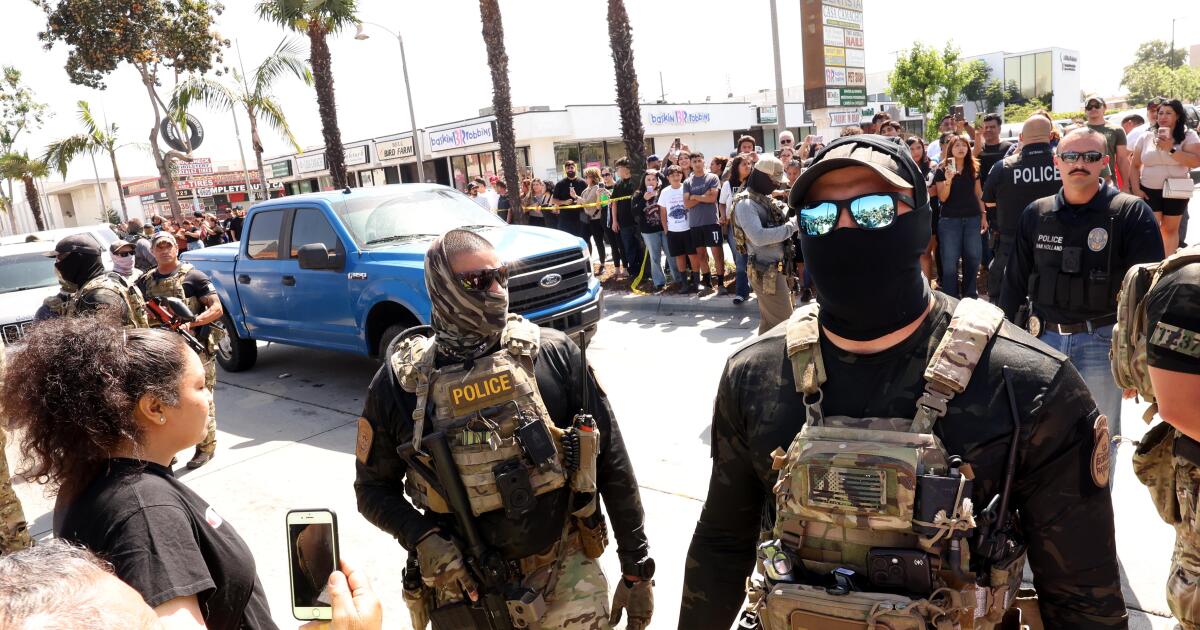
A federal judge issued a tentative ruling on Thursday that suggests she will order the Trump administration to halt unlawful stops and arrests that advocates say have terrorized Angelenos, forced some immigrants into hiding and damaged the local economy.
The ruling was not made public, but a final order is expected Friday on the case that has become a centerpiece in the battle over Trump’s mass deportation plan. The lawsuit filed by immigrant rights groups last week seeks to block federal agents from stopping and arresting brown-skinned people without probable cause and then placing them in “dungeon-like” conditions without access to lawyers.
Ahead of an hours-long hearing in a downtown Los Angeles federal courthouse , Judge Maame Ewusi-Mensah Frimpong provided attorneys with a lengthy ruling based on earlier court filings in the case. Tentative rulings are not uncommon, and Frimpong said she was providing it to give both sides, “an understanding of how I see the case.”
The ruling suggested Frimpong would grant two temporary restraining orders, one encompassing stops and arrests and the other to ensure detainees had access to legal counsel.
“It is truly a tentative, it is not final,” Frimpong said, adding that things could change based on arguments she heard from attorneys Thursday afternoon. “My intention coming into this hearing, given the urgency and the weight of the matters at issue, is to issue my ruling tomorrow.”
The American Civil Liberties Union, Public Counsel, other groups and private attorneys brought the suit on behalf of several immigrant rights groups, three immigrants picked up at a bus stop and two U.S. citizens, one whom was held despite showing agents his identification.
Throughout the hearing, Frimpong appeared to take issue with government lawyer Sean Skedzielewski and his lack of specific evidence to refute accusations of indiscriminate targeting.
She pressed Skedzielewski on how agents were making arrests, after he argued that “these are sophisticated operations” and seemed to say that arrests stemmed from particular people who were being targeted.
In other cases where local and federal law enforcement are targeting people for crimes, the judge pointed out, there are reports after an arrest “as to why they arrested this person, how they happened to be where they were and what they did.”
“There doesn’t seem to be anything like that here, which makes it difficult for the court to accept your description of what is happening, because there is no proof that that is what is happening as opposed to what the plaintiffs are saying is happening,” Frimpong said.
Skedzielewski argued the lack of evidence is why the court should not grant a temporary restraining order. The government, he argued, had only “a couple days” to try to identify individuals mentioned in the court filings.
“We just haven’t had a chance to identify in many cases who the people stopped even were, let alone — over a holiday weekend — get ahold of the agents,” he said.
Frimpong didn’t seem moved. The appointee of President Biden questioned the government’s reliance on two high-ranking officials who have played a key role in the raids in Southern California: Kyle Harvick, a Border Patrol agent in charge of El Centro, and Andre Quinones, deputy field office director for Immigration and Customs Enforcement.
Their declarations, she said, were “very general” and “did not really engage with the pretty high volume of evidence that the plaintiffs have put in the record of the things we have all seen and heard on the news.”
“If there’s any one of these people and there was a report about ‘this is how we identified this tow yard, parking lot and so on,’ that would have been helpful,” Frimpong said. “It’s hard for the court to believe that in the time that you had, you couldn’t have done that.”
Skedzielewski said the evidence is replete with instances of stops, but “it is not replete with any evidence that those stops or that the agents in any way failed to follow the law.”
He said agents’ actions were “above board.”
Mohammad Tajsar, an attorney with the ACLU of Southern California, told the judge that agents cannot solely use a person’s workplace, their location or the particular work they’re doing as reason to stop people.
Tajsar added that it was because of the government’s “misunderstanding of the law” that they’d made so many stop of U.S. citizens, including Brian Gavidia, a named plaintiff who was detained by Border Patrol agents outside of a tow yard in Montebello.
Tajsar said Gavidia, who was present in the courtroom during the hearing, was stopped “for no other reason than the fact that he’s Latino and was working at a tow yard” in a predominantly Latino area.
“Because of this fundamental misunderstanding of the law from the government, we have seen so many unconstitutional and unlawful arrests,” Tajsar said.
Tajsar also pushed back on the government saying they didn’t have enough time, stating that “they had time and they have all the evidence.”
This week the city and county of Los Angeles — along with Pasadena, Montebello, Monterey Park, Santa Monica, Culver City, Pico Rivera and West Hollywood — sought to join the suit.
In their court filing, the cities and the county countered the raids haven’t actually been about immigration enforcement, but instead are politically driven “to make an example” of the region for “implementing policies that President Donald J. Trump dislikes.”
They cited Trump’s post on his social media platform where he calls on immigration officials to do “all in their power” to achieve “the single largest Mass Deportation Program in History” by expanding efforts to detain and deport people in Los Angeles and other cities that are “the core of Democrat power.”
U.S. Department of Justice attorneys argued the detentions were legal, and any injunction could not be applied broadly.
“The government has a legitimate and significant interest in ensuring that immigration laws are enforced, and any limitation would severely infringe on the President’s Article II authority,” government lawyers wrote.
Since the operation began on June 6, immigration agents have arrested nearly 2,700 undocumented individuals, according to data released by DHS on Tuesday. The widespread arrests have paralyzed parts of the city where high numbers of immigrants work, such as the Flower District downtown.
The cities argued the “unlawful raids” are preventing them from performing critical law enforcement functions as they “divert limited resources to determine whether armed individuals exiting unmarked vehicles are masked, unidentified federal agents — or masked, unidentified criminals.”