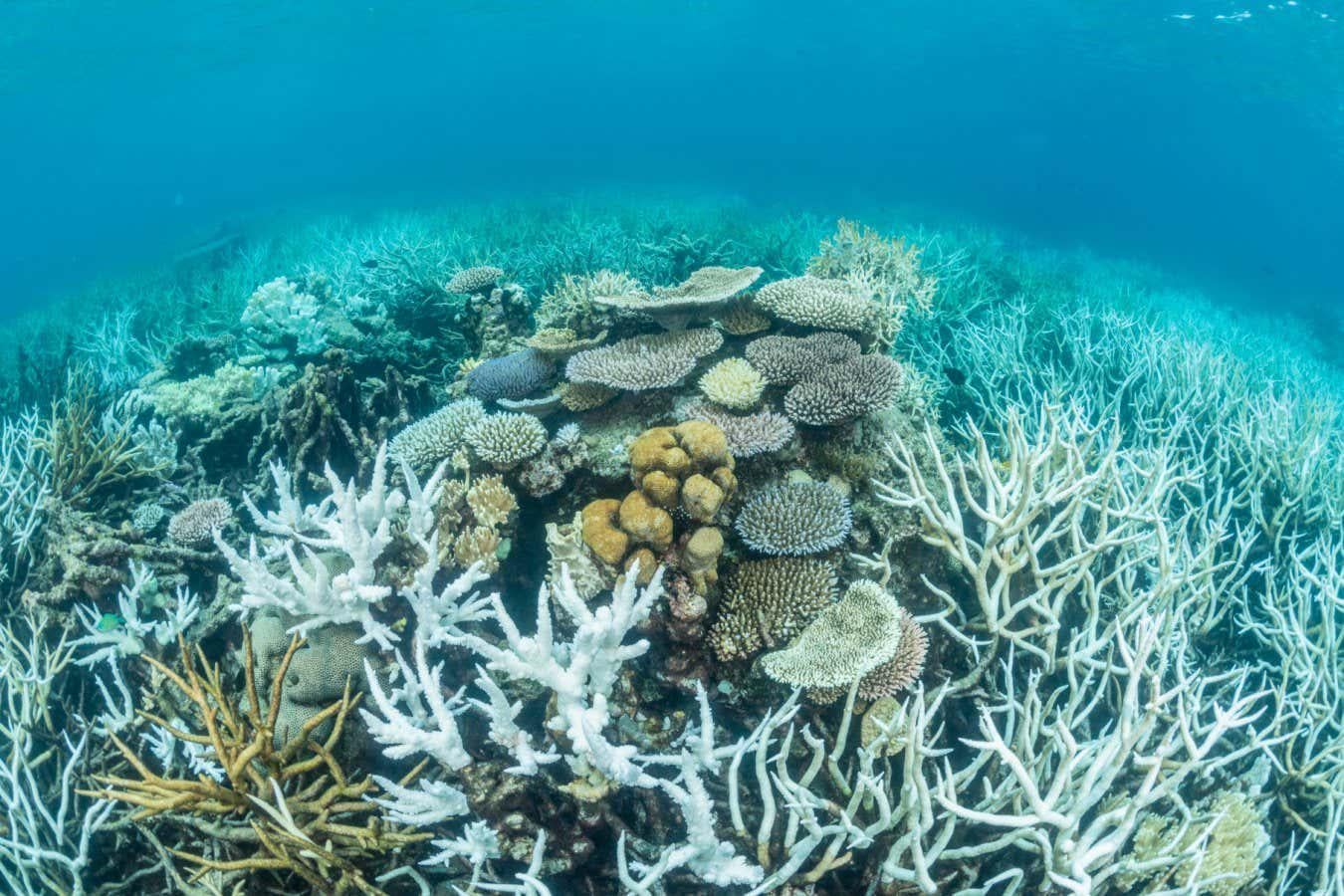
Calls for urgent Marine Cloud Brightening to address Great Barrier Reef heatwaves caused by reduced shipping sulphur
https://www.newscientist.com/article/2487784-artificial-cooling-urgent-for-great-barrier-reef-after-warming-spike/?utm_source=newsshowcase&utm_medium=gnews&utm_campaign=CDAqDwgAKgcICjDKx5gJMNeGbDDEx4gE&utm_content=rundown
by Economy-Fee5830
4 comments
#Artificial cooling ‘urgent’ for Great Barrier Reef after warming spike
*A drop in shipping emissions has caused a surge in warming at the Great Barrier Reef, fuelling calls for drastic actions such as marine cloud brightening to lower the risk of coral bleaching*
By Madeleine Cuff on July 11, 2025
Strategies to artificially shade Australia’s Great Barrier Reef from rising temperatures are urgently needed, scientists have warned, in light of new research that suggests changes to shipping fuels have increased the bleaching risk to the coral.
The Great Barrier Reef has suffered extensive bleaching damage in recent years caused by rising sea temperatures driven by climate change.
Changes to rules governing shipping fuel composition in 2020 have caused additional damage, says Robert Ryan at the University of Melbourne. These changes have reduced emissions of sulphur dioxide, a health-harming pollutant, but also removed aerosols that can enhance the cooling effect of marine clouds over the reef.
Ryan and his colleagues used a computer model to simulate the impact of the changes to shipping fuels on cloud cover and solar radiation above the Great Barrier Reef over 10 days in February 2022. They used the results of previous studies to estimate the impact those changes would have on sea surface temperatures and bleaching risk at the reef.
They found that shipping emissions at pre-2020 levels boosted the cooling effect of clouds over the area, and the rules curtailing sulphate aerosol pollution have removed much of this cooling effect. As a result, the new shipping fuel regulations caused the equivalent of an additional 0.25°C of sea surface temperature heating, and made coral bleaching conditions between 21 and 40 per cent more likely during the 10-day period that was studied.
“There’s been an 80 per cent reduction in shipping sulphate aerosol, and that has likely, we find, contributed to conditions at the Great Barrier Reef which make coral-bleaching events a little bit more likely,” says Ryan.
Bjørn Samset at the Center for International Climate Research in Oslo, Norway, says the research helps to answer outstanding questions about the impact of aerosol pollution reduction on local environments. “Localised aerosol influences are likely quite a lot more prominent than we have been thinking, and their influence on marine heatwaves is still a big knowledge gap,” he says.
But he warned that although the results show “a clear influence from shipping on the air quality and clouds around the Great Barrier Reef”, they cover only a short period, making comparisons with other research in this field tricky.
Ryan is also part of a team working on a method to artificially cool the reef using marine cloud brightening (MCB), a climate-intervention technique that would involve spraying sea salt particles into the air to try to increase the cooling effect of marine clouds.
Such artificial cooling measures are arguably now “more urgent” for the Great Barrier Reef in light of the new findings, the researchers suggest in their paper. “If some part of the marine cloud brightening effect from ships has been removed due to changes in sulphate emissions, then I could see how that might make one wonder whether it should be re-implemented in a targeted programme,” says Ryan.
Daniel Harrison at Southern Cross University in Australia, who also worked on the study, says the findings demonstrate that MCB could work to cool the reef, given that shipping emissions had a similar cooling effect. “What we have here is a real-world study of what was already happening,” he says. “We can see that it was working.”
Harrison has been awarded funding by the UK’s Advanced Research and Invention Agency for a five-year project to trial MCB at the Great Barrier Reef. MCB could help to “take the edge off the bleaching while we hopefully get our act together with reducing emissions,” he argues.
Other experts are much more sceptical, suggesting there is not enough evidence to demonstrate that deliberate MCB could be both safe and effective. Terry Hughes at James Cook University in Queensland, Australia, says trials of MCB to date have been a “complete flop”, failing to produce convincing evidence that it can reduce local sea temperatures at the reef.
Reference: doi.org/10.21203/rs.3.rs-6703506/v1
I’m onboard with this idea; the evidence is strong that sulfur rich marine fuel was unintentionally mitigating climate change.
There are two intertwined obstacles. The first is governance. We need a robust process to build and assess international consensus and consent before we intentionally alter the climate. The second is conspiracy theories; a small but significant subset of Americans are convinced that climate change is a hoax but weather modification is happening. This is, at its root, psychological denial. Emotional relief is obtained by blaming climate change on some secret cabal of powerful people, instead of oneself and one’s peers and ancestors. It is hard to admit mistakes, especially mistakes so great they can be described as “sins”. This blame shifting often involves anti-semitism. There is often a fear of world government. This is not unreasonable, but there are also a lot of problems with the current system of warring nation states.
I think that several forms of climate modification will be feasible in the near future. This one is feasible now, and it saves money rather than costing. Refine bunker fuel less. Unfortunately, I despair of achieving any kind of consensus in the near future that would make any of this possible. I even suspect that people who vote against pollution controls on terrestrial coal power plants and diesel vehicles will somehow oppose returning to the status quo ante of 2019 regarding bunker fuel.
Collective ideas shift greatly over just two or three generations, but that is too slow to keep up with the pace of climate change.
Always wait till it’s too late.
We’re so cooked lmfao
Comments are closed.