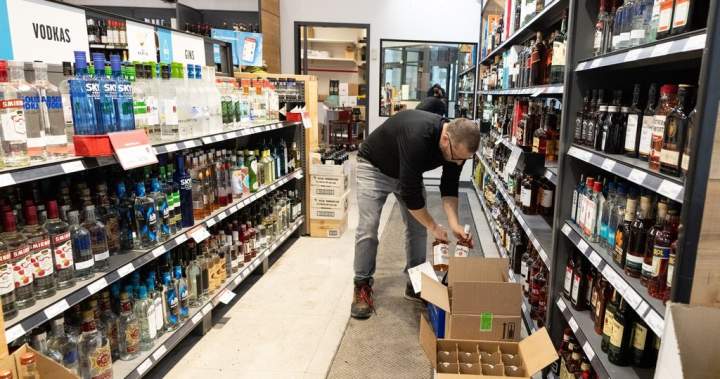
The U.S. spirits industry is reporting a big drop in sales in Canada after multiple provinces pulled liquor off shelves and Canadians turned to buying more goods at home in response to the trade war.

A joint press release by Spirits Canada and the Distilled Spirits Council of the United States shows that from March 5 until April 30, sales of U.S. spirits in Canada fell by 66.3 per cent compared with the same period last year.
Multiple provinces pulled American alcohol off the shelves on March 5 in response to U.S. President Donald Trump’s tariffs and his talk of annexing Canada.
From March 5 until the end of April, Canadian spirits sales also declined, but at a lower rate of 6.3 per cent. Other imported spirits declined by 8.2 per cent.
The two groups said total spirits sales in Canada dropped 12.3 per cent during the same period.
“The North American spirits sector is highly interconnected, and the immediate and continued removal of all U.S. spirits products from Canadian shelves is deeply problematic for spirits producers on both sides of the border,” said Cal Bricker, president and CEO of Spirits Canada.
“The current disruption demonstrates the critical importance of maintaining open, reciprocal trade relationships that benefit consumers, businesses and government revenues in both nations.”
Some American makers criticized the decision by the provinces to pull U.S. liquor off shelves at the time, with Jack Daniel’s maker Brown Forman’s CEO Lawson Whiting calling the move “worse than a tariff.”
“I mean, that’s worse than a tariff, because it’s literally taking your sales away, (and) completely removing our products from the shelves,” he said on a post-earnings call.
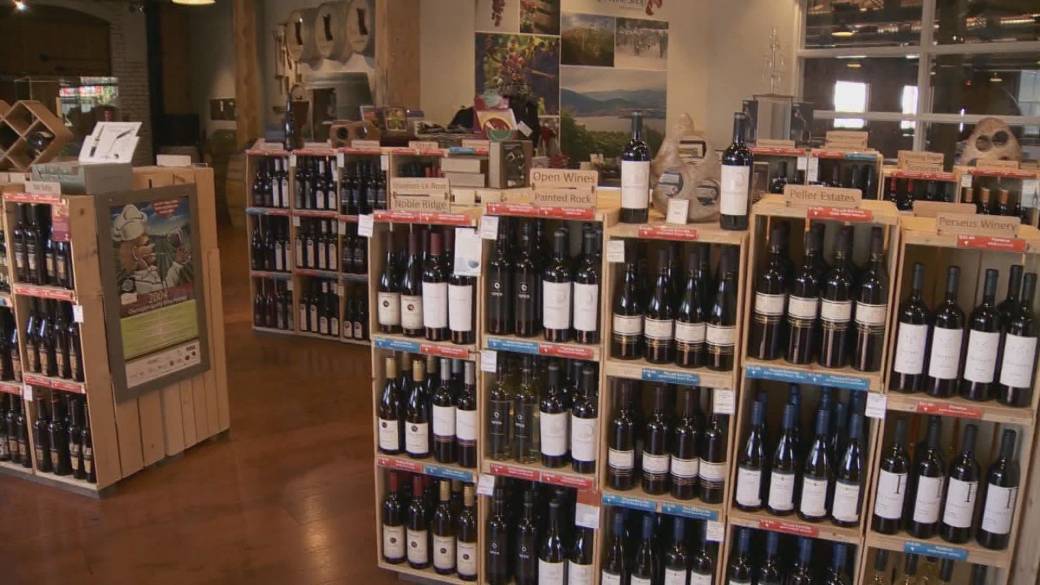
1:56
Cautious optimism after inter-provincial alcohol trade announcement
According to Spirits Canada and the Distilled Spirits Council, total spirits fell sharply by 20 per cent year over year in March.
Canadian spirits sales increased 3.6 per cent in April, with other imported spirits up 3.7 per cent, but the gains didn’t compensate for the losses from U.S. removal.

For news impacting Canada and around the world, sign up for breaking news alerts delivered directly to you when they happen.
Compared with last year, overall spirits sales remained down 3.3 per cent in April, a decline of $13.9 million.
Chris Swonger, president and CEO of the Distilled Spirits Council, said in the joint release that U.S. liquor should be back on Canadian shelves and that the move is “needlessly reducing revenues for the provinces and hurting Canadian consumers and hospitality businesses.”
‘Mean and nasty’ — or doubling down?
Trending Now

Delta pilot’s ‘aggressive manoeuvre’ avoids mid-air collision with B-52 bomber
‘We miss you,’ U.S. senators tell Canada as Lutnick vows tariffs will stay
Months into the trade war, Canadians seem to show no signs of letting up on avoiding U.S. goods and travel — in fact, numbers have grown.
Ipsos polling conducted exclusively for Global News and released in time for Canada Day showed that 72 per cent of Canadians are avoiding U.S.-made goods.
The polling also showed that 77 per cent of respondents think less of the U.S. as a country because of Trump’s attacks on Canada’s economy and sovereignty.
Trump’s ambassador to Canada told a Washington state audience on Monday that the president sees Canadians as “mean and nasty” for refusing to travel to the U.S. and pulling American alcohol.
“That’s their business — I don’t like it, but if that’s what they want to do, that’s fine. They want to ban American alcohol; that’s fine. It doesn’t necessarily send real positive signals in terms of their treating us well,” Pete Hoekstra told the Pacific NorthWest Economic Region Foundation.
More on Canada
More videos
“There are reasons why the president and some of his team refer to Canada as being mean and nasty to deal with, OK, because of some of those steps.”
Hoekstra went on to say he has no problem getting U.S. liquor into Canada, as border officers don’t check his vehicle when he crosses the border.
Global News asked the U.S. Embassy in Canada about Hoekstra’s comments, which they said was in response to a question at the conference.
“Ambassador Hoekstra pointed out that the decision of some Canadian provinces to ban the sale of U.S. alcohol does not contribute to a positive relationship between our two countries,” the embassy wrote. “As Ambassador Hoekstra has expressed on several occasions, the U.S. Government sees the provincial bans on U.S. alcohol as counterproductive to resolving the broader issues.”
The embassy went on to say Hoekstra “emphasized his optimism about the future of the U.S.-Canada relationship.”
British Columbia Premier David Eby, in response to Hoekstra’s comments, urged his province’s residents to double down on their efforts to buy and travel within Canada.
—with files from Global News’ Sean Boynton and Reuters
© 2025 Global News, a division of Corus Entertainment Inc.