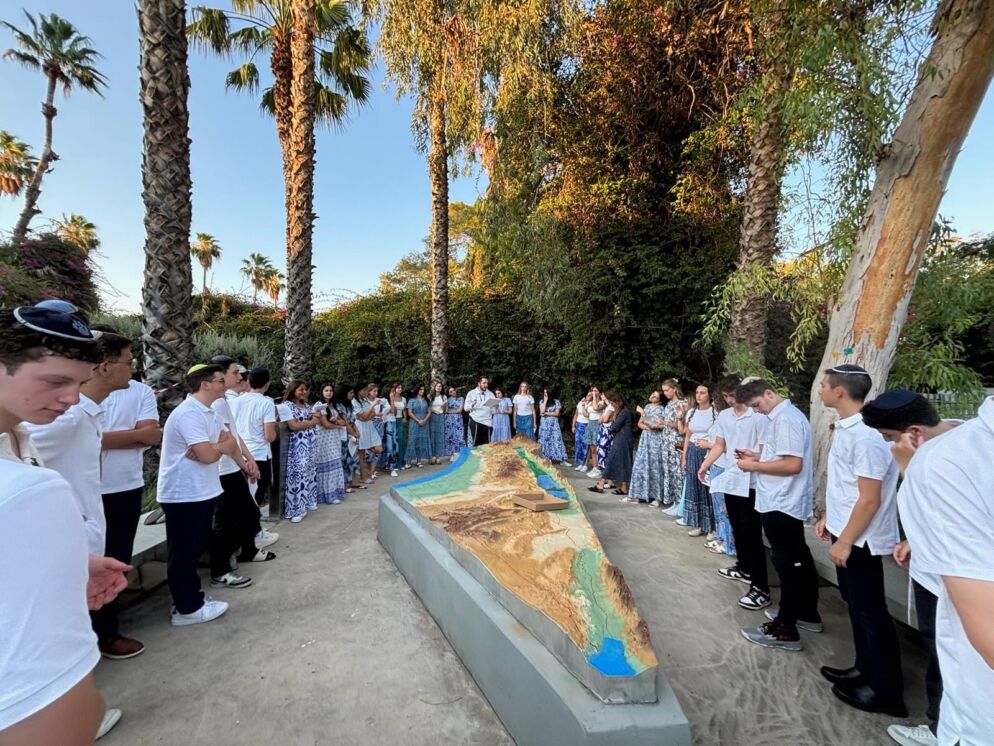
 Mach Hach campers dress in blue and white for Shabbat. (Courtesy of Mach Hach BaAretz)
Before the conflict with Iran, summer programs Mach Hach BaAretz, NCSY, CTeen, and Yavneh’s Na’aleh had plans to send high school students to Israel for a once-in-a-lifetime trip. Teenagers from across the Mid-Atlantic region planned to attend such programs until conflicts arose in Israel.
Rabbi Dan Katz, Mach Hach’s camp director for over 10 years, stressed the importance of bringing campers to Israel.
 Mach Hach campers gather for Mifkad before Shabbat. (Courtesy of Mach Hach BaAretz)
“Israel’s at the forefront of all our education and all our summer camps and local chapters and everything we do. And so for us, the 10th-grade trip to Israel is not just another summer,” he said.
NCSY Summer, an organization that operates trips in the U.S., Europe and Israel for teens with varied Jewish backgrounds and which is run by director Elliot Tanzman, had a similar stance on sending participants to Israel.
While advocating for Israel summer programs, Tanzman understood that trips to Israel were never quite set in stone.
Tanzman said, “Whenever you’re dealing with traveling to Israel, there’s always a sense of uncertainty about what’s going to be happening in Israel at any given time … And that’s important to note, because if you’re signing up for an Israel trip from post-Oct. 7 until now, you, as the parents, you, as a participant, understand that it’s not a regular year.”
Tanzman framed the Israel-Iran conflict in a unique way. He explained that just as last year’s programs underwent setbacks post-Oct. 7, but found a way to remain open, this year they would also be able to run despite the conflict.
Navigating Canceled Plans
Rabbi Mendy Lepkivker, one of the program coordinators for CTeen Summer, shared how the organization navigated the challenges of planning a safe and meaningful summer program for their girls’ and boys’ trips amid the war in Israel.
Rather than immediately canceling trips, CTeen waited as long as possible to see if Israel would become a viable option.
“Our approach was not to immediately drop what we’re doing.” Lepkivker said. “Let’s approach with caution. After all, safety is the highest priority for us as an organization, and we are only going to proceed if, of course, it’s 100% safe.”
 CTeen Girls paying tribute to the millions of Jews that perished in Auschwitz. (Courtesy of CTeen)
Rabbi Nachman Rivkin, the director of CTeen Summer, worked up to 70 hours a week to ensure every program offered a safe and meaningful experience.
He worked with Lepkivker to plan alternative itineraries, including a three-week program in Europe visiting Holocaust sites and heritage locations for a rerouted girls’ trip and a U.S. West Coast program for two French CTeen trips.
While the girls journeyed through Europe, the boys’ group was able to visit Israel as planned.
Their itinerary included stops at the Nova music festival site and the former police station in Sderot, which were directly impacted by the events of Oct. 7.
Rivkin said, “We never want to see any teenager miss out on a meaningful summer experience, which is why we rescheduled for whoever was willing to pivot. We rescheduled every program, whether it was to Europe, to Israel, or to America.”
Tanzman reflected on his organization’s reactions to Israel being shut down. He explained that he and his colleagues had to consider a few essential questions, including how long they could wait to see if things would settle down in Israel and at what point they should activate alternative programming.
He also stressed that “not all programs are created equal,” noting that some had to be adjusted or compromised depending on their departure dates and whether they were a travel-based program or a camp-based program.
Impact of a Cease-Fire
Prior to the announcement by President Donald Trump of the cease-fire between Israel and Iran, NCSY was prepared to communicate with parents if programs had to be canceled.
“We actually had an email ready to go with what our alternative plans were going to be … all boys options, all girls options, co-ed options, travel-based, campus-based. We had a slew of different options that we were literally ready to send out,” Tanzman said. “We told parents that six days prior [to the program’s departure] we were going to communicate.”
Luckily, six days before NCSY programs Kollel and Michlelet left, the cease-fire was announced.
Travel plans were made only once security teams approved them. Only 22 out of 900 kids didn’t go on NCSY’s scheduled trips.
 Mach Hach bus arrives at the Western Wall. (Courtesy of Mach Hach BaAretz)
Mach Hach had a similar procedure.
When all flights to Israel were canceled, Katz sent an email to parents with two alternative plans to ensure that Mach Hach campers would still have a fun, Zionist experience.
These plans included a shorter trip with a charter flight, or if Israel remained shut down, a program in the U.S. for the kids during the second half of the summer.
About 30 minutes after sending the email, Trump announced the cease-fire.
One day later, Katz received a clearance from their security consultants for the trip. They would even be able to run a fuller itinerary than the previous summer.
“They said that they were going to return to the regular flight schedule in time for our start date of the trip,” said Katz. “We basically gave parents 24 hours to let us know if they were in. And out of our 570 families, 564 came.”
During the 24-hour window, Katz opened his calendar in case any parent wanted to discuss their concerns.
“After those calls, [most of them were saying] that they felt everything was [OK] for them,” Katz said.
Refunds
Refunds were a more complicated matter.
For NCSY, when security personnel decided it was safe to travel to Israel, Tanzman decided to revert to the original refund policy.
“Even though our official policies were reinstated, we hope to work with those parents that canceled and extend a partial refund if we are able to [get a refund] from our venders. And if that’s the case, then our refund and withdrawal policies are back in full effect,” Tanzman said. “Our official policy is, if you’re not joining us, if we are able to [get a refund] from our vendors, we would try to work with you to the best of our ability.”
 Mach Hach bus at Kfar Kedem. (Courtesy of Mach Hach BaAretz)
Mach Hach took a different approach and ensured a very flexible refund option in which parents who decided not to send their kids on the trip were completely refunded, aside from the $1,000 deposit they had already put down.
Katz assured parents that they “didn’t want anybody to be forced” to make the decision of sending their child if they were uncomfortable.
A Parent’s Perspective
The mother of a Baltimore girl who had originally planned to attend NCSY Give, a chesed-focused summer program in Israel, had a close family member who persuaded the daughter to remain home.
Recognizing that this family member wouldn’t change their mind, the mother explained that her daughter said, “It is more important to me to have this relationship with this family member than my dream to go to Israel.”
Afterward, the family was comforted by a message from Give director Erin Stiebel, who wrote, “I can’t wait to see what this summer brings [for your daughter].” Stiebel added that the girl would come to understand why she had to miss this trip.
The mother felt that this thought was “just really insightful and impactful, and I’m grateful for her giving me that insight.”
Although she missed out on a summer of giving in Israel, this girl found meaningful ways to give back locally, delivering food to a community member who was hospitalized and assisting a single mother with her move. Her family has dubbed this unexpected series of chesed opportunities “Give Baltimore.”
Staffing Issues
Camp Yavneh, a sleepaway camp, faced major disruptions to its signature Israel trip for rising seniors, Na’aleh, a five-week travel and leadership experience.
Rather than wait for news on when the country would reopen to tourists, camp director Jane-Rachel Schonbrun acted quickly.
It soon became clear to Schonbrun that Yavneh’s Israel program wasn’t the only summer camp that would require changes.
As both the sleepaway and travel camp director, Schonbrun faced challenges that were twofold — and ironically opposite.
 Na’aleh group when they arrived in Israel (Courtesy of Camp Yavneh)
The Israel travel program was temporarily shut down due to the lack of flights into the country, while the New Hampshire camp struggled with staffing shortages as about 30 Israeli counselors were unable to leave Israel.
Schonbrun’s solution? Bring all of the Na’aleh campers to New Hampshire and give them junior counselor roles to help cover staffing gaps.
Though this plan fixed their logistical problems, Schonbrun said the camp felt empty without their Israeli staff members.
“We don’t hire Israeli [staff members] just to fill roles. We hire them because it’s really important to us to have a big presence of Israel at camp,” Schonbrun said.
 Shlichim arrive at Camp Yavneh. (Courtesy of Camp Yavneh)
About a week after filling the staff positions with rising seniors, the Israelis finally arrived, prompting a daily scramble to adjust plans and provide housing for twice the expected number of staff.
“We have had to be very creative. We did have to order some new beds and mattresses and open some spaces that were not open before, but we’ve made room,” Schonbrun said.
Once flights began taking off to Israel again, Schonbrun’s first priority was ensuring that the campers would be able to return to America at the end of the program. After a few days, it became clear that everything in Israel was opening up.
“We really scrambled, and in about four days ended up confirming tickets and a modified itinerary and sending the kids,” Schonbrun said.
She added, “We really just tried to keep [our] perspective on things. As stressful as it was for us to have to reconfigure our program, we weren’t going through the stress that people in Israel were going through.”
Shmarya Gasner, who oversees specialty staff at Camp Moshava Indian Orchard in Honesdale, Pennsylvania, described a similar start to camp.
During the staff preparation week prior to camp, close to 100 staff members were stuck in Israel. Even after camp had begun, another 100 children living in Israel were unable to get flights to camp.
Moshava was faced with two options: hire inexperienced, untrained teenagers who may only stay for two weeks, or find former staff members to fill essential roles.
“We were missing people in the kitchen. So a board member came in and started working in the kitchen. Then you had other positions that were more technical, that you could just step into with a little bit of someone telling you how things work. We were missing three nurses. We were missing the person running the Gan program, a day camp for the staff kids,” Gasner said.
Gasner explained that the camp directors were hoping to find people who would be flexible.
“We created a list of people we knew were available and could say, ‘We may need you for one day to two weeks — we just don’t know.’ We had to gently say, ‘We don’t know how long we need you for. Can you be here?’ And when the Israelis could come, we didn’t want to be rude and say, ‘Oh, you have to leave now,’ because there’s limited housing,” Gasner said.
The camp relied heavily on alumni connections, board members pitching in and people who had worked at camp in previous years, almost all with existing ties to Moshava.
In the lead-up to the summer, Gasner noted that many parents had called him to ask if the camp would run. He reassured them that it would.
“People might not understand how much happened behind the scenes, but a lot did happen behind the scenes to open with 1,500 people on day one, and now we’re up to 1,700. It’s no small feat,” Gasner said.
The Why
With Israel being a core value of these summer programs, the various programs expressed pride in being able to stick with most of their initial plans for giving their campers an Israeli connection, and rework those that fell through.
Despite initial concerns about cancellations, several program organizers expressed gratitude to leadership, parents and campers for keeping their desire to have the Zionist summer camp experience they were promised.
 CTeen Israel Journey paying their respects at the Nova musical festival massacre site.
(Courtesy of CTeen)
“A lot of these kids are learning in public high schools and they’re experiencing antisemitism. Coming on such a trip and seeing firsthand what’s going on, it gave them such resilience, such pride in who they are and who they stand for,” Lepkivker said.
“A meaningful Jewish summer for a teenager is priceless. You cannot really put a price tag on how transformative a summer could be for a teenager. Regardless of where they visit, our goal is to give them a meaningful Jewish experience,” Rivkin said.
Amy Hollander is a Washington Jewish Week intern.