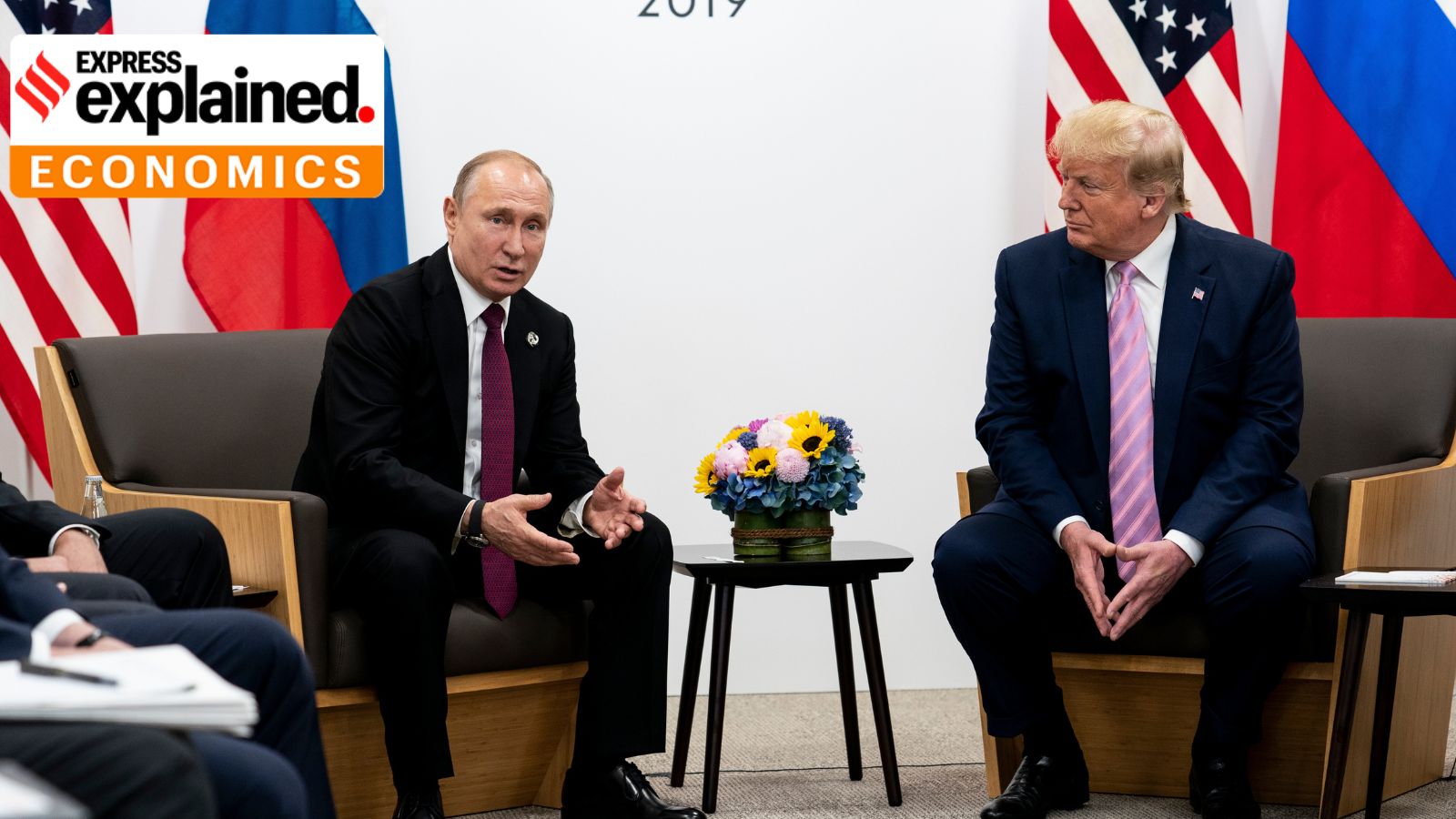
US President Donald Trump seems frustrated with his Russian counterpart, Vladimir Putin, over the war in Ukraine, clearly wanting the over three-and-half-year-old war to end, while Putin appears unyielding. The American president, meanwhile, believes he has a lever he can use to push Putin’s buttons.
That lever is India’s significant oil imports from Russia. Trump has been berating India over its Russian oil imports and pressuring New Delhi into cutting down on imports from Moscow in the hope that threatening or penalising a key trade partner would force the Kremlin’s hand into ending the war in Ukraine.

While Trump evidently finds it convenient to go after India on the issue at a time when New Delhi and Washington are locked in tense trade pact negotiations, it is worth noting that the US had a major role to play in India ramping up oil imports from Russia, for which New Delhi is now being vilified by Trump and his administration. Over the course of the war in Ukraine, US officials have publicly stated that India’s purchase of Russian oil had Washington’s endorsement, at least implicitly.
In his latest salvo, Trump on Monday threatened that he will “substantially” raise tariffs on New Delhi for profiting from exporting fuels derived from Russian oil. Trump’s latest attack came just days after he announced 25 per cent tariffs and an unspecified “penalty” on India for its defence and energy imports from Russia.
Responding sharply to Trump’s remarks, India said that while it has been targeted by the US and the European Union for importing oil from Russia, these imports began as its traditional supplies were diverted to Europe, and the US at that time had “actively encouraged such imports by India for strengthening global energy markets stability”.
With Washington’s blessings
When Russia invaded Ukraine in February 2024, Moscow’s share in New Delhi’s oil imports was less than 2 per cent. The reasons were obvious: Russia was geographically distant and already had established markets where a bulk of its crude was exported. India, on the other hand, depended significantly on West Asian suppliers like Iraq and Saudi Arabia, which are located close by.
With much of the West shunning Russian crude following the invasion, Russia began offering discounts on its oil to willing buyers. Indian refiners were quick to avail the opportunity, leading to Russia—earlier a peripheral supplier of oil to India—emerging as India’s biggest source of crude within a matter of months, displacing the traditional West Asian suppliers. Russia now accounts for 35-40 per cent of India’s total oil imports by volume. As Europe decided to stop the import of refined petroleum fuels from Russia, Indian refiners increased fuel exports to the continent.
Story continues below this ad
Besides alleging that India was helping fund the war in Ukraine by buying Russian oil, critics of India’s oil and fuel trade argued that the country’s refiners were facilitating a backdoor entry into Europe for fuels made from Russian crude. There was, however, nothing illegitimate about this trade, as there was no specific ban on fuel imports from countries that were buying Russian oil. That ban has now been announced by the EU and is slated to take effect from January 2026.
Despite the noise from sections of the West against India over the country’s hefty purchases of Russian crude, this shift in oil and petroleum product trade had Washington’s blessings, as the US wanted energy markets to remain stable and well-supplied. In a recent interaction with CNBC International, global energy expert and Rapidan Energy Group President Bob McNally said that it was the Biden administration that “begged” India to buy Russian crude to keep global energy prices in check.
“The Indians must be having some confusion (due to Trump’s stance) because Joe Biden went to India after the invasion of Russia and begged them to take Russian oil…they begged India, ‘Please take the oil’, so that crude prices would remain low, and they did. Now we’re flipping around, saying, ‘What are you doing taking all this Russian oil?’ The point is Trump is serious…he is frustrated with Putin,” said McNally, who served as the Special Assistant to the President on the White House National Economic Council and Senior Director for International Energy on the National Security Council during George W Bush’s first term as US President.
India’s actions in line with US policy: Biden era officials
Story continues below this ad
Various US government officials during the Biden presidency also publicly acknowledged that India’s actions helped balance the international oil market and were in line with what the US wanted in order to keep the global market well-supplied. Had most of the Russian oil gone off the market—as happened with Iran and Venezuela—international oil prices would have shot up, which would have hit the global economy that was still fragile coming out of the pandemic.
At an event in May 2024, the then US Ambassador to India Eric Garcetti said, “Actually, they (India) bought Russian oil because we wanted somebody to buy Russian oil at a price cap. That was not a violation or anything. It was actually the design of the policy because, as a commodity, we didn’t want oil prices going up, and they fulfilled that.”
Garcetti was correct, as Russian oil was and continues to be sanction-free, and only a price cap of $60 per barrel was introduced in December 2022 on seaborne Russian crude by the US and its allies. The cap prohibits export of Russian seaborne crude at over $60 per barrel if the trade involves Western shipping or insurance services. Oil importers like India, which are not part of the price cap coalition comprising G7 countries and their allies, are not bound by the price cap as long as their purchase of Russian oil does not involve any shipping or insurance service from providers in the coalition countries.
In April last year, senior US officials had said at a New Delhi event that the US neither expected India to reduce its oil imports from Russia nor had it even requested it to do so. The then US Treasury Assistant Secretary for Economic Policy Eric Van Nostrand had said that the objective of the sanctions and G7 price cap regime was not to push Russian crude out of the market, but to keep it flowing while limiting the Kremlin’s revenue from oil exports, which in turn impaired Russia’s ability to fund the war in Ukraine.
Story continues below this ad
“The price cap is designed to leave Russia with only bad options…We want him (Putin) to choose between three bad things: selling with coalition services under the price cap, selling outside the price cap, or shutting his oil in and not putting it to market. With a strong and robust price cap regime, Putin is going to prefer to sell as much as he can outside the price cap. But in order to maximise his sales outside the price cap, when a large part of the global coalition is already involved in the price cap, he is going to have to offer it cheaper,” Nostrand said.
Anna Morris, the then US Assistant Secretary for Terrorist Financing and Financial Crime, said at the same event that from a technical standpoint, Russian oil once refined into petroleum fuels and products could no longer be considered of Russian origin, dismissing the argument that Indian refiners were facilitating Russian petroleum’s entry into Europe.
“I also want to specify that once Russian oil is refined, from a technical perspective, it is no longer Russian oil…If it is refined in a country and then sent forward, from a sanctions perspective, that is an import from the country of purchase, it is not an import from Russia,” Morris said.
While the Biden administration seemed satisfied with the price cap and letting Russian oil flow, Trump has taken a much more aggressive stance, threatening financial costs on importers of Russian energy.