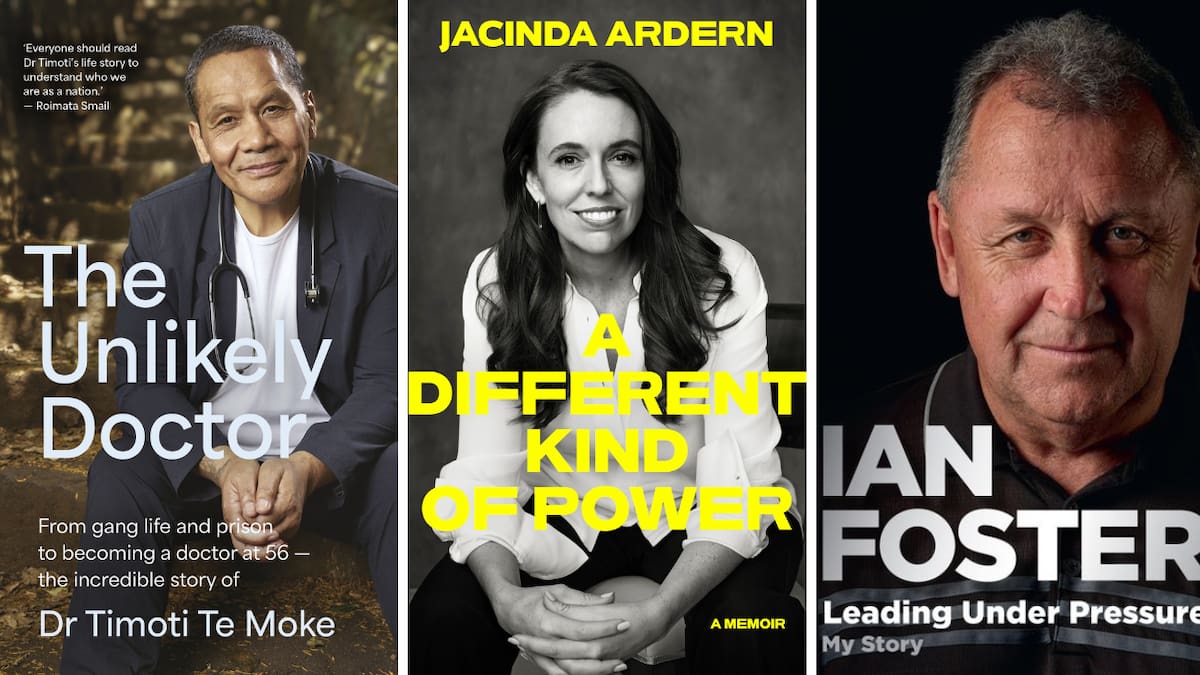
Memoirs prove popular picks for NZ readers. Photos / Supplied
Mark Broatch
1. (NEW) The Unlikely Doctor by Timoti Te Moke (Allen & Unwin)
Rocketing into the number one spot is Dr Timoti Te Moke’s memoir of becoming a doctor at the age of 56.
From the publisher: “Born into love but then thrust into violence and shaped by struggle,
Timoti Te Moke was never destined to be a leader. After an early start as a bright boy in the eastern Bay of Plenty, nurtured by his reo M�ori-speaking grandparents, Timoti’s life changed sharply when his mother took custody of him when he was 6. He survived abuse, state care, gangs and prison, his life marked by trauma and pain.
“By 14, he was behind bars. By 20, he’d crossed the Tasman, trying to leave his past behind. But it was a moment in a prison cell – a glimpse of blue sky – that sparked a life-altering question: What if this isn’t all there is?
“Through grit and an unyielding drive for justice, Timoti transformed his life. He returned to Aotearoa, became a paramedic and, after facing racism and an unsupported manslaughter charge that nearly derailed his life, became a medical student in his 50s. Timoti is now a fully qualified doctor – proof that brilliance can come from anywhere, and that our society must change to allow it.�
2. (1) A Different Kind of Power: A Memoir by Jacinda Ardern (Penguin)
The former PM’s memoir, the first such account since Jim Bolger’s, drops from the top spot after holding it for seven weeks.
Ardern’s book has generally found favour among reviewers, including Henry Cooke for the Listener. He thought it intimate and fluent, “compulsively readable, easily consumable in two or three sittings, and often very funny�, even if it barely explained her government’s policy decisions. “Ardernism was always more a sensibility than a full ideology. It was a way of looking at the world and reacting to it, not a theory of change.� Cooke says “there are some hints, near the end of the book, that perhaps she isn’t so certain quitting was the right idea … There is little attempt to engage with the arguments against the latter half of the Covid period, when MIQ’s usefulness looked shaky and vaccine mandates radicalised thousands of people.�
Tracy Watkins, editor of The Post and Sunday Star-Times, agreed the book let us into some of Ardern’s emotional highs and lows. “We also gain some fresh insight into her own personal mechanisms for coping with such momentous events as the terror attack, and Covid. But we don’t learn a lot more about what was going on behind closed doors within her government, which must, at times, have been under enormous strain.�
Discover more
The Guardian considered it “an emotionally rich and candid read, [but] the downside of skipping the political detail is that it’s hard to get a sense of how exactly her astonishing early popularity ebbed away�.
Tim Stanley of The Telegraph was more acerbic, writing that “the practicalities of the job don’t interest her: this book hinges on how everything felt�. The natural disaster at Whakaari White Island and the Christchurch mosque killings “brought out Ardern’s best: authoritative and sensitive, she has a fine temperament�. But she subtly vilified her opponents, he says: “I am so kind that anyone who disagrees with me must be nasty; so reasonable that my critics must be nuts.�
3. (3) Leading Under Pressure by Ian Foster & Gregor Paul (HarperCollins)
Demonstrating the rule that rugby memoirs are a sure bet in NZ, Ian Foster’s account of his time as All Blacks coach remains near the top of the bestsellers. I haven’t read Foster’s book, but I hope it goes into the – in my opinion – unedifying way he was replaced as coach. Only super-retrospective refereeing stopped his team of All Blacks winning the RWC.
From the publisher: “Appointed as head coach in 2019, Ian Foster led the All Blacks through one of the most tumultuous periods of the team’s 120-year history. Leading Under Pressure is a fascinating look into the pressure-cooker inner sanctum of the world’s most famous rugby team. With revelations about Foster’s time in the job, it also delves into the politics of rugby, and the events preceding the dramatic 2023 Rugby World Cup.�
4. (2) Polkinghorne by Steve Braunias (A&U
Journalist and Listener columnist Steve Braunias’s account of New Zealand’s trial of the century so far.
From the publisher: “With unparalleled access to the key players, Braunias offers readers his unique insight into the investigation, the trial and the astonishing revelations that kept the New Zealand public utterly transfixed.
“The death of Pauline Hanna in her home in Remuera, and the arrest of her husband, eye surgeon Dr Philip Polkinghorne, led to an epic trial that played out like a scandalous exposé of rich Auckland life. Braunias pieces it all together and presents it as an unforgettable opera – including an extraordinary encounter that will leave readers stunned.�
You can read more about Steve Braunias’s crime writing here and an extract from the book here.
5. (NEW) Underworld by Jared Savage (HarperCollins)
NZ Herald journalist’s latest book about New Zealand’s world of gangs and organised crime.
From the publisher: “The brutal execution of an innocent man. The undercover DEA agent who fooled the Hells Angels in a 400kg cocaine plot. The brutal execution of a not-so innocent man. The never-ending quest to bring down New Zealand’s most wanted gangsters. These stories read like a crime novel – delving down into a parallel universe that many do not know even exists: the underworld.
“Jared Savage’s first book, Gangland, traced the evolution of the methamphetamine drug trade in New Zealand from the late 1990s to 2020. His second book, Gangster’s Paradise, focused on stories about the escalation of organised crime: more drugs, more guns, more money. Underworld follows that pattern but now the situation is even more dangerous. The stakes even higher.�
6. (6) No, I Don’t Get Danger Money by Lisette Reymer (A&U)
Waikato-born Reymer, after covering the Tokyo Olympics, found herself in the UK, where she became Newshub’s Europe correspondent. She burst into tears when she got the job, which the Listener’s reviewer found instantly endearing.
“Her next three years were ‘London, August 2021 … Przemysl, Poland, March 2022 … Bucha, Ukraine, May 2022 … Kahramanmaras, Turkey, late April 2023 … Tel Aviv, late October 2023 …’ So it goes, with other locales in between, ending in Ethiopia, Lucerne, London again, and Barcelona, August 2024.“Her commitment to catastrophes starts with watching the Twin Towers fall on Mum and Dad’s TV. It’s the first of many, many narratives in a text that’s anecdotal rather than analytical. But then, stories are frequently the best way of getting to the guts of an issue, and Reymer tells hers with clarity and competence-plus.�
7. (4) The Book of Guilt by Catherine Chidgey (Te Herenga Waka University Press
Holding its own on the list is Catherine Chidgey’s much-praised latest novel, which tells the mysterious, ominous story of three boys in an alternative 1970s Britain.
It’s a “tense, compelling, genre-fusing book�, said Emma Neale in the Listener. “There is the hint of submerged identity; of aspiration and prosperity, rubbing skins with disappointment and neglect; a preoccupation with what is authentic and what is fraudulent; the self and truth only dimly visible … Calling on the deeply rooted psychological power of the storytelling rule of three, the novel is divided into The Book of Dreams, The Book of Knowledge and The Book of Guilt. Three women, Mother Morning, Mother Afternoon and Mother Night, care for a set of 13-year-old triplets in an all-boys’ orphanage. There are three main narrative perspectives: Vincent, one of the triplets; the Minister of Loneliness, a government minister in charge of national care institutions known as the Sycamore Homes; and Nancy, a young girl kept in seclusion by fastidious older parents. This attention to pattern also coolly embodies the quest for order and control, the troubling obsession at the core of the fictional investigation.�
You can read Michele Hewitson’s interview with Catherine Chidgey here.
8. (8) Hairy Maclary and Friends: Little Learning Library by Lynley Dodd (Picture Puffin)
Four books in a handy case to start your child’s own Hairy Maclary mini-library for just $16.
From the publisher: “Little ones love to learn with rascally Hairy Maclary and his rollicking gang! Introducing important first concepts including the alphabet, counting to 10, colours and opposites, this delightful tiny board book collection in a slipcase makes a perfect first library for the youngest fans of Hairy Maclary and his friends.
“Each little learning book is populated with Lynley Dodd’s much-loved characters getting up to their usual antics, and large, simple text. The sturdy board pages are the ideal size for little hands to hold and durable enough to withstand the rough and tumble of toddlers. Pulling the books out and returning them to their slipcase provides a fine-motor challenge, and the four books also make a 4-piece puzzle that combines into a gorgeous illustration.�
9. (NEW) Hairy Maclary from Donaldson’s Dairy by Lynley Dodd (Puffin)
Board book of the first Hairy Maclary title, introducing the iconic terrier and his friends, Hercules Morse, Bitzer Maloney, Muffin McLay, Bottomley Potts and Schnitzel von Krumm.
“Out of the gate
and off for a walk
went Hairy Maclary
from Donaldson’s Dairy
“Hairy Maclary’s friends join him for a walk until, with a sudden yowl, a wail and a howl, they all run off. What could have caused such a scatter of paws?�
10. (RETURN) A Dim Prognosis by Ivor Popovich (A&U)
Ivor Popovich’s A Dim Prognosis opens with the horrors of the Whakaari White Island eruption. The hospital he was rotated to a few years into the job had the country’s mains burns ICU. Alongside a lively procession of cases he’s attended to, he notes, like all places, work culture issues, technology problems, tribalism, responsibility shifting. Though not all workplaces have people’s lives in their hands. The book is candid on the ethical quandaries around patients, tactless and sometimes bullying senior doctors and the black humour of the trenches, but at the book’s heart is the stark calculus of a rapidly ageing population, medical advances, the public-private nexus and an improperly resourced health service. “Healthcare is a zero-sum game.�
Popovich, who either kept a diary or has a remarkable memory, as he reports complex verbatim conversations, does offer suggestions on how to improve matters. Most involve more spending. But also better management, such as many older patients who should be elsewhere – in care, rest homes, dementia units, hospices – and triaging these people to better situations would seem a major step forward.
Source: NielsenIQ BookScan – week ending August 2.
Reminder, this is a Premium article and requires a subscription to read.
Copy LinkEmailFacebookTwitter/XLinkedInReddit