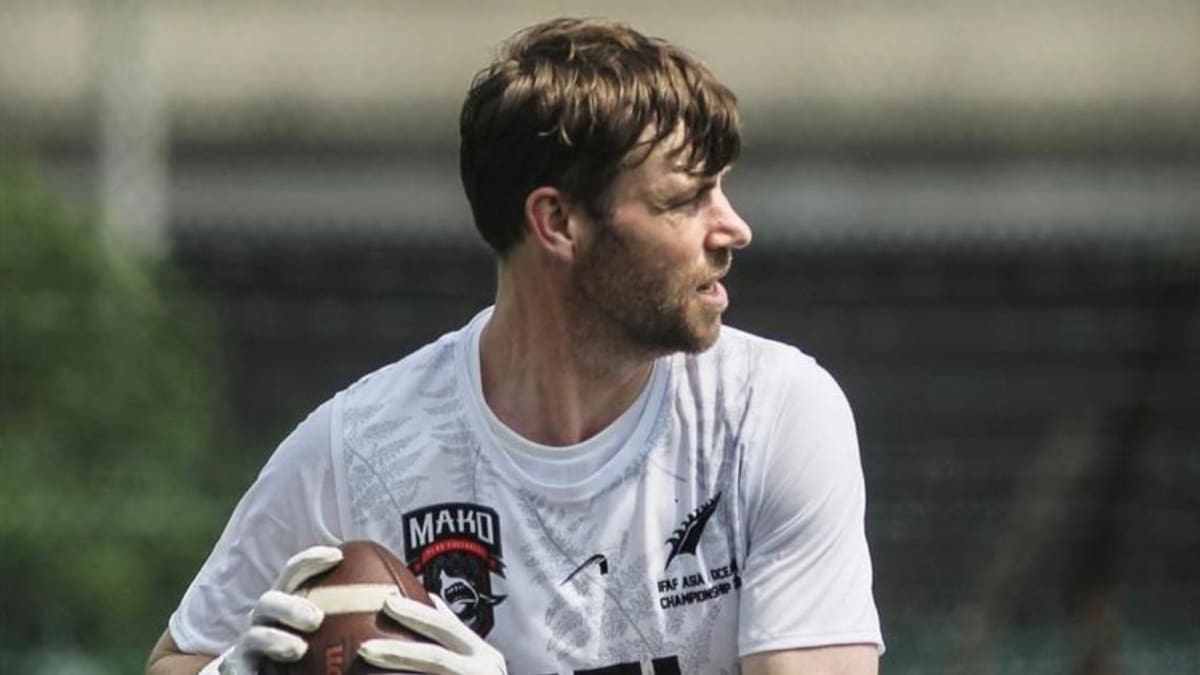
Flag football is a condensed, five-a-side version of American football. Blockers and contact tackles are replaced with rippa-rugby style tags, but the foundations of the game, such as set plays and the forward pass, are still hallmarked.
Kiwis who grew up playing rugby or touch possess transferable skills, but the key for international success is to improve the foundations and professionalisation, Fabela said.
It’s a journey with many steps, the first stop being the Intercontinental tournament in China, spanning from October 23-27.
“[There’s] no choice but to win the gold medal to secure our spot,” Fabela said, referring to qualification in the 2027 World Championships in Finland.
These two events and another Intercontinental in 2027 are the side’s best hopes of securing a top-six world ranking and a place in the 2028 Olympics.
New Zealand currently rank 13th in the world.
“Some would say it’s impossible – I don’t believe that. I believe we have the right coaches and athletes to compete,” Fabela said.
“We need to treat ourselves as high-performance athletes and act like we’re going to the Olympics.”
It’s a challenge Fabela has already begun to address, including through holding a camp at Wellington’s New Zealand Campus of Innovation and Sport (NZCIS), the nation’s premier high-performance training facility.
“If we want to win, this is where we need to be. This is where all the best athletes in our country at their craft are preparing.”
Defender Tom Rance has been part of the national set-up since 2023 and said Fabela’s new approach has elevated the team to new heights.
“I think the team’s definitely got a lot more professional and the programme which Myke’s taken over this year – he’s really lifted it.”
Rance highlighted the importance of the NZCIS experience for the players, given the purely amateur nature of the sport.
“As a small sport, it’s all self-funded. It is hard for some of us to keep making these commitments, and the last thing we want to do is price out players.”
And the top side have an increasingly large pool of talent from which to draw from.
From just 16 teams competing in a national tournament in 2020, this year there were 50.
“I think it’s grown massively because people have experienced the culture, and it just feels like you’re one huge community,” Fabela said, adding that the code has grown three to four times faster than he thought it would, “and now that the Olympics have happened, that growth will be extraordinary’.
Women’s side have bigger mountain to climb
The men aren’t the only team striving for Olympic glory.
The head coach of the national women’s flag football side, Jono Entwistle, said it’s a “long shot” for his side (currently ranked 15th) to make the cut, but he believes his team has the ability and the want to perform.
“What’s super cool about these wāhine is their hunger to learn,” Entwistle said.
“They want every part of it; they want the film study, they want the technical breakdown, and they want the written feedback.”
Like the men, it’s a “year-on-year” process in terms of qualification, with the biggest work-on being installing the finer, more technical sides of the game.
“We don’t have some of those fundamentals that really translate,” Entwistle said.
“We do have a long-term plan, but right now we’re really focusing on the short-term plan of performing at continentals so the campaign can keep rolling.”