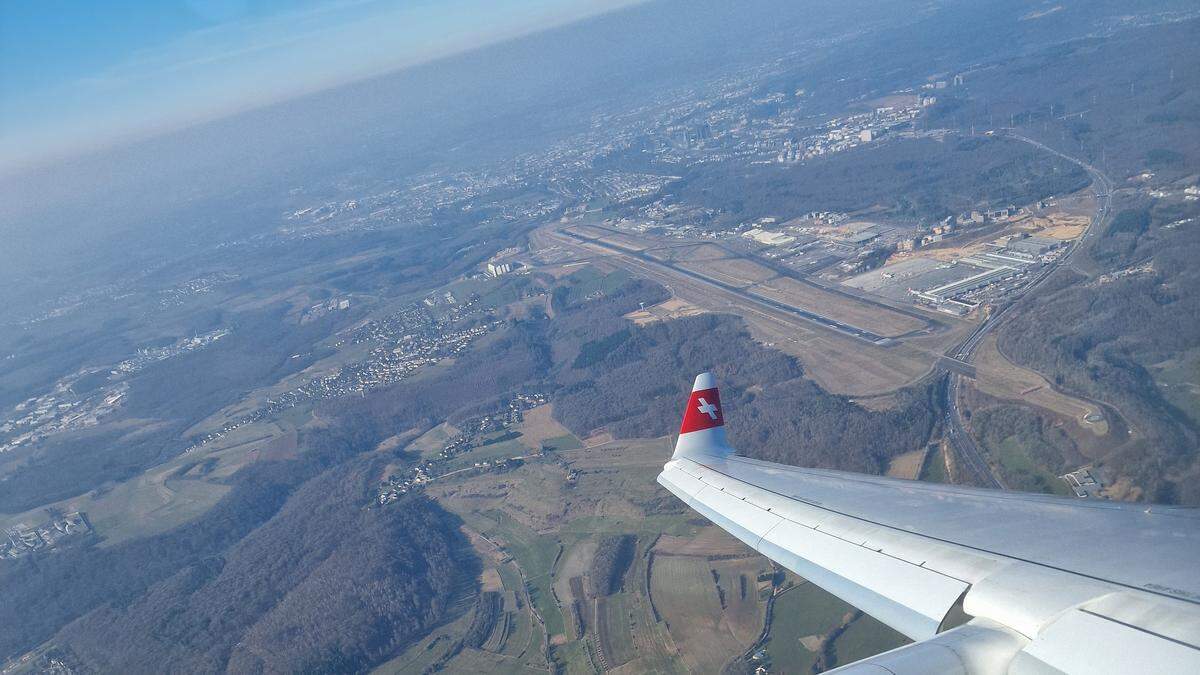
“Even with a larger terminal, we will reach our limits again at Findel at some point,” Transport Minister Yuriko Backes said in an interview with the Luxemburger Wort at the end of July.
“That’s why I would say that Luxembourg needs a new airport in the long term. We’re not talking about next year or in ten years, but perhaps 2050. We are now working on anticipating the next 20 or 30 years,” Backes said.
Her comments have sparked debate, especially whether a completely new location is really needed. After all, the tram line to Luxembourg Airport has only just been opened.
The main reason, however, is the limited space available on the Findel site. “Two runways are not possible on the existing site,” Backes said, explaining the limited growth opportunities.
Around five million passengers fly from the country’s sole airport every year, in addition to 830,000 tonnes of freight. Backes has predicted that the airport will be dealing with eight million passengers annually by 2040.
Also read:Luxembourg will need a new airport in long term, transport minister says
A look at a selection of other international airports may help to answer the question of whether this forecasted increase in passenger numbers really requires a second runway in the long term. As a single-runway airport, Luxembourg is anything but an isolated case.
43 million passengers – London Gatwick
London Gatwick actually has two runways, but is not allowed to use them in parallel operation due to the insufficient distance between them © Photo credit: Shutterstock
Technically, London Gatwick has two runways, but they cannot be used in parallel operation due to insufficient spacing.
The British capital’s second largest airport therefore operates as a single-runway airport and was ranked 10th in Europe in terms of passenger numbers last year with 43 million, which included heavyweights such as London Heathrow (two runways), Frankfurt (four runways), Istanbul (three runways), Paris (four runways) and Amsterdam (six runways).
In terms of aircraft movements, Gatwick was well ahead of Luxembourg, with 265,358 last year, compared to 92,862 flight movements in the Grand Duchy in 2023.
Gatwick lagged well behind in terms of air freight compared to Luxembourg, with around 100,000 tonnes in 2024.
Almost 30 million passengers – London Stansted
London Stansted, 60 kilometres outside of central London, is by far the largest Ryanair base © Photo credit: Shutterstock
With just under 30 million passengers last year, London Stansted, 60 kilometres outside of central London, is well ahead of Luxembourg, and the British airport also recorded around twice as many flight movements last year, at 201,031.
The Irish low-cost airline Ryanair, which operates its largest base at Stansted, accounts for the largest share of this.
In terms of freight business, Stansted is stronger than Gatwick with almost 300,000 tonnes, but still significantly below Luxembourg.
Also read:Where should Luxembourg’s new airport be located?
25 million passengers – San Diego
A British Airways Boeing 747-400 on final approach to San Diego Airport in California © Photo credit: Shutterstock
The airport in the Californian metropolis of San Diego is even closer to the city centre than the airport in Luxembourg.
Specifically, only around two kilometres separate the runway from downtown San Diego, while Luxembourg’s city centre is more than four kilometres away from the airport runway.
Due to their proximity to the city centre, both airports have to contend with similar problems, as expansion, particularly with regard to an additional runway, is also virtually impossible in San Diego.
Nevertheless, with more than 25 million passengers and 227,592 flight movements last year, the airport is well ahead of Luxembourg.
Intercontinental flights in large aircraft and authorised landings at night (but not take-offs) also contribute to this.
However, the Grand Duchy is clearly ahead in terms of freight volume, with 114,525 tonnes travelling through San Diego last year.
17 million passengers – Milan Bergamo
Milan Bergamo benefits from the uniformity of aircraft types used by low-cost carriers. © Photo credit: Shutterstock
The northern Italian airport Bergamo, which is often marketed by low-cost airlines as “Milan Bergamo”, is the second largest of three airports in the metropolitan region around Milan.
While air freight hardly plays a role here, with just 22,964.4 tonnes last year, the scheduled flights of the low-cost airlines – primarily Ryanair and Wizzair – ensure that the terminal is full.
In concrete terms, the airport handled 17.353 million passengers last year, with 109,971 flight movements.
In an interview with the Luxemburger Wort at the beginning of August, Benny Martin, Professor of Logistics and Supply Chain Management at the University of Luxembourg, explained that the uniformity of the aircraft plays a major role in Bergamo and helps “to serve a much larger number of passengers than Findel currently does.”
Also read:Luxembourg air traffic controllers hit out against ‘virtual tower’ plans
While low-cost jets from the Boeing 737 and Airbus A320 family are primarily used in Milan, the field in Luxembourg is much more mixed.
While Luxair operates Boeing 737s of the same size, it currently still operates the significantly smaller De Havilland Q400 turboprop aircraft, which will soon be replaced by similarly sized Embraer E195-E2s.
In addition, there are the large cargo jumbos of Cargolux, as well as various other cargo aircraft and, from time to time, government and military aircraft.
Nine million passengers – Stuttgart
Stuttgart is the seventh largest airport in Germany and has a significantly higher number of passengers than Findel, despite having comparable flight movements © Photo credit: Shutterstock
In 2024, Germany’s seventh-largest airport, Stuttgart, handled 9.152 million passengers and 94,177 flight movements on its single runway. While flight movements are comparable to Findel, Stuttgart lags far behind in terms of air freight, processing 36,141 tonnes last year.
The only single-runway cargo giant
A Cargolux Boeing 747-400 taxis for take-off at Findel. No other single-runway airport in Europe handles so much air freight © Photo credit: Dustin Mertes
Luxembourg is in the top 10 of Europe’s largest cargo airports, but it is the only airport in that list with just one runway.
The list is headed by Istanbul, Frankfurt and Paris, which are all very close to each other with 1.877 to 1.977 million tonnes.
London and Amsterdam follow a distant second with around 1.5 million tonnes, followed by Leipzig with just under 1.4 tonnes.
Liège is in seventh place, with significant freight growth of 14.8% in 2024 compared to the previous year, surpassing the million tonne mark and continuing to emerge as Findel’s biggest freight competitor in the region.
Cologne ranks closely ahead of Luxembourg Airport in eighth place, followed by Milan in tenth position, with around 730,000 tonnes.
Cologne and Liège in particular have the major advantage of night flight authorisation in addition to further runways, an important factor in favour of long-haul flights.
Measured against the competition from major airports in the top 10, the importance of Luxembourg Airport in the international freight sector is clear – and yet it manages this with just one runway.
Room for improvement
But air freight or not, the majority of cargo flights are operated by Boeing 747 or Boeing 777 widebody cargo aircraft and do not significantly increase the number of aircraft movements overall, apart from perhaps slightly longer waiting times on take-off or landing due to the turbulence generated.
However, looking at the data, passenger flights in small aircraft make up a significantly larger part of aircraft movements, and Findel is still far behind other single-runway airports in terms of both passenger volumes and aircraft movements.
Also read:Luxembourg airport steps up runway inspections after issues
It will certainly be a while before 2050, but as passenger volumes increase, the jets used will also become larger, which in turn will reduce the number of flight movements.
The bottom line is that there still seems to be “enough room to grow” at the existing site at Findel, as Professor Mantin said earlier this month.
(This article was originally published by the Luxemburger Wort. Machine translated, with editing and adaptation by John Monaghan.)