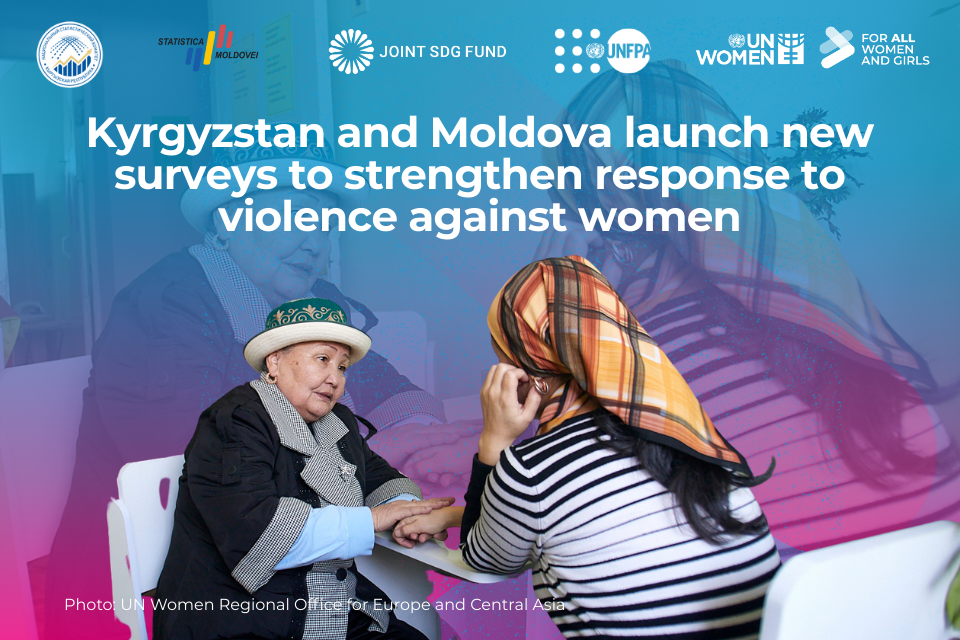
In a landmark move to strengthen national responses to gender-based violence, Kyrgyzstan and Moldova have launched pilot surveys to measure the prevalence of violence against women. These initiatives mark a significant step toward building robust gender data systems that will inform evidence-based policies and uphold women’s rights.
The surveys—titled “Women’s Well-being and Safety”—are being implemented under the regional programme “Empowering Equality: Strengthening Gender Data Systems in Europe and Central Asia,” implemented by UN Women, UNFPA, the UN Development Coordination Office, and national statistical offices, under the Joint SDG Fund. Focusing on Sustainable Development Goal (SDG) 5, the programme enhances gender data systems in three pilot countries—Armenia, Kyrgyzstan, and Moldova—by increasing their national capacity to collect, analyze and disseminate gender statistics in line with international standards. By institutionalizing this approach, the programme paves the way for scaling up and replicating the model in other countries across the Europe and Central Asia region.
Measuring violence against women in Kyrgyzstan
In Kyrgyzstan, the survey is being led by the National Statistical Committee of the Kyrgyz Republic. It will generate representative data on physical, psychological and other forms of violence, both within and outside of intimate relationships. It will also explore factors contributing to vulnerability, access to support mechanisms, and the impact of societal norms and stereotypes.
According to the National Statistical Committee, in 2024, 14,618 people sought help from crisis centres and institutions providing psychosocial support, with women accounting for 82 per cent of all cases. Of these, 61 per cent were related to domestic violence. Young women aged 29 to 39 were the most affected group, accounting for over 37 per cent of all cases. Women in older age groups were significantly less likely to seek assistance.
“This survey is a critical milestone in fulfilling Kyrgyzstan’s commitments under the Convention on the Elimination of All Forms of Discrimination against Women (CEDAW), the Beijing Platform for Action, and the 2030 Agenda,” said Nazira Kerimalieva, First Deputy Chair of the National Statistical Committee. “These commitments require the collection and use of reliable, representative and comparable statistical data on violence against women to inform effective public policy, monitor progress and advance women’s rights.” This effort aligns with Kyrgyzstan’s National Strategy for the Development of Statistics (2022–2026), which identifies the strengthening of gender statistics as a national priority.
Kyrgyzstan’s first-ever survey measuring the prevalence of violence against women is being designed through strong collaboration between government, civil society and development partners. Photo: UN Women
A preparatory workshop, held in Bishkek on 29-30 July 2025, brought together over 30 stakeholders from government, civil society, crisis centres and development partners to discuss what data was needed, survey objectives and methodology, as well as ethical standards and respondent safety. The fieldwork phase is scheduled for 2026.
Aliza Soltonbekova, First Deputy Minister of Labour, Social Protection and Migration of the Kyrgyz Republic, said the survey was a vital step forward: “As the institution responsible for implementing gender policy, the Ministry strongly supports this survey. It will enable us to gain a deeper understanding of women’s actual needs and strengthen government efforts in violence prevention and support for survivors, as part of the implementation of the National Strategy for Achieving Gender Equality by 2030 and the corresponding National Action Plan.”
Counting violence against women in Moldova
UN Women and UNFPA are providing technical and strategic support throughout the process, ensuring that data is used to improve policies and protections for women and girls. Photo: UNFPA Moldova
Moldova is taking a similar path. The process began with a dialogue between the survey’s designers and those using its findings to ensure that the data collection would reflect national policy priorities and promote meaningful use of gender statistics. The new survey will align with Eurostat’s methodology and support Moldova’s commitments under the Istanbul Convention and the EU accession framework.
The initiative also contributes to the implementation of Moldova’s National Programme for the Prevention and Combating of Violence Against Women and Domestic Violence (2023–2027), specifically Objective 4.4, which calls for disaggregated data collection in line with the Istanbul Convention. It further supports the recommendations of the Group of Experts on Action against Violence against Women and Domestic Violence (GREVIO) and is included in the National Programme for Moldova’s EU Accession (2025–2029). Additionally, it will enable the production of SDG indicators 5.2.1 and 5.2.2, as outlined in Moldova’s national framework for monitoring the 2030 Agenda for Sustainable Development.
At a recent workshop hosted by the National Bureau of Statistics on 22-23 July 2025, around 40 participants—including representatives from relevant ministries, civil society and other public authorities—provided input on the survey’s objectives and design to respond to emerging needs on VAW data. The event emphasized the importance of intersectionality, ethical principles and confidentiality in data collection.
“This statistical survey differs from any other study on violence because it is the only one that measures the prevalence of violence at the national level and the prevalence of different forms of violence among the population,” stated Aurelia Spătaru, Deputy Director General of the National Statistical Committee, during her opening remarks.
“Data reveals the unfiltered reality faced by girls and women who are survivors of violence. Without it, public policies risk missing the real needs that most urgently require intervention,” added Viorica Țîmbalari, Director General of the National Agency for the Prevention and Combating of Violence Against Women and Domestic Violence.
UN Women and UNFPA are providing technical and strategic support throughout the survey process in both Kyrgyzstan and Moldova—from methodology development to data analysis and policy integration. Pilot surveys are scheduled for late 2025, with full-scale national surveys planned for 2026.
The data collected will contribute to tracking progress on SDG targets 5.2.1 and 5.2.2, supporting both national monitoring frameworks and international comparability. By generating high-quality, disaggregated data, these efforts will help shape more responsive, inclusive and effective policies to prevent and combat violence against women.
While 83 per cent of the data needed to measure intimate partner violence (SDG indicator 5.2.1) was available in 2024, regular data collection remains a challenge. To date, only Albania, Georgia and Kazakhstan have conducted two rounds of VAW prevalence surveys since 2015, allowing for meaningful tracking of trends and progress over time.
Note: All joint programmes of the Joint SDG Fund are led by UN Resident Coordinators and implemented by the agencies, funds and programmes of the United Nations development system. With sincere appreciation for the contributions from the European Union and Governments of Belgium, Denmark, Germany, Ireland, Italy, Luxembourg, Monaco, The Netherlands, Norway, Poland, Portugal, Republic of Korea, Saudi Arabia, Spain, Sweden, Switzerland and our private sector funding partners, for a transformative movement towards achieving the SDGs by 2030.