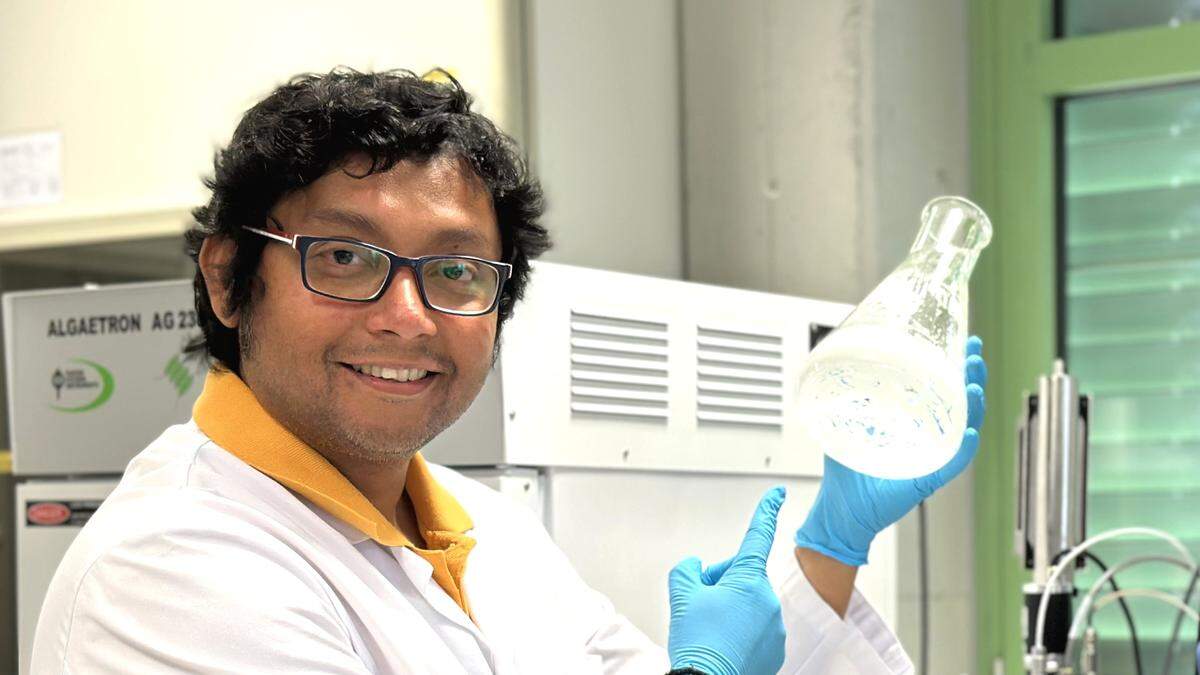
Microplastics have infiltrated nearly every aspect of our lives. They have been found in newborns’ umbilical cords, in the heights of the atmosphere, and in the depths of the ocean. Studying their effect on oceanic microbial life has now led to a breakthrough by Anupam Sengupta’s team at the University of Luxembourg.
The problem with microplastics
The term microplastic is used for any plastic part smaller than five millimetres, even though the term ‘micro’ technically refers to anything smaller than a millimetre. Sengupta, the head of the Physics of Living Matter research group, explains that there are two sources for this sort of material in our world.
The breakdown of larger plastic objects is one of them. If items such as PET bottles are discarded in the environment, they will eventually whittle down to the size range of a millimetre or smaller due to erosion and sunlight.
The second origin is “intentional microplastics”, a technical term used to describe additives put into products by design. These already start as microscopic matter, typically in the range of tens to hundreds of micrometres. “A micrometre is about a hundredth of the width of human hair, so it’s very small and invisible to the naked eye, but they are one of the key additives in a lot of products of daily use,” the researcher says.
In practice, they are often added to cosmetics, such as toothpaste, various paints, tires, and even clothing. Their industrial usefulness makes them very prevalent, and although we may not notice them in our everyday lives, they eventually land in our ecosystems. “If this keeps happening over decades and if millions of people are using such products, at one point, you start to see there’s a major footprint they leave behind,” Sengupta warns.
“We are at this stage where microplastics are being detected and observed in every part of the biosphere, from the upper reaches of the atmosphere to the lowest parts of the ocean, even close to the Mariana Trench,” he adds.
Currently, there are no existing solutions to replace the additive role of microplastics in both industrial and consumer products. The EU has adopted a regulation in 2023 on gradually phasing out and even banning microplastics from daily products, which means “there’s an urgent need to replace these particles”, Sengupta says. This creates an opportunity for researchers to step in.
Also read:I tried… going zero waste (and failed miserably)
A chance discovery
Sengupta’s lab works at the intersection of physics and biology, and focuses on examining microorganisms, from algae to bacteria, both in the context of human health and climate change.
The team was investigating “how microorganisms like bacteria get impacted by microplastics in marine ecosystems” when they observed an interesting behaviour in the microorganisms that appeared to produce their own substance in the presence of microplastics. “As with many important lessons in science, the discovery was quite serendipitous,” Sengupta says.
This finding was notable as it uncovered that microplastics could affect these organisms at a fundamental biological level. The researchers took an interest in the substances exuded by the organisms and found that they were “biominerals they produced as a stress response.”
In turn, this inspired them to observe if other types of bacteria or algae produce similar biominerals, even naturally. “That gave us the idea, could we actually use these biominerals as a potential replacement for microplastics in products of day-to-day use? Because in terms of size range, they were quite fitting,” Sengupta says.
The main obstacle was to figure out how to manipulate this matter in order to give it specific shapes, sizes, and properties. “Nature just does it, but then comes the part of innovation and engineering, how can we make them suitable as a potential replacement for microplastics?” Sengupta says. This led to a slew of experiments and studies of the different conditions and parameters under which these particles are produced and how they can be enhanced.
For example, roughness is an important factor to control. “In cosmetics, whether a foundation will have a glossy or a matte finish depends on how light gets reflected. If you have particles which are smooth and well-rounded, they allow for efficient reflection. But if you have particles with rough surfaces, light reflection gets diffused and you get a matte finish,” Sengupta explains.
“If we can fundamentally control these properties at the scale of particles, we can control relevant attributes in targeted products,” he says. This led the team to develop a line of protocols and technology which are currently in the process of being patented. The team is also collaborating with local companies, such as Peinture Robin and Goodyear, to test some of their creations, “and the results are quite promising,” the researcher adds.
Applicability versus cost
Sengupta explains their discovery can offer many other potential applications and offshoots, such as a compelling project on self-healing concrete. “Whatever we do in the lab is extremely exciting; we are always discovering new things, but to bring these benefits to humanity in tangible ways is the key challenge,” Sengupta says.
“To make it a usable product, it has to be easily integrable into existing technological pipelines in the industry, which requires us to validate our innovation in actual industrial settings.” Their partnerships with local and European businesses are thus a crucial step. “It’s an iterative process where collaboration and teamwork are vital. Without the support from the university, the Luxembourg National Research Fund, our business mentors, and collaborations with local and European business partners, this journey would not have been possible.”
Also read:A guide to recycling your waste
Even if the product becomes usable, the biggest barrier to bringing such alternatives to the market remains the price. Currently, the price of microplastic particles is extremely cheap. Any discovery that originates in a lab will have a very high starting cost, and the focus needs to be on scaling. Sengupta explains that when they first started, “we were producing less than a gram. Now, with our lab-scale prototypes, we are producing in the order of kilograms, so the next step would be to have a mini manufacturing plant dedicated to this and analyse how the pricing compares with industrial microplastics currently in use.”
“The hope is that in a year from now, we’ll at least have some flagship products, tailored for specific sectors. Even if they may be niche to start, the message has to be clear that this is a sustainable bio-based and carbon-neutral, even carbon-negative process and product,” Sengupta says, as when the microbes produce these substances, they take carbon away from the atmosphere.
“It’s been a wonderful experience because Luxembourg as a country now has quite a strong focus and policy-level incentives for sustainability and carbon neutrality, so I think we are doing our little part towards that,” Sengupta concludes.