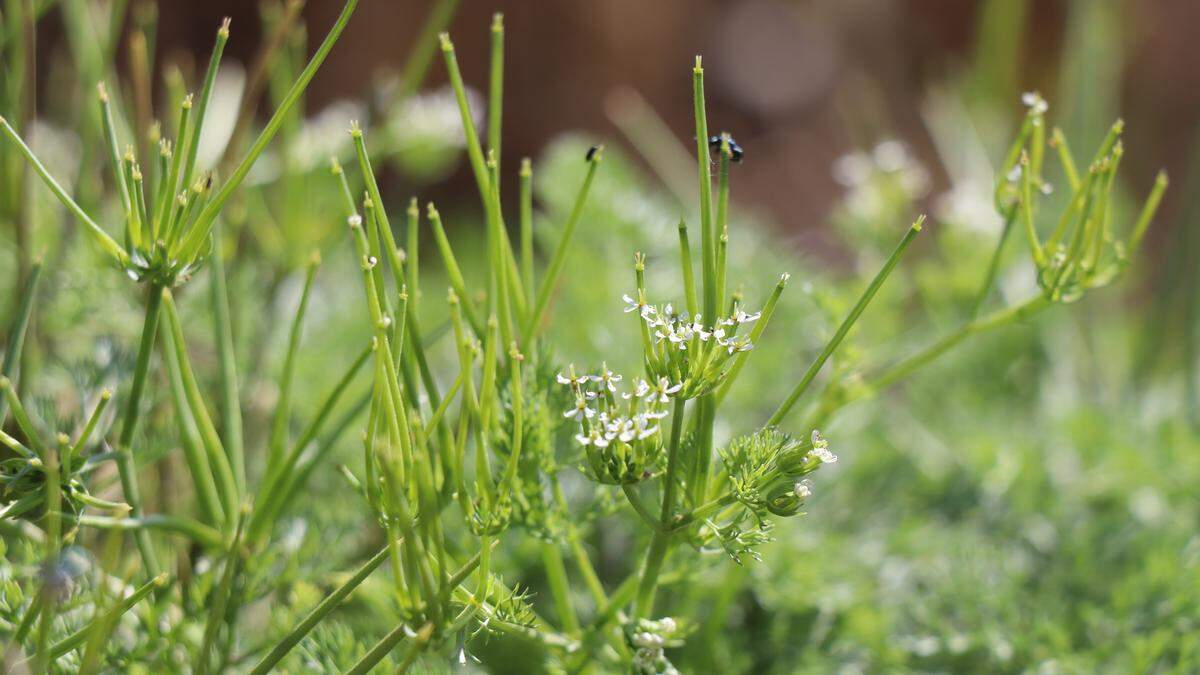
Biologists at the SIAS inter-municipal conservation agency have every reason to be happy as during the latest surveys of arable land, a wild plant, Scandix pecten-veneris , or shepherd’s needle, was rediscovered close to Mondorf-les-Bains.
The herbaceous plant traditionally grows between wheat, rye and barley but fell foul of stubble burning and pesticides, leading to a steep decline in Western Europe during the 20th century. Its distinctive upright and parallel fruits, reminiscent of a comb, were even believed to be extinct in Luxembourg since 1963, according to the Natural History Museum. Elsewhere, including southeast England, the plant clung on, albeit barely.
Shepherd’s needle was once widespread in the Moselle region mainly because of its preference for warm, dry limestone soils in summer, said Cédric Godart, environmental biologist at the SIAS syndicate.
The plant owes its name to its fruits, which look like a needle © Photo credit: SIAS
Intensive cultivation and herbicides
Godart attributes the temporary disappearance to the intensive cultivation of the land and the use of chemical pesticides. “The plant was probably swept underground, so to speak, so that it was no longer sighted,” he said.
Also read:Conservationists sound alarm bells over endangered birds in Luxembourg
The plant came to light during so-called field mapping, in which the characteristics of agriculturally productive areas are documented in map form. “It was probably there before, but had not been recorded in previous years,” said the SIAS environmental biologist. Not only individual plants were found, but also populations of more than 100 individuals.
More rare wild herbs discovered
SIAS is now surveying rare plant and animal species more frequently, particularly in the east. “We are now looking for them more specifically because the populations are declining,” Godart said. Other rare field species have also been discovered in the area of southeast Luxembourg covered by SIAS: the yellow crownvetch (Coronilla scorpioides) in the municipality of Schuttrange and hare’s ear mustard (Conringia orientalis) near Stadtbredimus.
Also read:Trees in need: how Luxembourg is protecting its forests
The syndicate does not want to monitor the spread of endangered native species. In order to promote the reintroduction of the shepherd’s needle, for example, the SIAS biological station is collecting seeds and will sow them at suitable locations.
“This is coordinated via a national strategy for the conservation of wild field herbs and is done in collaboration with other biological stations in Luxembourg,” said a press release from the syndicate. In addition, special conservation programmes are being established to preserve existing endangered populations on site.
What is SIAS?
The inter-municipal syndicate SIAS, based in Senningerberg, promotes sustainable development and nature conservation. Its members include 21 municipalities in the southeast and centre of the country: Betzdorf, Biwer, Bous-Waldbredimus, Contern, Dalheim, Flaxweiler, Frisingen, Grevenmacher, Hesperange, Junglinster, Lenningen, Manternach, Mondorf-les-Bains, Niederanven, Remich, Sandweiler, Schengen, Schuttrange, Stadtbredimus, Weiler-la-Tour and Wormeldange.
(This Article was published by the Luxemburger Wort. Translated by AI, with editing and adaptation by Alex Stevensson.)