
GT
Grant Thornton Malta
More

We combine global scale with local insight, quality and understanding to give you the assurance, tax, and advisory services you need to realise your ambitions.
On 2 September 2025, the Government of Malta published Legal Notice 188 of 2025: the Final Income Tax Without Imputation Regulations, 2025 (the “Regulations”).
Malta
Tax
To print this article, all you need is to be registered or login on Mondaq.com.
On 2 September 2025, the Government of Malta published
Legal Notice 188 of 2025: the Final Income Tax Without Imputation
Regulations, 2025 (the “Regulations”). These Regulations,
issued under Article 22B of the Income Tax Act, introduce a new
elective tax framework that allows certain entities to opt for a
final income tax at the rate of 15%, applied on chargeable income,
in lieu of Malta’s long-standing full imputation
system.
Scope of Application
The option is open to:
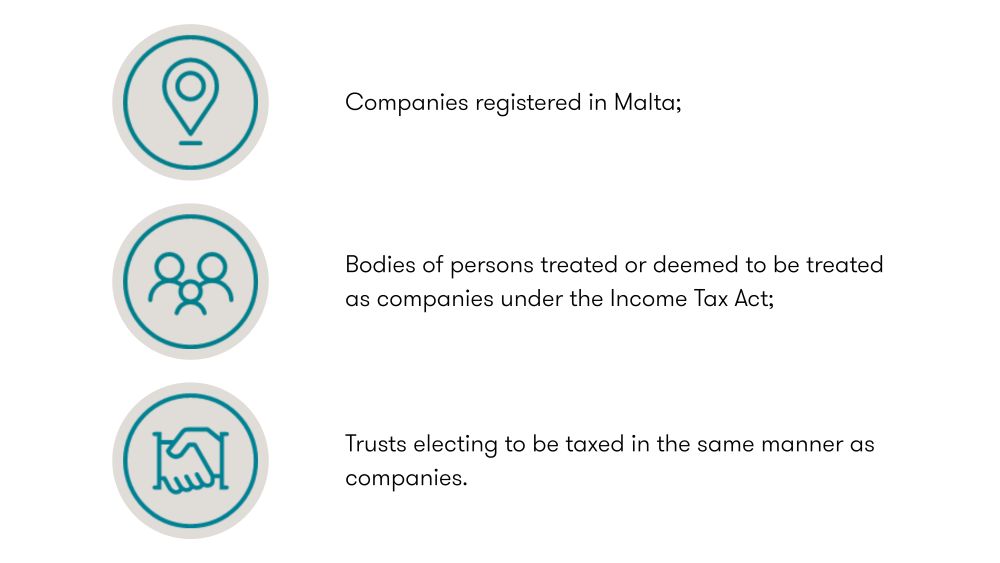
Any entity may elect for the new regime in respect of chargeable
income derived in the fiscal year preceding the year of assessment
2025 (i.e. basis year 2024) and subsequent years.
The Elective Regime
Entities may elect to be subject to a flat 15% tax on chargeable
income. This tax is final; it is not creditable, not refundable,
and not available as an offset at shareholder level.
The elective final tax does not apply to:
Dividends received from profits that are not allocated to the
Final Tax Account of another Maltese company; and
Income already taxed at a final rate under other provisions of
the Income Tax Act and allocated to the Final Tax Account.
Once an entity elects for the 15% regime, it must remain under
this system for at least five consecutive years.
Should it revert to the ordinary imputation system, it must remain
there for a minimum of five years before re-electing for the final
tax regime.
The Regulations include a “higher of” test: the tax
payable under the 15% final tax regime cannot be less than the
effective tax that would have been payable under the ordinary
system, after accounting for refunds available to shareholders
under Article 48 of the Income Tax Management Act.
Final Tax Account Allocation
Profits taxed under this regime are mandatorily allocated to the
entity’s Final Tax Account.
Policy Context
The introduction of a final 15% tax regime comes at a time when
global tax reform is in flux, most notably, following a G7
agreement that now allows the U.S. tax system to operate in a
side-by-side manner with Pillar Two. Malta’s framework has
historically relied on the full imputation system, which
effectively eliminated double taxation at shareholder level.
By offering an alternative final tax of 15%, Malta seeks to
provide greater clarity and alignment with international tax
developments, while preserving flexibility for taxpayers. The
regime is elective, allowing groups to assess whether the
traditional imputation model or the new 15% final tax provides a
more efficient outcome in light of their global tax profile.
What this means for businesses
Entities now face a strategic choice:
Continue operating under Malta’s full imputation system,
with its higher headline rate and shareholder refund mechanism;
or
Elect into the 15% final tax regime, accepting the lock-in
period and the finality of the tax, while potentially achieving
greater international alignment and simplification.
The content of this article is intended to provide a general
guide to the subject matter. Specialist advice should be sought
about your specific circumstances.