Recent satellite images indicate that North Korea is covering drainage channels that flow into a sedimentation pond at a uranium refinery in Pyongsan, North Hwanghae province.
The construction work appears designed to evade satellite surveillance by the international community and conceal wastewater dumping.
Not long ago, serious concerns were raised in South Korean society about North Korea’s wastewater discharge at Pyongsan. There were even indications that the International Atomic Energy Agency (IAEA) might take public action, which would inevitably make the wastewater dumping an international issue — a prospect that North Korean officials reportedly feared.
According to a recent Daily NK report citing sources inside North Korea, several factory managers were fired and relocated to remote areas with their families because the wastewater dumping issue at Pyongsan had embarrassed North Korea internationally.
North Korea has decided to respond by redesigning the area around the Pyongsan facility and moving the drainage canal underground. Consistent with these reports, recent satellite images show that work is underway to conceal the canal.
The images also show that another chemical sample tank has been built at the Pyongsan uranium refinery, bringing the total number of tanks from nine to ten. North Korea appears to be taking steps to gradually expand its uranium refining capacity in line with leadership orders to strengthen nuclear capabilities.
Drainage canal to the sedimentation pond going underground
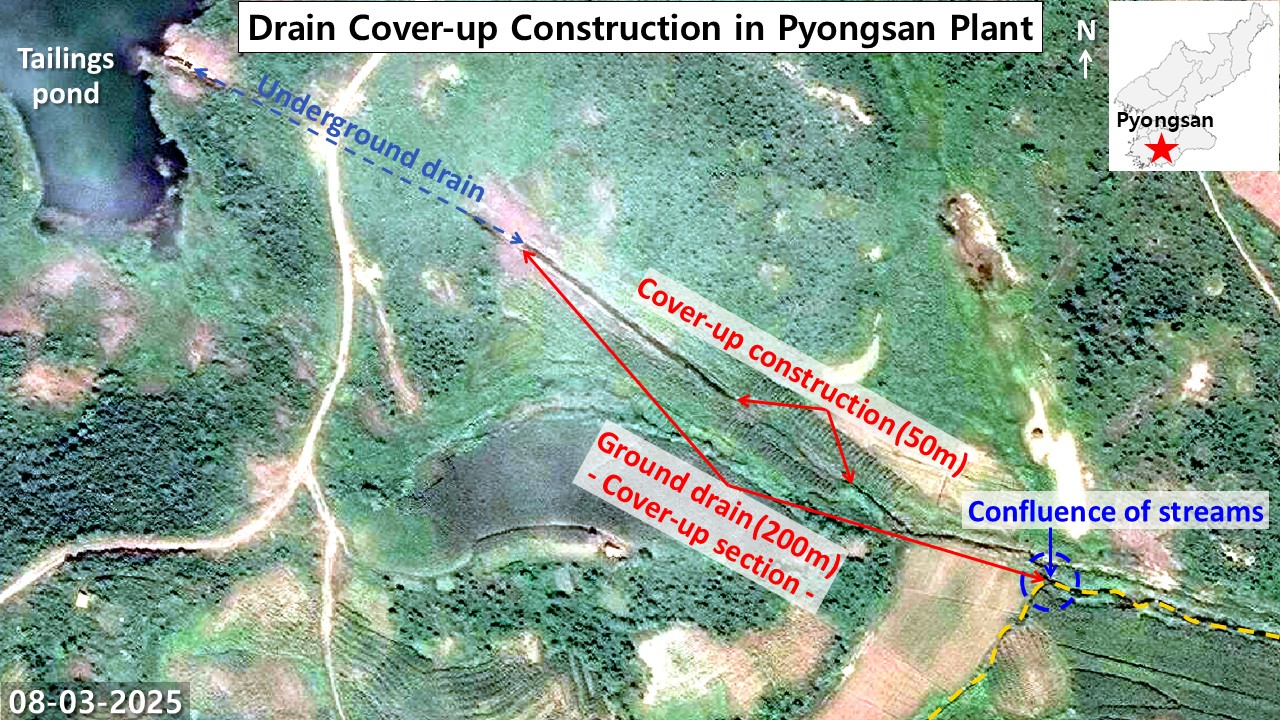 Construction work is underway to cover the drainage channel to the sedimentation pond at the uranium factory in Pyongsan, North Hwanghae ㅔrovince. North Korea appears to have begun work to conceal wastewater discharge in preparation for satellite surveillance. (WorldView-3)
Satellite images taken in early August show North Korea covering the drainage canal that runs to the sedimentation pond at the Pyongsan uranium refinery to move it underground. The project was likely begun to avoid satellite surveillance by the international community.
The images provide evidence that a 50-meter stretch of the drainage canal has been covered with structural materials apparently designed to hide it from view. The structural materials will presumably be covered with dirt and then planted with trees to camouflage the canal and make it appear as natural terrain.
Construction is expected to eventually cover the 200-meter section running from the underground pipe to where the canal joins a nearby stream. Once the entire drainage canal is covered and camouflaged, satellites will no longer be able to monitor wastewater dumping into the sedimentation pond. In short, North Korea appears to be aggressively working to conceal its wastewater discharge via the drainage canal.
Facilities added to expand production
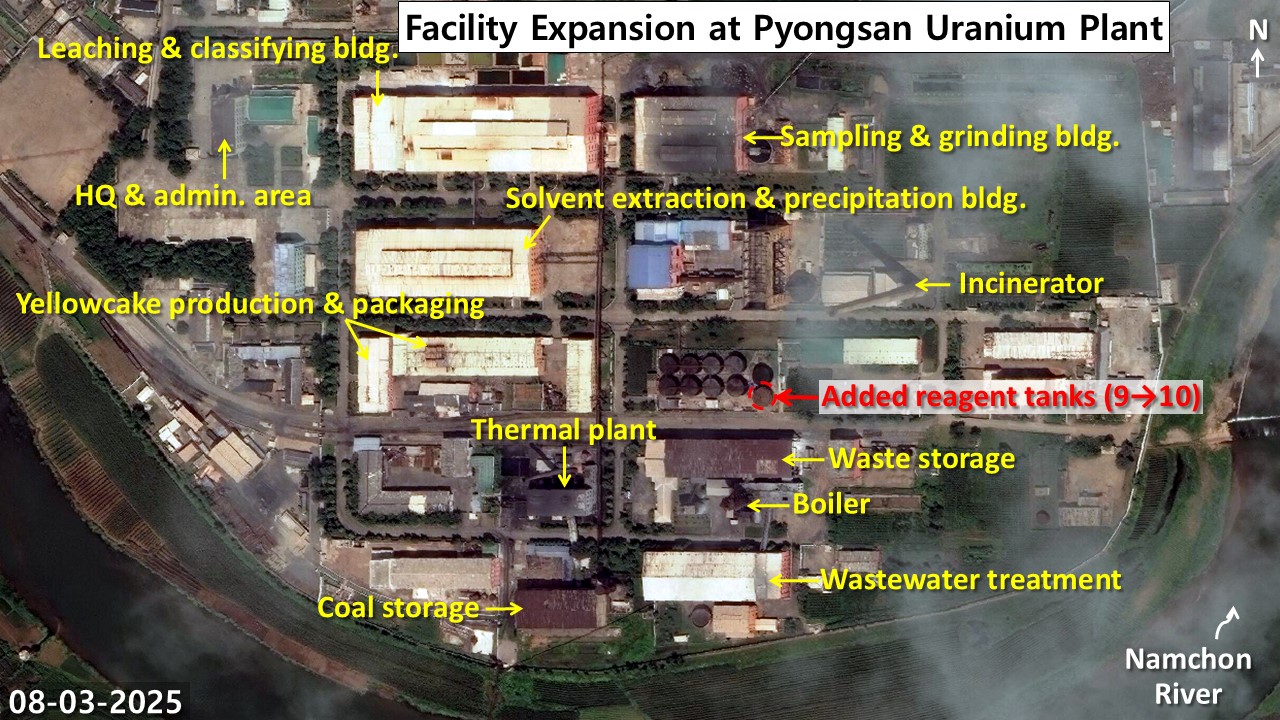 The number of chemical sample tanks at the Pyongsan uranium factory has increased from nine to ten. North Korea appears to be expanding facilities related to uranium concentrate production in accordance with leadership measures to “strengthen nuclear capabilities.” (WorldView-3)
Recent satellite images also show that the number of chemical sample tanks at the uranium refinery has increased from nine to ten. In early March, Korean public broadcaster KBS reported that the number of tanks at the facility had risen from eight to nine, interpreting this as evidence of facility expansion aimed at boosting refined uranium production.
The latest satellite images show that another sample tank has been installed over the past few months. The Pyongsan factory appears to be expanding its uranium refinement capability in accordance with Kim’s orders to upgrade the country’s nuclear arsenal last September. The sample tanks are thought to contain the acid and alkaline solutions needed to refine and extract uranium from ore.
North Korea’s increased production of fissile materials would violate U.N. Security Council resolutions and challenge international peace, safety, and the nonproliferation regime. The expansion of the Pyongsan uranium refinery appears designed to increase nuclear weapons production, which could give North Korea more leverage in future negotiations with the U.S.
News from Pyongsan refinery: access limited, sample collection strictly monitored
Daily NK reported that a considerable number of refinery managers were punished because of the recent controversy over wastewater dumping into the sedimentation pond.
After vivid images of wastewater flowing into the stream were captured by satellites from an “enemy state” and thoroughly analyzed, raising international concerns about potential marine pollution, North Korea promptly ordered that managers be replaced and punished due to the resulting “international humiliation and damage to the regime’s image.” Some managers were sentenced to three months of hard labor, while others were banished to remote areas with their family members.
The regime also ordered the area around the refinery to be redesigned. This prompted the current efforts to cover the drainage canal and disguise it as natural terrain, which were detected in satellite footage from August.
When the South Korean press was actively covering news about the wastewater discharge some time ago, officials at the Pyongsan refinery claimed to be puzzled by media scrutiny, arguing that dumping wastewater in the stream was a temporary and essential part of the refinery’s operations. The officials seemed to believe that releasing wastewater from the sedimentation pond was technically necessary for expanding the refinery’s production capacity.
Workers at the Pyongsan refinery do not drink groundwater, instead bringing in spring water from other areas. The refinery area is off-limits to the general public for security reasons, and the guard detail has been expanded as part of tougher security measures designed to keep out unauthorized personnel and closely monitor attempts to collect soil or water samples.
Internal monitoring of both the guard detail and neighborhood watch units in the area has been tightened, and area residents are being warned that “our enemies’ eyes are in the skies.”
In keeping with leadership orders about strengthening the nuclear arsenal, Pyongsan refinery management has made it a priority to boost fissile material production to meet or even exceed state quotas.
Along with tightening security measures at the factory, managers have ordered the drainage ditch be moved underground, with additional workers being brought onto construction teams.
North Korea has dismissed expressions of concern about marine pollution by the IAEA and other international stakeholders as “violations of sovereignty,” with officials expressing strong disgust about overseas protests.