In early August, NASA’s Earthdata Search web application released 2024 data on global forest and land use, analyzed by a Boston University research team using NASA’s MODIS satellite imagery. The Earthdata Search website has made this data publicly available each year since 2001. I used this data to assess North Korea’s reforestation progress.
North Korea’s reforestation campaign—a national greenification initiative—ran for a decade from 2015 to 2024. Kim Jong Un launched the campaign with a pledge to turn the entire country into “mountains of gold and treasure” in his 2015 New Year’s address. Our analysis of North Korea’s reforestation progress using Earthdata finds that the country added 1,222,768 hectares of forest over those ten years—just 72.7% of its original 1,682,000-hectare goal.
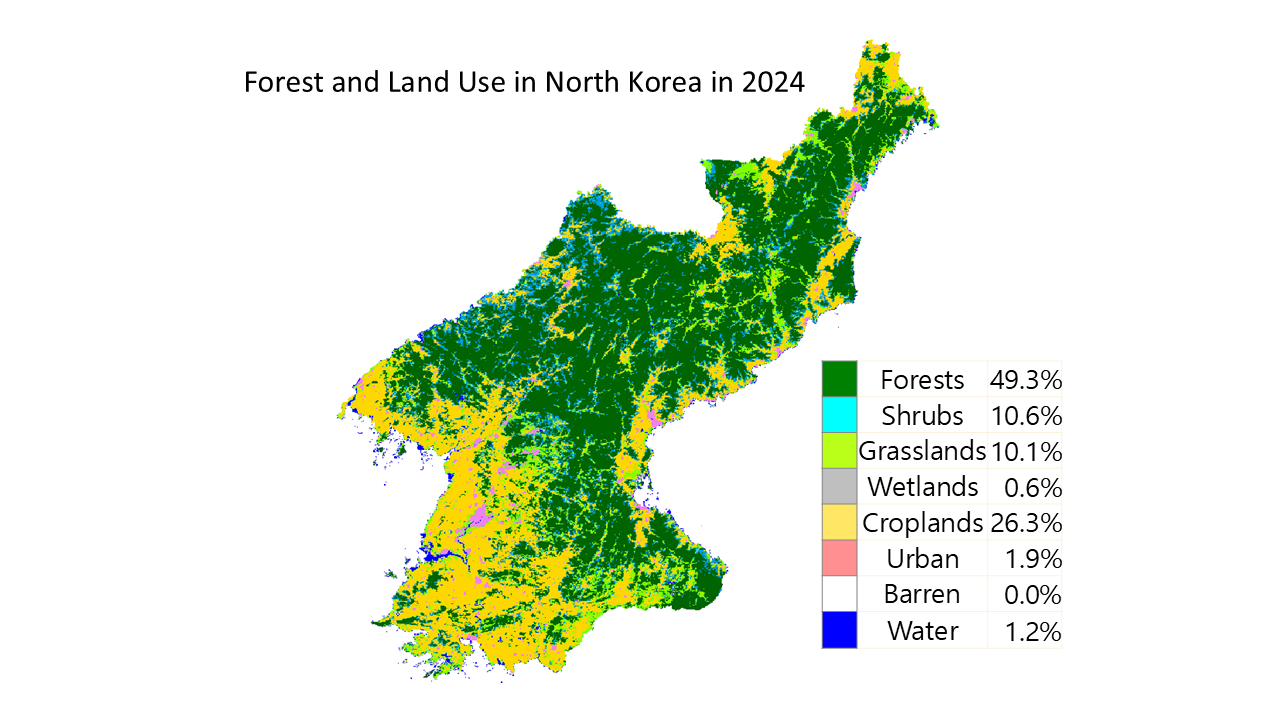 This 2024 map of North Korean forest and land use is based on publicly available data from NASA’s website. The distribution analysis, conducted using MODIS satellite data, shows forests covering 49.3% of North Korea’s territory and cultivated land accounting for 26.3%. (EARTHDATA SEARCH)
Since Earthdata covers North Korean territory across three pages, my 24-year analysis of forest and land use changes since 2001 required examining 72 pages of data. My review found the following breakdown of North Korean land use in 2024: woodland (49.3%), cultivated land (26.3%), grassland (10.1%), shrubland (10.6%), and miscellaneous (3.7%).
Forest trends reveal campaign impact
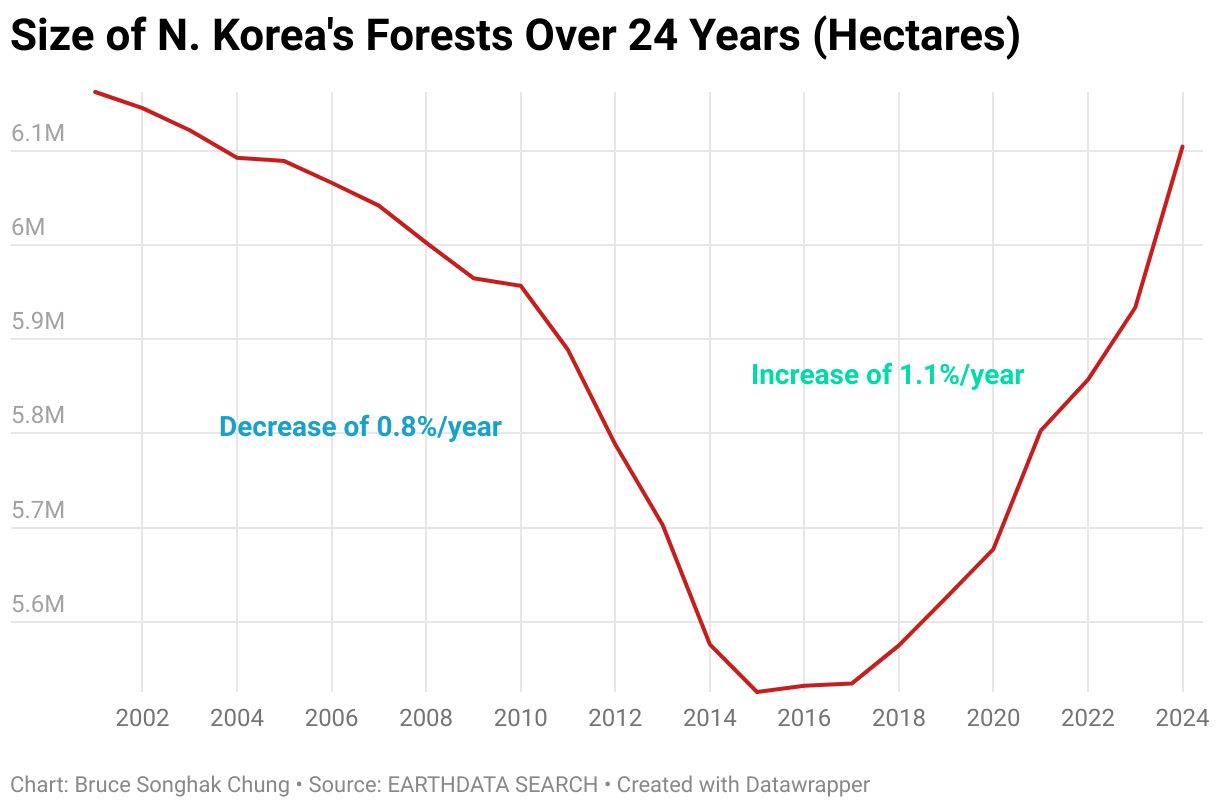
My time-series analysis shows that North Korea’s forested area decreased by 0.8% annually from 2001 until 2015, when the trend reversed. Since then, forested area has grown by 1.1% each year. The turnaround coincides precisely with North Korea’s launch of its decade-long reforestation campaign aimed at creating “mountains of gold and treasure.”
As of 2024, North Korea has an estimated 6,104,960 hectares of woodland—an increase of 579,744 hectares from the 2015 low of 5,525,216 hectares. While the country remains 58,000 hectares behind its 2001 level of 6,162,960 hectares, the forest restoration efforts over the past decade represent encouraging progress.
I also examined where woodland has expanded and contracted across North Korea during the past decade using post-classification comparison methods on remote sensing data. Comparing 2014 (before the reforestation campaign) with 2024 (the most recent available data), areas of woodland growth appear in blue while areas of woodland loss appear in red.
The data shows clear woodland increases in southwestern regions including the Hwanghae provinces, Pyongan provinces, and Pyongyang. In contrast, conspicuous forest losses continue in northern mountainous areas—Jagang province, Ryanggang province, and the Hamgyong provinces—where logging and other extractive practices persist.
North Korea has implemented punitive forestry policies preventing ordinary citizens from cutting trees or farming in mountainous areas. However, unlike the lowlands and urban areas of the southwest, the rugged northern mountains continue experiencing deforestation from woodcutting and small-scale farming, perhaps because state control is weaker there.
Notably, China’s three northeastern provinces also show substantial woodland growth, indicating that China is conducting its own vigorous greenification program including wasteland restoration.
Campaign falls short of ambitious targets
 Analysis shows forests have increased in southwestern regions including Hwanghae and Pyongan provinces, while northern mountainous areas such as Jagang and Ryanggang provinces continue to experience forest loss due to logging and degradation. (EARTHDATA SEARCH)
My detailed analysis using Earthdata found that North Korea planted 1,222,768 hectares of trees over the past decade, including short saplings on hills and grasslands. However, this falls 459,232 hectares short of the regime’s original 1,682,000-hectare goal, achieving only 72.7% completion.
It’s worth noting that this study incorporates recently released 2024 data and revised 2023 data after Earthdata corrected earlier errors.
North Korea typically uses its annual Supreme People’s Assembly meetings to review previous year’s accomplishments and announce new plans and projects. However, in January 2025, the regime covered its ambitious decade-long reforestation campaign briefly and without fanfare, surprising observers who expected North Korea to promote the project as a major achievement demonstrating the leader’s benevolence. While the reasons for this low-key treatment remain unclear, forestry officials may have recognized they fell well short of declared goals.
Deforestation challenges persist
My analysis reveals that deforestation in North Korea remains severe. As of 2024, the country had 1,232,539 hectares of deforested areas, representing 13.7% of mountainous areas (8,990,000 hectares) and 10.0% of total territory (12,313,800 hectares). North Korea’s deforested areas cover 20 times the area of Seoul (60,524 hectares), indicating that reforestation efforts remain far from complete.
Kim Jong Un once ordered his people to cover the country with parks and lush forests as part of the greenification drive. While North Korea’s reforestation campaign passed its nominal October 2024 deadline, the regime will likely continue its coercive forestry policy based on punishment and control while demanding public sacrifices to pursue its goals.