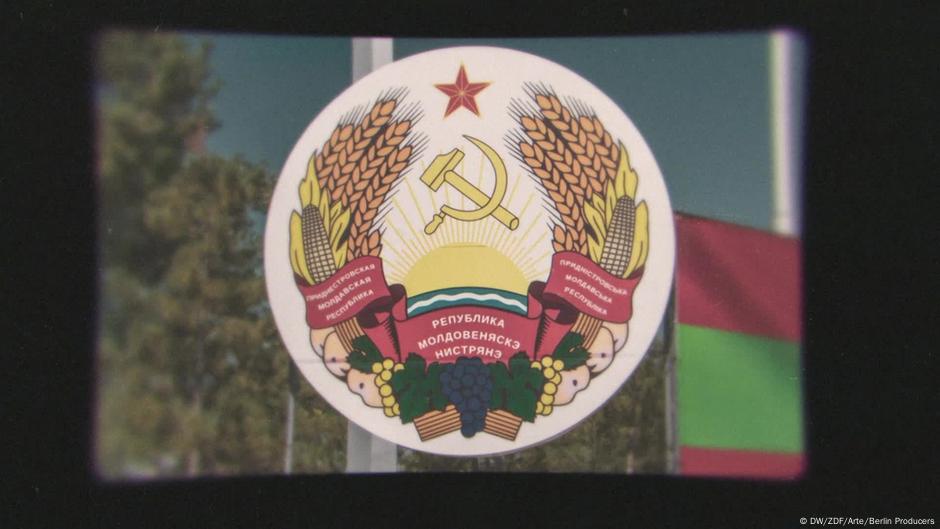
It has its own flag, currency and government.
Image: DW/ZDF/Arte/Berlin Producers
The self-proclaimed Republic of Transnistria is not internationally recognized. But it has been closely intertwined with Russia politically, economically and militarily for decades.
Image: DW/ZDF/Arte/Berlin Producers
Some 1,500 Russian soldiers are permanently stationed in the region. In spring 2022, shortly after the Russian invasion of Ukraine, there were explosions and attacks on government buildings.
Image: DW/ZDF/Arte/Berlin Producers
Since the Republic of Moldovawas granted EU accession candidate status in 2022, the long-forgotten region has once again become the focus of geopolitical power games.
Image: DW/ZDF/Arte/Berlin Producers
While the Moldovan capital Chişinău tends to pursue a more pro-European course, many people in Transnistria cling to Russia – despite problems like Transnistria‘s deep poverty. The region’s economy is dominated by a powerful network of oligarchs. Critics speak of a system of mutual protection between business, politics and pro-Russian power structures.
Image: DW/ZDF/Arte/Berlin Producers
Until the beginning of 2025, Transnistria’s economy was reliant on gas from Russia. A fragile balancing act – as some 80 percent of Transnistria’s exports go to the EU. But the energy crisis that followed the gas freeze has exacerbated tensions in the region.
Image: DW/ZDF/Arte/Berlin Producers
While pro-Russian actors want to expand their power, supporters of a pro-European course are focusing on greater integration into the EU.
Broadcasting Hours:
DW English
SUN 28.09.2025 – 00:02 UTC
SUN 28.09.2025 – 03:30 UTC
SUN 28.09.2025 – 14:30 UTC
MON 29.09.2025 – 01:15 UTC
MON 29.09.2025 – 05:02 UTC
MON 29.09.2025 – 22:30 UTC
TUE 30.09.2025 – 07:30 UTC
WED 01.10.2025 – 18:30 UTC
Lagos UTC +1 | Cape Town UTC +2 | Nairobi UTC +3
Delhi UTC +5,5 | Bangkok UTC +7 | Hong Kong UTC +8
London UTC +1 | Berlin UTC +2 | Moscow UTC +3
San Francisco UTC -7 | Edmonton UTC -6 | New York UTC -4