Which is right? They both are. Wellness may be in social media ad campaigns and have diets and apps and fads under the umbrella, but it’s entirely subjective. The northeast believe they have greater wealth and social standing, which they consider traditional wellness. The south sense of purpose and community identity, which is existential wellness.
Both may be linked to the “First Settler Wellness Effectâ€� – which European colonizers inhabited various regions, according to conclusions drawn from survey results of 325,777 U.S. residents. The belief of the authors is drawn from surveys gathered in the Gallup-Healthways Well-Being Index between 2009 and 2016 filtered through the “American Nations Model”, which divides the U.S. into different cultural regions stemming from early settlement patterns.
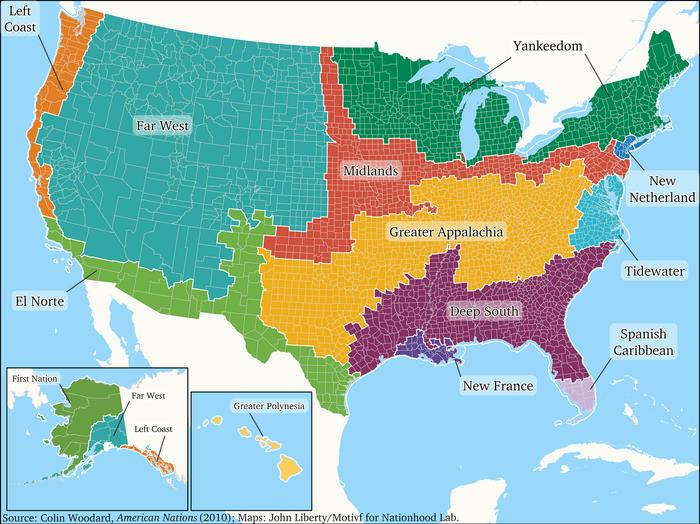
In his 2011 book, American Nations: A History of the Eleven Rival Regional Cultures of North America, Colin Woodard divided the continent into several “nations� with cultural identities shaped by the settlement patterns and prevailing ideologies of European settlers in those regions. Credit:
Samson et al., 2025, PLOS One, CC-BY 4.0 https://creativecommons.org/licenses/by/4.0/
According to their paper, the honor-based emphasis on personal autonomy, loyalty, and social reputation in the South stems from the different types of people who settled there versus the northeast and northern states, which consider wellness a factor of economic security and health.
“These regional ‘folkways’ predict both traditional wellbeing (social support, community trust) and existential wellness (purpose and meaning) even after accounting for socioeconomic factors,â€� the authors write. “What struck us most was the durability of culture—centuries-old settlement patterns continue to forecast modern lived experience. This doesn’t imply destiny; it suggests policy works best when it aligns with local cultural ecologies.â€�
Citation: Samson DR, Oesch N, Woodard C (2025) Wellbeing across the American Nations: First Settler Effects influence traditional and existential wellness. PLoS One 20(9): e0327972. https://doi.org/10.1371/journal.pone.0327972