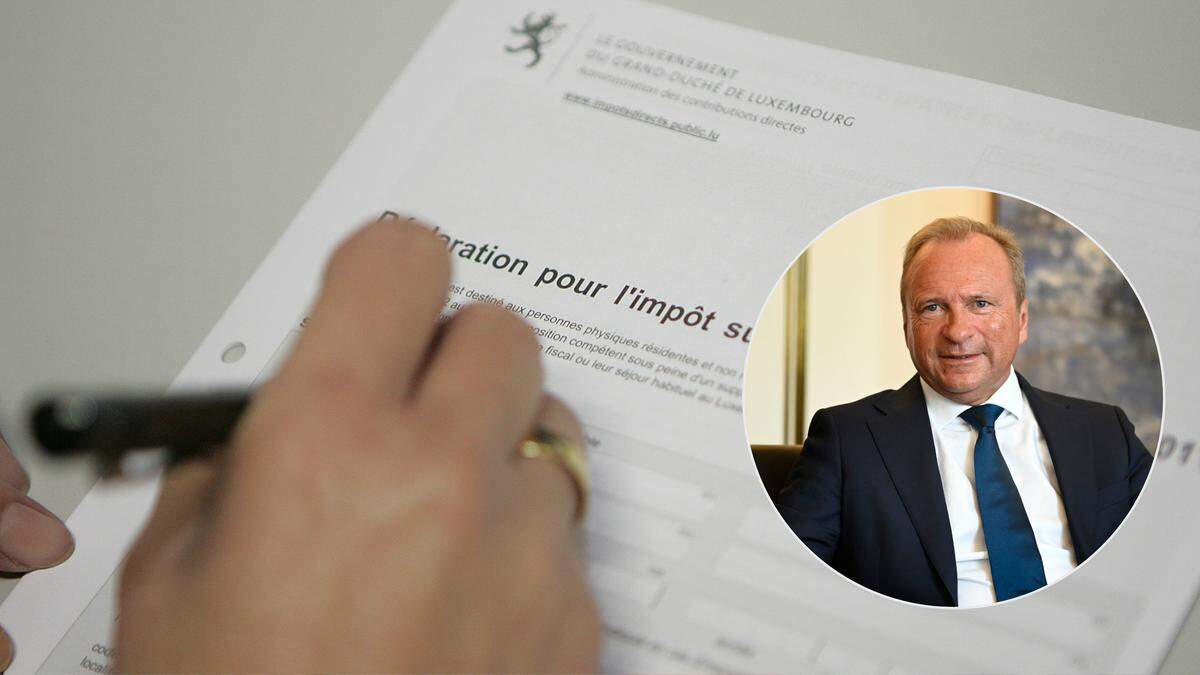
The phrase ‘tax reform’ rarely makes hearts flutter, but coming changes will likely impact everyone who pays income tax in Luxembourg.
Finance Minister Gilles Roth outlined the broad details of the proposed revamp to MPs on 1 July. Roth plans to table a bill next year that would come into force in 2028.
Also read:Gilles Roth: No social cuts or tax increases despite higher military spending
The basic idea is to introduce a single tax class, a subject that has come up regularly in recent decades, but never been put into practice.
The establishment of a single tax class symbolises the desire to put an end to the practice of taking marital status into account when calculating income tax, in order to introduce strictly individual and fairer taxation.
This promises to be a minor revolution, since marital status has influenced the collective taxation of spouses in Luxembourg since 1842, as pointed out by personal tax expert Joëlle Lyaudet in a book entitled Est-il venu le moment de fiscalement rompre? (Is it time to fiscally break up?) published by the Fondation Idea think-tank last May.
Current model from 1960s
The current system of personal taxation is based on three tax classes: 1, 1A and 2. These are allocated on the basis of family situation, marital status, number of dependent children and age.
Class 1 represents single people with no dependent children, who are single or divorced. This is the basic class, with a standard tax scale.
Next comes class 1A, which includes single people with at least one dependent child, widows and over-65s. The 1A tax rate is lower than in Class 1, to help single parents with the costs of bringing up children. There are also several tax exemptions and targeted tax breaks.
However, class 1A is generally considered to be less advantageous than class 2, which is for married or civil union couples. The reason why class 2 is so attractive is that it allows the ‘splitting’ mechanism to be applied.
This is a system whereby the incomes of the two spouses are added together and then divided by two, so that the tax rate is applied to half of the total income of the spouses. The resulting tax is then multiplied by two.
This technique allows households to benefit from the lowest tax brackets, which reduces the overall tax burden, especially if one spouse earns significantly less than the other.
This model of collective taxation rates for couples dates back to the second half of the 1960s, when, generally, only men worked.
The government and parliament at the time thought it logical that a father who supported his family (and his wife) should pay less tax than a single man.
Also read:Tax bracket individualisation could have €900m price tag
Single class benefits everyone
This is no longer the case, Roth said in an interview with Télécran magazine this summer.
Luxembourg now “needs a tax system that takes account of today’s society. In other words, whether people are married, in a civil partnership or simply living together, there should be no tax advantage or disadvantage.”
Hence the forthcoming disappearance of the three tax classes and the future introduction of a single tax class, dubbed the R scale, which will be based on the current 1A class.
Also read:Most couples in Luxembourg pay more into tax system than they get out
The new class will apply to current taxpayers in tax classes 1 and 1A, as well as to newly married and civil union couples.
Those who are already married when the new law comes into force will, if they wish, be able to continue to enjoy the tax benefits associated with class 2 for a transitional period of 20 years.
But, as Roth pointed out during his presentation to MPs last July, for the vast majority of these people who are currently married or in a civil partnership, it should be very advantageous to opt for the new scale as soon as it comes into force.
According to Finance Minister Gilles Roth, individualisation of tax rates should not result in any loss for taxpayers, whose purchasing power should increase significantly © Photo credit: Chris Karaba
This is because, as he also repeated, individualisation of tax rates should not result in any loss for taxpayers, whose purchasing power should increase.
That is not the case for the state, which is expected to lose between €800 and €900 million a year in revenue.
Also read:Tax revenue, spending and deficit all ticking up this year
Many of the bill’s details have not yet been finalised or announced, so the actual net result for taxpayers may vary.
(This article was originally published by Virgule. Translated using AI, with editing and adaptation by Aaron Grunwald.)