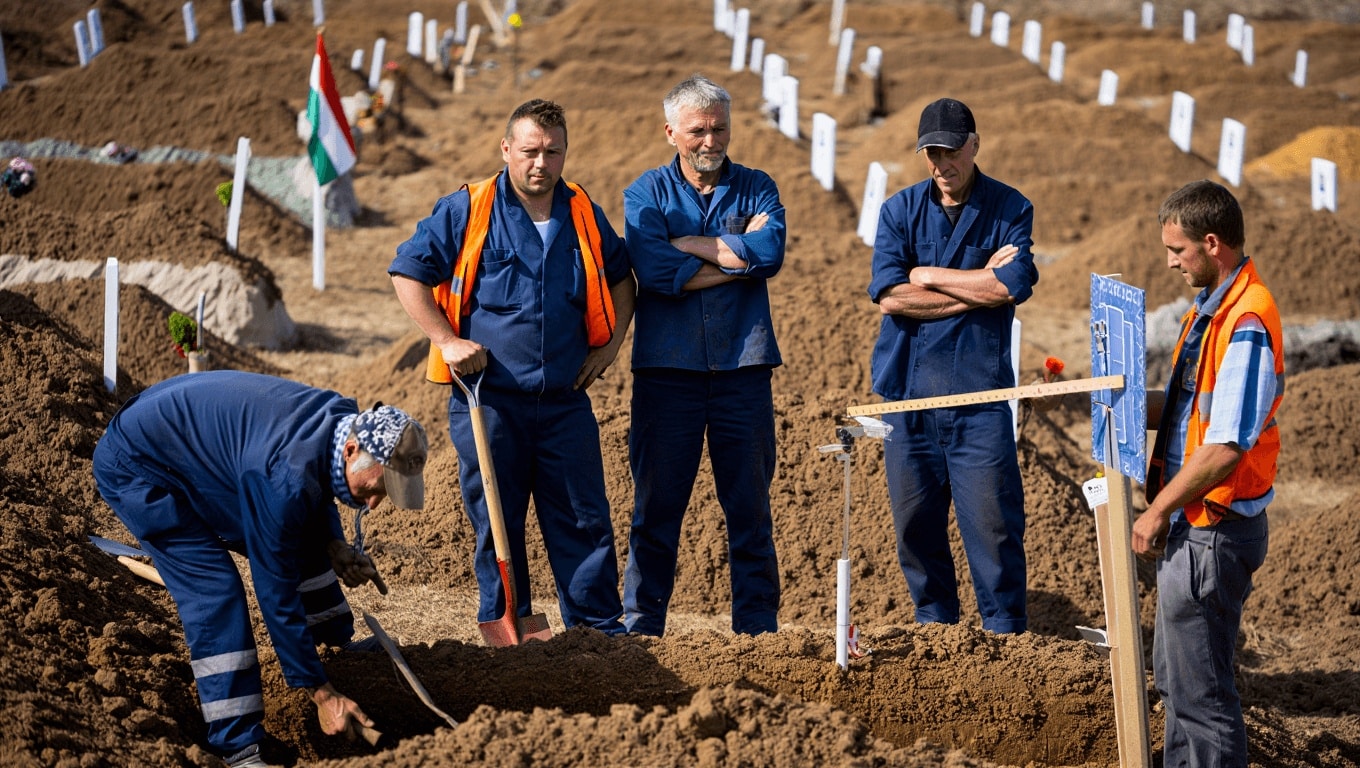
Hungary’s unconventional answer to a sporting event mixes muscle, craft and solemn duty: teams of professional cemetery workers race to dig and refill graves while judges score precision as much as speed. What might sound like a macabre sideshow is instead a deliberately respectful competition that spotlights the physical skill and discipline behind everyday burial work.
On a clear September day the competition drew crowds and cameras as crews carved out exacting rectangles of earth, heaved tons of soil, and rebuilt tidy mounds—all under the clock and the eye of stern referees. The spectacle is equal parts labor demonstration and cultural statement about honoring unseen labor.
How the Grave-Digging Contest Works: Rules, Dimensions and Judging
The event is organized around a single, demanding task performed by two-person teams. Each pair must excavate a grave to precise specifications, then return the soil to its original place.
Standard challenge and measurements
Grave size: about 2 meters long (~6.5 feet), 80 centimeters wide (~2.6 feet), and 1.6 meters deep (just over 5 feet).
Soil moved: roughly 2.5 tons of earth is removed and later replaced.
Team composition: two professional grave-diggers per team.
Scoring: what counts besides speed
Judges evaluate teams using a numeric scale that balances pace with workmanship. Key scoring factors include:
Time to complete the dig and backfill.
Accuracy of dimensions and straightness of the grave walls.
Presentation—clean edges, an even spoil heap, and overall neatness.
Judges can reward a slower crew that delivers immaculate results over a faster, careless team; the contest treats cemetery work as a skilled trade rather than a pure race.
Champions, Conditions, and Personal Accounts from the Pit
This year’s top spot belonged to Hungarian duo László Kiss and Róbert Nagy, who defended their title with a finishing time of 1 hour, 33 minutes and 20 seconds. When asked about their edge, they pointed to day-to-day routines on the job rather than special competition drills, saying the win came from long practice in real cemetery settings. Coverage of the event by outlets including Oddity Central relayed their comments.
Not every team fared as well. A squad from Russia’s Novosibirsk Crematorium finished at the back of the field and attributed a slow performance to unusually hot weather—reminding onlookers how environmental conditions influence this kind of physical labor.
Why Hungary Started a Grave-Digging Tournament: Recognition and Recruitment
Launched in 2016 by the national association that represents cemetery operators and maintainers, the event was conceived to pull a hidden profession into public view. Aside from a pause during the global pandemic, it has run annually to highlight skills that the general public rarely sees.
Respect: The organizers wanted recognition for a physically demanding and emotionally weighty job.
Recruitment: By showcasing craftsmanship and teamwork, the contest aims to attract younger workers to the field.
Visibility: Making the work public helps demystify burial practices and affirms the human labor behind funeral services.
What Spectators Learn: Technique, Discipline, and the Human Side of Burial Work
For visitors, the championship provides an unvarnished look at the combination of strength and technique required to dig a proper grave. Spectators watch crews form straight, square walls, use shovels with practiced rhythm, and sculpt uniform spoil heaps. The result looks less like chaotic digging and more like precision landscaping carried out under pressure.
The atmosphere of the event deliberately avoids turning the work into mockery. Instead, organizers present it as serious craft: competitors receive medals and trophies that symbolize more than competitive victory—they represent professional skill and endurance in a line of work most people rarely acknowledge.
Broader Impacts on Death Care, Training and Public Perception
Professional standards: The contest highlights best practices and can spur improvements in training and safety.
Community awareness: Making burial work visible helps the public understand the logistical and emotional labor behind funerals.
Educational value: Demonstrations offer on-the-ground lessons for apprentices and municipal workers who might benefit from hands-on exposure to proper techniques.
You might also like:

William Anderson is a multimedia producer specializing in videos, podcasts, and interactive galleries. With five years of immersive content creation, he turns information into a rich audio‑visual experience. His storytelling skills draw you directly into the heart of every story, on any platform.