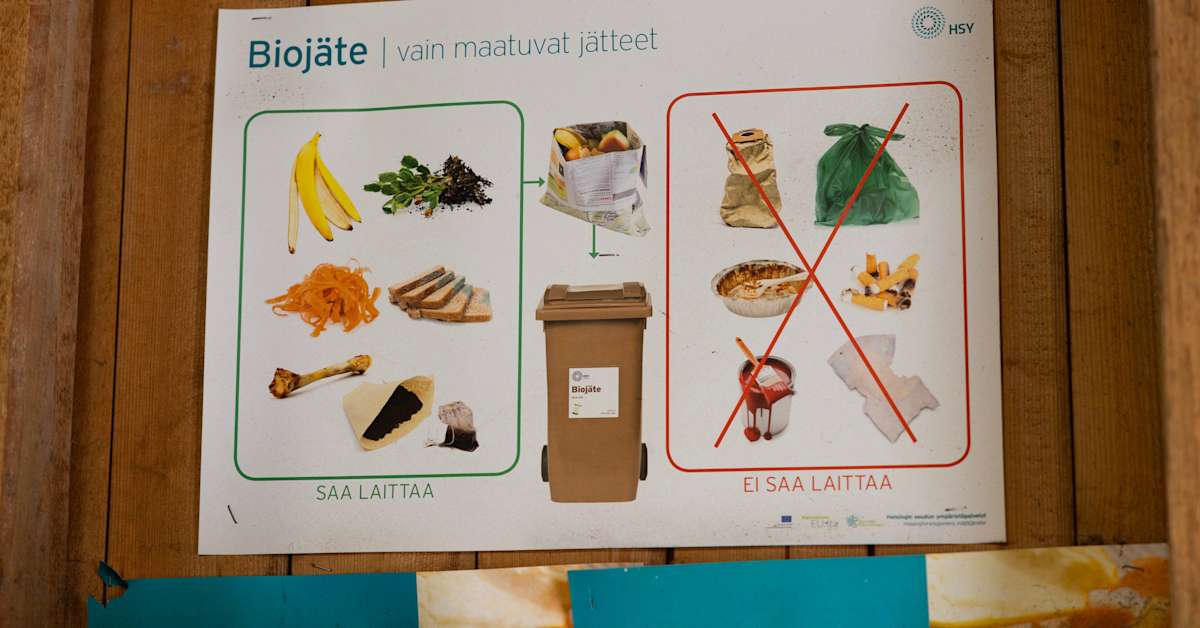
Nearly a third of garbage tossed into general waste bins by Finnish households is organic biowaste.
Open image viewer
A poster explaining which items can be placed in a biowaste receptacle. Image: Petteri Juuti / Yle
The EU’s waste recycling requirements are becoming stricter. By 2030, 60 percent of municipal waste must be recycled, compared to this year’s target of 55 percent.
Municipal waste is produced by homes, schools, shops and offices, for example.
“It unfortunately looks like we won’t reach the 55 percent target by the end of this year,” says Sirje Stén, a ministerial adviser at the Ministry of the Environment.
Back in 2020, Finland was one of 18 EU countries that failed to meet the required 50 percent recycling rate. According to the latest statistics, Finland still recycles less than half of municipal waste. The target for 2035 is 65 percent.
Multi-million-euro fines possible
Finland is therefore subject to EU infringement procedures. After a multi-stage process, there is the threat of a ruling by the EU Court of Justice and possibly a fine of tens of millions of euros. However, there is still a long way to go before that might happen, Stén notes.
“The EU made a statement on the matter last year, and Finland responded to it. There has been no official statement from the Commission on Finland’s response, so we don’t know whether they accepted our response,” says Stén.
The number-one problem with municipal waste is that far too much food-based biowaste still ends up in mixed waste bins. On average, 30 percent of the contents of a single garbage bag thrown into mixed waste is biowaste, even though there has been separate sorting of compost in Finland since 1993.
“Bins in the yard don’t help if people don’t sort. That’s the biggest thing, that 5.5 million people in Finland should be encouraged to sort their waste,” says Stén.
Last spring, a nationwide campaign was launched, urging people to sort biowaste and pointing out that it can be a valuable resource for fertilisers and energy.
“Finland is not a model student”
According to Hanna Salmenperä, a senior coordinator at the Finnish Environment Institute (Syke), sorting waste is seen as difficult in many households.
“Attention should be paid to this when designing homes and kitchens. There should be functional spaces and waste containers for sorting. In housing associations, waste collection points should be clean and pleasant to visit. These are quite practical things,” she says.
“We certainly have a lot of room for improvement in Finland. We’re not a model student in this regard,” says Salmenperä.