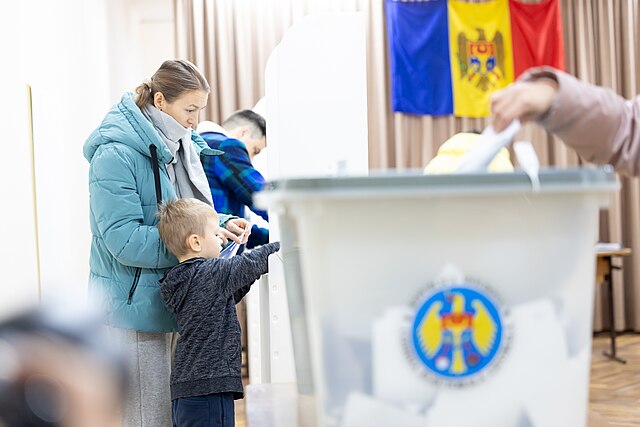
As the parliamentary elections in Moldova approach, scheduled for 28 September, the Kremlin is intensifying efforts to bolster pro-Russian parties in a bid to regain influence. By disseminating disinformation through social media platforms and media outlets controlled by fugitive oligarchs, and by exploiting the loyalty of certain opposition parties, Moscow aims to undermine Moldova’s European integration and establish a government aligned with Russian interests.
The level of Russian interference in these elections is unprecedented, as the outcome holds significant implications for Moscow’s objectives in the region. On 12 July, Igor Dodon, the leader of the major opposition Party of Socialists of the Republic of Moldova, visited Moscow once again. Irina Vlah and Vasile Tarlev, both opposition figures, accompanied him this time.
Since 1992, pro-Russian forces have maintained control over Transdnistria, a landlocked area in eastern Moldova that remains internationally recognised as part of Moldova. In this region, they have established the Pridnestrovian Moldavian Republic (PMR), which is only recognised by other unrecognised territories such as Abkhazia and South Ossetia, both of which are occupied by Russian forces. Severe human rights violations characterise the de facto government in Transdnistria. The pro-Moscow administration operates under a repressive system that includes the death penalty. In advance of the elections, it is reportedly targeting over 300,000 citizens with Moldovan nationality to compel their support for opposition parties.
Furthermore, pro-Moscow political entities, financially supported by oligarchs, have initiated a large-scale anti-EU and anti-Western campaign in Gagauzia, effectively acting against Moldova’s legitimate government. As a result, on 16 October 2024, the European Council added Evghenia Guțul, the governor of the Autonomous Territorial Unit of Gagauzia, to a sanctions list for promoting separatism, undermining constitutional order, and threatening the sovereignty of the Republic of Moldova. Other individuals, including Mihail Vlah, the deputy mayor and media relations advisor, Iurii Cuznetov, the deputy head of the region’s Department of Foreign Affairs, and Ilia Uzun, the vice president of the executive committee and a member of the National Assembly of Gagauzia, were also included in this sanctions list for actions destabilising the Republic of Moldova.
On 9 October 2024, the European Parliament passed a resolution strongly condemning Russia’s ongoing efforts to disrupt Moldova’s pro-European trajectory. The Parliament emphasised the serious nature of Russia’s increasing involvement in malicious activities, including electoral interference and hybrid operations, particularly in light of the forthcoming presidential election and constitutional referendum on EU integration on 20 October 2024. Members of the Parliament noted the role of various malicious actors, including pro-Russian Moldovan oligarchs and Russia’s state-funded RT network, in executing voter fraud schemes and information warfare. Despite these substantial challenges, incumbent President Maia Sandu emerged victorious in the elections.
On 15 July 2025, the European Council expanded the EU sanctions list to include nine individuals and three organisations associated with actions threatening Moldova’s sovereignty and independence, all linked to the fugitive oligarch Ilan Șor.
The threats that challenge the Moldovan democracy
On 18 September, the ruling Action and Solidarity Party (PAS) expressed concerns about potential repercussions for Moldova and its citizens should pro-Kremlin forces prevail in the parliamentary elections. The ruling party outlined seven distinct threats that could materialise if a government aligned with Moscow is established.
PAS maintains that the upcoming vote will be pivotal in determining whether Moldova aligns with Russian interests or continues its European integration. To underscore this critical choice, PAS organised an event that presented a dichotomy between “peace, development, and modernisation” and “poverty, lies, and theft.” Party leaders articulated how these threats could lead Moldova back to an authoritarian regime and adversely affect the daily lives of its citizens.
Threat 1: Potential suspension of funding and energy compensation payments
Igor Grosu, the Speaker of Parliament and leader of the PAS party, has issued a warning regarding the potential suspension of all construction projects initiated by the party, as well as energy compensation payments, if pro-Russian forces assume power after 28 September. He emphasised, “The threats we face are genuine and should not be underestimated. I urge all citizens to consider these matters with great care. This situation transcends the interests of the PAS and is fundamentally about the future trajectory of Moldova post-September 28. There is no middle ground.”
Threat 2: Kremlin’s possible appointment of fugitives to government positions
Prime Minister Dorin Recean, positioned second on the PAS electoral list, acknowledged that while justice reform “cannot be accomplished in a single day or year,” the government is committed to this essential endeavour. He cautioned that should pro-Russian forces gain control, “individuals currently evading justice may be permitted to return and would be welcomed back with open arms.”
He highlighted that a pro-Russian majority could promote individuals such as Ilan Șor as prime minister, Veaceslav Platon as finance minister, or Vlah as foreign minister.
He stressed that “This scenario is not merely a misunderstanding; it represents a serious and tangible risk. Moscow is actively supporting criminal elements within Moldova to facilitate a power grab and install these individuals in key leadership roles. Their intentions are clear, and it is crucial to reflect on what we genuinely desire on 28 September.”
Threat 3: Risk of losing visa-free travel to the European Union
Deputy Speaker of Parliament Doina Gherman has cautioned that a pro-Russian government could jeopardise citizens’ current freedom of movement within Europe. “We face the possibility that our relatives may no longer be able to return home, and we could encounter closed borders once more. It is imperative to consider how we can allow this to happen when we have a more favorable path—our European path—before us.”
Threat 4: Potential obstruction of the EU accession process
MP Lilian Carp has articulated concerns that a pro-Kremlin government could hinder Moldova’s efforts to join the EU and convert the nation into a “police regime.” “Individuals loyal to the Kremlin may occupy critical positions within the government, state institutions, and law enforcement agencies. Gradually, Moldova could be transformed into a state characterised by repression, where fear and violence replace the principles of freedom and democracy. This would ultimately lead to a loss of our national independence,“ Carp stated, underscoring that a PAS majority in the elections is essential for the country’s progress.
Threat 5: Emergence of an authoritarian regime
Education Minister Dan Perciun noted that if pro-Russian parties prevail in the parliamentary elections, Moldova risks forfeiting its freedoms and democratic values. He asserted that the PAS is engaged in a struggle “not against Dodon, Vlah, and Ion Ceban, but against the forces of Russia.“
“We stand for democracy and freedom. It is critical to consider the reality faced by an entire generation, which has known nothing but Putin and autocracy. Individuals who have dared to express differing opinions, protest, or vote contrary to prescribed norms have faced violence, exile, or even fatal repercussions in prison. This stark reality is one that we must confront, as it threatens to approach our doorstep, supported by illicit financial flows.”
Threat 6: Possible revocation of voting rights for the Moldovan diaspora
Foreign Minister Mihai Popșoi, who has suspended his official duties during the election campaign, has indicated that pro-Kremlin factions could revoke the voting rights of the diaspora if they ascend to power. “There is a desire to regress to past conditions: enduring long waits at consulates, diminishing polling places, and restricted travel options to Europe. The threat is real that our citizens abroad may be denied the opportunity to participate in elections. The voice of the diaspora is more crucial now than ever,“ Popșoi emphasised.
Threat 7: Risk of Moldovan children being exploited in armed conflicts
MP Marcela Adam said that “Kremlin-aligned alternatives“ would lead Moldova into a state of Russian control, where “our children may become embroiled in Putin’s conflicts.“
She highlighted that a pro-Kremlin government may concede everything to the Kremlin, “our land, our liberties, and, most importantly, our children.”