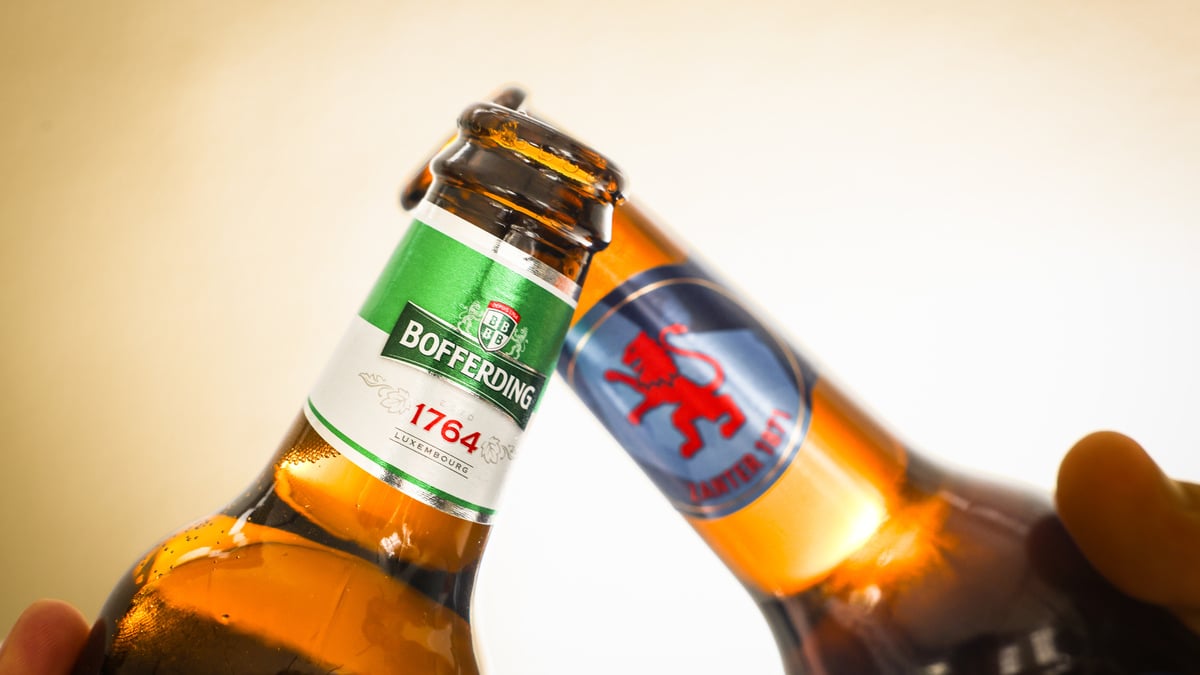
In recent decades, the country’s two main brewers have consolidated their dominance over the sector. Bar owners complain of intolerable rules, and Luxembourg’s Competition Authority has begun investigating their practices. This is the first article in an investigative series on the beer market in Luxembourg.
The owner of a bar in Luxembourg City that has been open for over thirty years speaks bitterly about the business conditions set by the country’s biggest brewers and drinks distributors.
“They do whatever they want with us. They set the rules, decide the prices of drinks, and even dictate what we can sell. It’s a true dictatorship,” he told our reporter inside his bar after being granted anonymity. Like almost all owners of licensed establishments that sell alcoholic drinks in the Grand Duchy, he fears reprisals from the big breweries.
The beer market in Luxembourg is peculiar. The country boasts some of the oldest European records of beer production (the first references date back to 1300, at Neumünster Abbey in the Grund), and there has been a proliferation of artisanal producers in recent years. But walk into a bar and you will largely find the same set of staples on tap.
Luxembourg’s main beer producers
Brasserie Nationale is the maker of Bofferding, Battin, and Funck-Bricher beers and Lodyss bottled water. It is Luxembourg’s largest brewery. It also owns Munhowen, the country’s largest company delivering drinks to restaurants and bars.
Brasserie de Luxembourg Mousel-Diekirch is Luxembourg’s second-largest beer-maker. It has been owned since 2002 by Belgium’s Anheuser-Busch InBev, the world’s largest beer company.
Brasserie Simon has been in the hands of descendants of the Simon family since its creation in 1824. It produces the Simon brand and several specialty beers.
Family-owned Lëtzebuerger Stad Brauerei makes Clausel beers from its base in Luxembourg City’s Clausen district.
Cattitude is the microbrewery behind Twisted Cat branded beers. It also operates a bar and restaurant in Dudelange.
Luxembourg’s brewers association, the Confédération des Brasseries et des Brasseurs du Luxembourg, also has as members the companies behind Heischter and Hinkelsbaacher beers, as well as labels too small to own their own production equipment.
Most of the country’s cafés, pubs and restaurants see their business limited to products sold by the breweries producing the Diekirch and Bofferding beer brands. The corporate control these brands exert over the national market, however, is now coming under scrutiny. Their dominance – which has silenced hospitality managers for decades – appears to be making its way into the public agenda.
The Luxembourg Competition Authority announced last week that it had begun investigating the country’s beer market. Its preliminary investigation found that the two breweries’ long-standing practice of tying bars and restaurants to exclusive sales of their products seem to keep prices high and limited opportunities for new competitors.
“The companies in question are accused of having blocked the national market for the production and supply of beer to the out-of-home channel (namely hotels, cafés and restaurants) by concluding single-brand contracts with a clear majority of beverage establishments located in Luxembourg,” the Competition Authority said of its investigation.
© Photo credit: Marc Wilwert
Although the two breweries were not identified by name, the targets of the investigation are obvious: Brasserie Nationale – maker of Bofferding, Battin and Funck-Bricher beers, and Lodyss bottled water – and Brasserie de Luxembourg Mousel-Diekirch – owned by Belgian brewing giant ABlnBev.
Why them? The market power of the two companies has remained largely unchanged since 2016, when Brasserie Nationale and Brasserie de Luxembourg together produced 82% of the country’s beer and dominated the beverage market in the hospitality sector, according to the competition authority’s 2019 report on the sector.
Brasserie Simon, producer of Simon, Okult, and Ourdaller beers, was third, producing 6% of Luxembourg’s beer in 2016, according to the report. Microbreweries were a growing force, but together they represented no more than 9% of the market at that time.
Contracts tying bars and restaurants to specific brands are also common in Germany, Belgium and the United Kingdom. But in the Luxembourg case, their dominance in the sector has raised questions about the depth of the brewers’ control.
Brasserie Nationale and Brasserie de Luxembourg did not respond to our requests for comment about the competition authority’s investigation.
Penalties for engaging in monopolistic cartel practices are punishable with hefty fines under Luxembourg and European law.
Total control
The owner of the Luxembourg City bar feels cornered.
“They hold the operating licenses, the rights to the spaces where alcohol can be sold, and they even establish contracts with their own impositions [sales goals],” the man explains. “We have to buy what they want, in the amount they want. And then pay and shut up. This can’t be fair.”
Indeed, the Grand Duchy’s competition authority is focusing on the types of exclusive contracts that restaurant or pub operators have signed with the two breweries or their related distribution companies that actually deliver the drinks.
“A significant number of contracts include an obligation to distribute at least 80% of a specific brand of beer. Other clauses impose a minimum turnover or a minimum quantity of beer to be sold, often of such magnitude that the clauses are, in practice, equivalent to exclusivity clauses,” the competition authority’s 2019 report stated.
These contracts could benefit a bar operator with promises of special discounted prices or the provision of items like €2,000 beer kegs, refrigerators and beer taps, the report said.
The arguments on the other side are that exclusive contracts allow Luxembourg’s large brewers – which are small by European and global standards – to help new hospitality businesses get off the ground. Bars and restaurants operate in a sector where bank loans are difficult and businesses often fail, said Isabelle Lentz, CEO of Munhowen, the distribution subsidiary of Brasserie Nationale.
Isabelle Lentz, CEO of Munhowen, the distribution subsidiary of Brasserie Nationale. © Photo credit: Guy Jallay
“We know the restaurant and the landlord. We provide financing and other things, like furniture or a beer tap. We’ve known how this works for decades. In many cases, we also guarantee the landlord’s rent. This allows restaurants to emerge and develop,” Lentz told the Luxemburger Wort earlier this year.
In addition to contracts that bind bars and restaurants to specific brands, Luxembourg breweries also keep bars and restaurants under control, as they may own and rent the bar premises or provide the necessary liquor license for operation.
For decades, Luxembourg law has attempted to limit how many establishments sell alcoholic beverages by capping the number of state-issued licenses based on the size of municipalities, with smaller cities having fewer licenses available. But the Grand Duchy’s licensing law also allows breweries, bar owners and other individuals to acquire and hold licenses that can then be rented or sold to third parties.
Brasserie Nationale and Brasserie du Luxembourg hold 43% of the 2,767 alcohol licenses in active use, including 1,147 that can be transferred from one location to another rather than being tied to a specific address, Finance Minister Gilles Roth said in response to a parliamentary question last year without naming the local beer giants.
The average selling price of a license in 2011 was around €35,000, with owners listing its value as an asset on their balance sheets, the Luxembourg Chamber of Commerce reported that year. A draft law proposed in 2010 to issue new, more easily available liquor licenses for €15,000 each would have wiped around €20 million from Luxembourg breweries’ balance sheets, the chamber said 14 years ago in opposing the change.
Beer production in Luxembourg dates back as early as 1300 AD © Photo credit: Marc Wilwert
The proposed law remained in parliament until it was withdrawn in 2019.
With alcohol licenses held in bulk by large breweries on top of their exclusivity contracts, Brasserie Nationale and Brasserie de Luxembourg “control the final points of sale, preventing new entrants from entering the market or developing their presence and production beyond a few independent outlets,” the competition authority stated in 2019.
“Limiting the number of cabaret licenses has contributed to the creation of a market dominated by two breweries, to the detriment of craft breweries and beverage establishments, as well as the entire Horeca [hotels, restaurants and cafés] sector,” the competition authority stated in 2022.
Back to 2025. A decision on the need to intervene as a result of the investigation could take several months or even years, as is typical for any competition decision in the European Union, a spokesperson for the Luxembourg authority stated.
Competition authorities strive to ensure that companies do not become overly dominant in a market and that companies have an incentive to constantly innovate and offer consumers the best possible products and services.
“The beer sector has been the subject of constant attention by the Authority for several years,” the spokesperson wrote in an email. Now, it’s time to take a closer look.
*This article is part of a joint investigation by the Luxembourg Times, Luxemburger Wort and Contacto.