In the run-up to this week’s general election, Czechs venturing online have been served up a growing amount of content that reflects the world-view of President Putin.
Some is a direct translation of articles from Russian sites banned under sanctions imposed after the full invasion of Ukraine in February 2022. Much of the rest reflects Kremlin talking points, whether on the conflict itself, climate-change denial or attacking Nato or the EU.
“The Czech internet is being flooded with this stuff before the election,� said Vojtech Bohac, the head of Voxpot, an investigative website that conducted a study into the growth of such sites, which are churning out about 5,000 articles a month — equivalent to the output of the country’s largest mainstream publishing house.
Similar material, apparently inspired by Russia’s government or those linked to it, is circulating in Moldova, 900 miles to the east, which faces crucial parliamentary elections on Sunday that could dictate whether the former Soviet republic of 2.4 million people will continue on a pro-western course, its newly elected president angling for membership of the EU, or tilt back towards Moscow.
Last week, in a series of 250 raids, about 74 people were arrested on suspicion of planning to provoke anti-government riots on the eve of the vote.
“Moldova is hugely important to Russia. There’s a kind of symbolic importance to it,� said Ben Dubow, an expert at the Washington-based Centre for European Policy Analysis, who has been monitoring the spread of pro-Moscow propaganda on websites and social media.
Both elections have coincided with alarm about incursions this month by Russian drones and aircraft into Polish, Estonian and Romanian airspace in what appears to be an attempt to test Nato’s defences and willingness to respond.
• Russia sees Moldova as a decisive battle in its war on the West
• Zelensky: We are living through most destructive arms race in history
At a meeting on Friday, ten of the EU’s easternmost states formally launched an initiative to build a “wall� — containing a mix of everything from acoustic sensors and signal-jammers to traditional artillery — to detect and destroy incoming drones.
The Czech Republic, whose nearest border with Russia is more than 600 miles away, was not among them, but shares its easterly neighbours’ concern. “On a scale from one to ten, where one means lasting peace and ten means war, we are approaching eight,� Karel Rehka, chief of the general staff, told Czech television last week.
Security experts see the aerial and online probing as part of a policy of hybrid warfare that dates back to the early 2000s, which Putin stepped up after his first assault on Ukraine in 2014, when he seized Crimea, and again eight years later.
Will Moldova roll over?
Of the two countries going to the polls, Moldova, sandwiched between Ukraine and Romania and a member neither of the EU nor Nato, is by far the more vulnerable.
The party of Maia Sandu, the pro-western president re-elected for a second term last November, is struggling to hold on to its majority in the face of a strong push by a political bloc led by Igor Dodon, the former pro-Moscow president she defeated in 2020.

The pro-western government in Moldova is struggling to hold on to a majority
VADIM GHIRDA/AP
According to Dubow, online disinformation follows more traditional influence operations aimed at promoting the Russian world-view via television broadcasts, now banned in the country, or through the Moldovan Orthodox Church, which ultimately answers to Moscow.
Confronted with the assault, the government finds itself in an invidious situation: tolerate the sites or clamp down and risk confirming the charge that it is suppressing free speech.

Maia Sandu, the pro-western president of Moldova
RONALD WITTEK/EPA
Sandu, 53, last week accused the Kremlin of “pouring hundreds of millions of euros� into spreading disinformation and warned that her country’s independence and future membership of the European Union are under threat.
The president herself has been a target: one campaign dubbed “Matryoshka� has falsely accused her of embezzling $24 million and being addicted to “psychotropic drugs�; another of trafficking Ukrainian children to paedophiles.
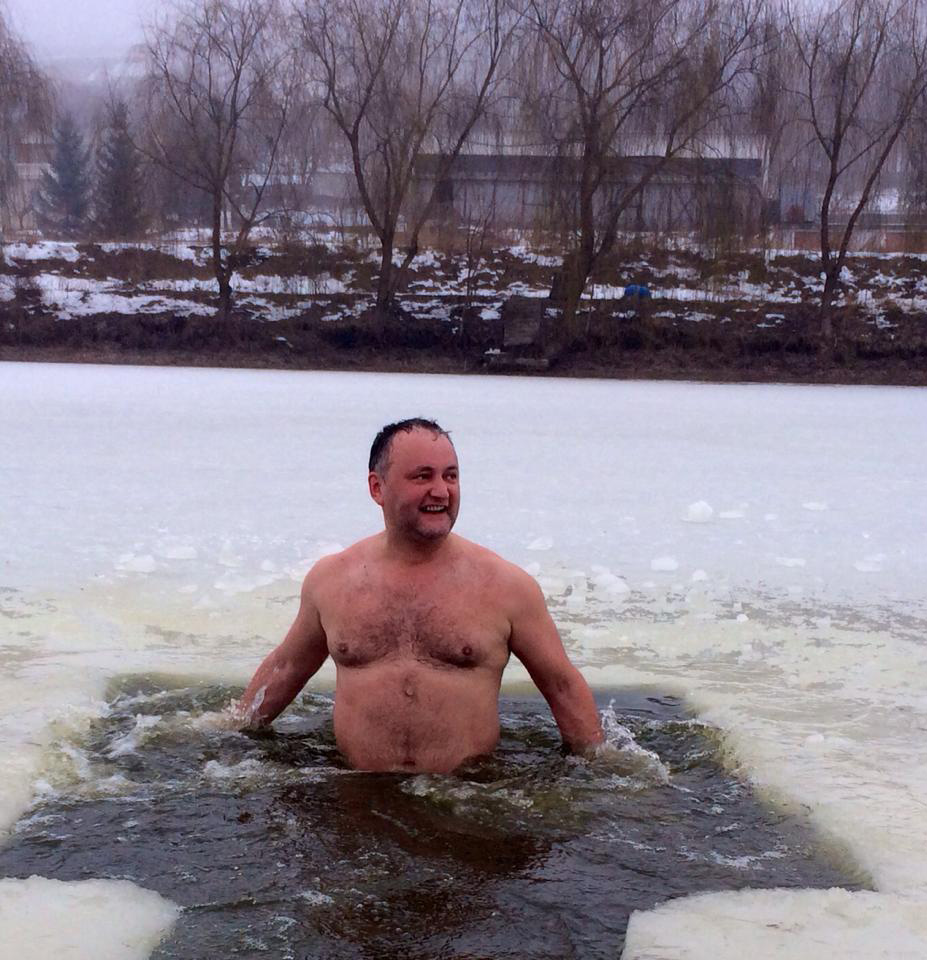
Igor Dodon, the former pro-Moscow president who was defeated in 2020
“If Russia gains control over Moldova, the consequences will be immediate and dangerous for the entire region,� she said. “Every Moldovan will suffer, no matter who they voted for.�
• Moldova arrests 74 over ‘Russian plan to incite mass riots’
Sandu’s warning was echoed by Ukraine’s President Zelensky, who said in a speech at the United Nations that his neighbour risked following Belarus and Georgia, both also fellow former Soviet republics, back into Moscow’s arms, adding: “Europe cannot afford to lose Moldova too.�
Reality check
The Czech Republic, a member for more than two decades of both Nato and the European Union, is far more firmly anchored in the West.
But its prime minister, Petr Fiala, is struggling to hold on to power ahead of elections on Friday and Saturday in the face of a challenge from Andrej Babis, 71, the billionaire businessman who ran the country until 2021.

Petr Fiala, the Czech prime minister, faces an uphill battle to retain power
MICHAL CIZEK/AFP /GETTY IMAGES
Polls put Babis’s right-wing populist Ano (Action of Dissatisfied Citizens) party on 32 per cent, way ahead of 19 per cent for Spolu, the coalition led by Fiala.
Fiala, 61, a former professor of political science, has kept the Czech Republic in the European mainstream, and last year pioneered a multinational arms initiative to provide Ukraine with hundreds of thousands of artillery shells.
“Fiala’s approach is like that of Angela Merkel: that at a time when everything is in a flux you want someone who is calm and steady — and that this lack of charisma is a good thing,� said Petra Guasti, associate professor of political science at Prague’s Charles University.

A supporter of the far-right Freedom and Direct Democracy party (SPD)
MICHAL CIZEK/AFP/GETTY IMAGES
Yet for Fiala, as for other European leaders, incumbency is proving a drawback among voters who seem determined to turn against whoever is in power — and listen to those who offer a radical alternative. To make matters worse, in the run-up to the election, two of his ministers have been hit by financial scandals.
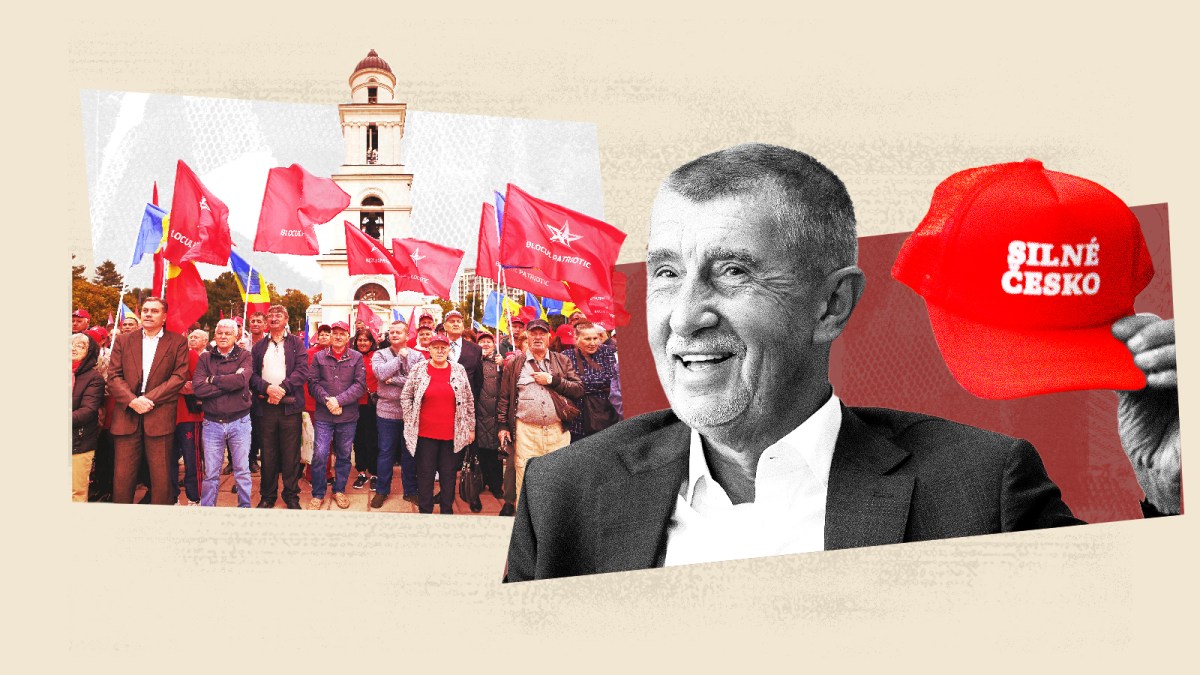
Babis — whose supporters sport red “Silne Cesko� (strong Czechia) caps, which he signs after rallies — has been making the most of his rivals’ discomfort.
“I went into politics when I was already very rich. That’s why they cannot corrupt me,� he said in June while in France for a meeting of right-wing European party leaders hosted by Marine Le Pen, the leader of the French populist right National Rally.

Andrej Babis and his supporters wear Trumpesque caps saying “Silne Cesko� (strong Czechia)
DAVID W CERNY/REUTERS
A few weeks later, the High Court overturned an earlier ruling clearing him of fraud for a €2 million EU subsidy he received for Capi hnizdo (Stork’s Nest), his luxury hotel and conference centre south of Prague. Babis denies the accusation, which he claims was politically motivated.
Such scandals are a gift for the sites investigated by Bohac and his team at Voxpot.
“It is a fact that Russia is trying to interfere in the Czech information space,â€� said KristÃna Sefcikova, head of the information resilience programme at the Prague Security Studies Institute. “It’s about exploiting societal conflicts and any kind of confusion, information chaos and relativisation of the truth.â€�
• Inside Putin’s propaganda playground — cash, clicks and clergy
• ‘Dog assassination plot’ threatens billionaire’s run for Czech PM
Such sites also appear keen to promote two fringe parties: the Stacilo (Enough) coalition, on the far left, and the Freedom and Direct Democracy party, on the far right, both of which are demanding a referendum on leaving Nato and the EU.
The parties, which together may take as many as 20 per cent of the vote, are both potential, if uncomfortable, coalition partners for Babis. Guasti said he may prefer to do a post-election deal with Fiala’s party, but without Fiala himself.
Both parties feature frequently on one of the most prolific sites, Cz24.news, whose slogan is “We are here for those who really want to know the truth�.

Trump with Babis and their wives Monika, left, and Melania, in 2019
ALEX EDELMAN/BLOOMBERG VIA/IMAGES
Sitting in his office on the edge of Prague, Bohac scrolls through the headlines and garish images that appear to be AI-generated.
“Europe is in shock. Russia has discovered a secret ally, which should help it to win, and there is no defence against it,� reads one that he translates into English. Others allege government politicians are drunk and on drugs; some are in favour of Trump; others explain how Ukraine is losing.
The site is registered abroad and does not reveal its owners. After some sleuthing, Bohac traced it to Jitka Entlichova, a former candidate for the Alliance of National Forces, a far-right party, whose day job involves looking after the family’s carpet and textile business in Kladno, west of Prague.
When Bohac met her at her warehouse, she admitted running the site “with the help of three or four volunteers�. Unconvinced, he said he questioned how such a small team could publish as much as a large established media organisation. Bohac said: “She then asked me to leave.�