This article was first published in “Télécran” (issue 37/2025). You can subscribe to the weekly magazine here.
A Luxembourg slate museum has applied to become the country’s latest Unesco World Heritage site, four decades on from the closure of the last mine.
Relevant officials have already visited the Haut-Martelange Slate Museum, or Musée de l’Ardoise, on several occasions, explains former mayor and museum president Marco Schank.
The officials have described the area as “extremely authentic”, says Schank, with a group set up with various local stakeholders involved in the application. However, a long process awaits, as it could be eight to ten years before a decision is made.
At its high point, the slate mine in Haut-Martelange used to employ around 600 people at the beginning of the 20th century before the industry’s gradual decline saw the last quarry in Luxembourg shut down in 1986.
The sight of the area lying vacant was a situation that various inhabitants of the neighbouring villages were not prepared to accept, and, wanting to prevent a piece of important industrial history from being forgotten, formed a charity in 1992.
In its early days, the Frënn vun der Lee association sought to make the site accessible to visitors again, re-opening the facility bit by bit over the following years thanks to the efforts of numerous volunteers.
When the Frënn vun der Lee started their voluntary work in 1992, the decay of this unique site in Europe was well advanced. A lot has happened since then, partly because various politicians recognised the potential.
Initially, protective measures were taken, such as covering the buildings. In 2010, a masterplan was developed by the heritage conservation office, which picked up speed again in 2017. Since the beginning of 2019, the open-air museum has been managed by the Musée de l’Ardoise association, which is made up of representatives from the government, the municipality of Rambrouch and the Frënn vun der Lee.
Tourism potential
When Télécran visited on a scorching August day, many Dutch and Belgian tourists had gathered to immerse themselves in Luxembourg’s industrial heritage.
And immerse in the truest sense of the word, because in addition to a walk across the eight-hectare site comprising 22 buildings, visitors have also been able to descend into the pit called Johanna since October 2022. There are many steps down to a depth of 42 metres, where the temperature is just 9°C.
As soon as you pass through the turnstile at the entrance, you are surrounded by darkness, which is brightened up by flickering lights modelled on the carbide lamps used at the time. It is damp. Again and again, drops fall from the wet walls. For some, it may take some getting used to descending into the earth. But it is fascinating from the very first second.
Visitors must wear a safety helmet to avoid injuring their heads on the rock formations that protrude in some places. And indeed, the corridor narrows in some places towards the top, so the helmet does not miss its mark. For safety, there are also handrails to hold on to along the entire circular route through the mine.
“We’re not in a race here,” says Schank, the former mayor, CSV deputy and government minister who is guiding visitors. “Everyone walks at their own pace – the way they feel comfortable.”
Safety precautions
A third safety precaution is reassuring for all those who don’t know exactly whether descending below the earth’s surface is right for them: small boxes with blue buttons are attached to the wall at certain intervals.
There is always a person at the cash desk at the entrance who monitors what is happening in the tunnel via a screen in case someone would rather go back. “I’ve only had that happen once or twice,” says Schank.
Since October 2022, visitors have been able to descend up to 42 metres into the mine known as “Johanna” © Photo credit: Marc Wilwert
The first underground mines were opened at the site at the end of the 18th century. In the beginning, the workers carried the blocks of rock up on their backs © Photo credit: Marc Wilwert
Workers took their breaks underground © Photo credit: Marc Wilwert
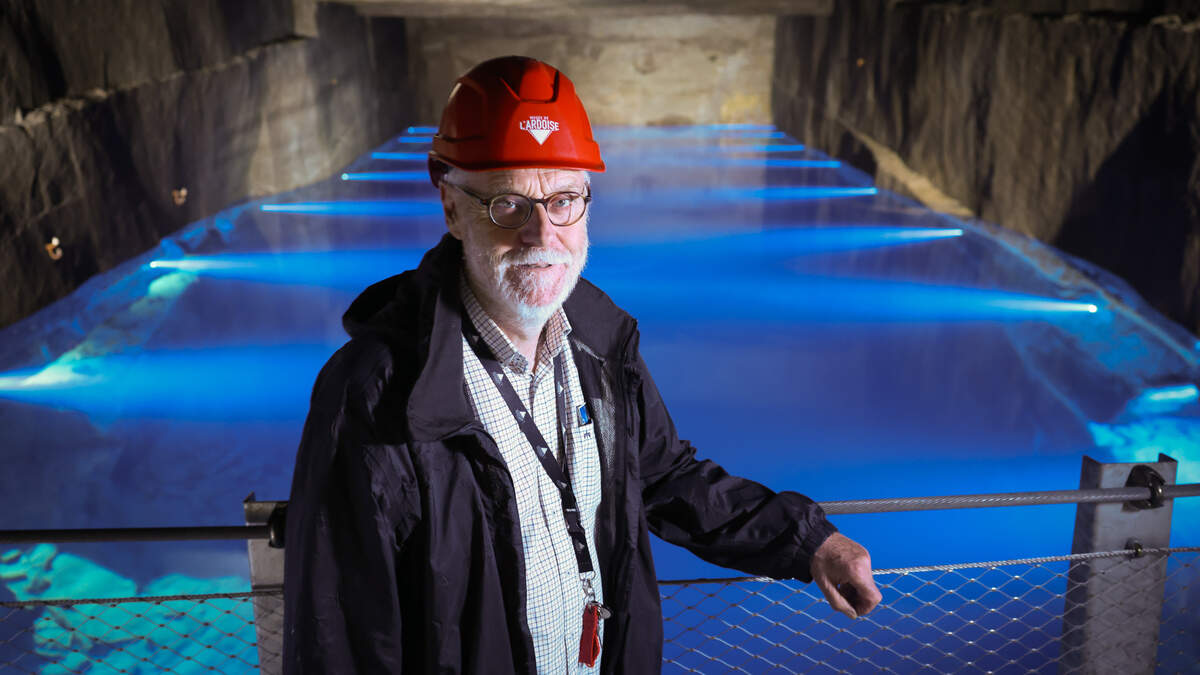
Light installations in the chambers create a mystical atmosphere © Photo credit: Marc Wilwert
A narrow bridge leads over the water surface of the deepest chamber, which moves gently back and forth depending on how many visitors are walking or standing on it © Photo credit: Marc Wilwert
At the end of the 18th century, the first underground pits were created in Haut-Martelange, which were operated by several families and where more than six million roofing slates were produced annually towards the end of the 19th century.
In the beginning, the slate was mined with picks and hammers, Schank explains, pointing to the distinctive marks on the walls.
“From the turn of the century, more and more work was done with pneumatic hammers and drills,” he said. In some pits in the second half of the 19th century, steam engines were also used. Other mining methods followed in the 20th century, such as the wire rope, which cut into walls.
A photo of a worker carrying a large block of slate up a ladder on his back is projected onto one wall of the chamber. “The load could not be tied down, otherwise the miner could have fallen down with the block,” says Schank, explaining that the worker also had to balance the rock while carrying it.
It was not until 1890 that inclined lifts were built to enable faster transport from the bottom to the top, and there were rails installed between the mining chambers.
Seeking the ‘good stone’
Before the time of the inclined lifts, old chambers were filled with slate rubble and walls were built in front of them. Workers used wooden poles to build fixtures along the dry stone walls to attach ladders to, and were also at great risk of contracting pneumoconiosis, which was only recognised as an occupational disease at a late stage.
The 24 mining shafts, which reached a maximum depth of 168 metres, were around 40 metres long and between 12 and 14 metres wide.
“When opening up new chambers, the workers went after the so-called ‘good stone’,” explains Schank. “They quickly developed a feeling for which one was suitable or not.”
Pumping out the groundwater was also a major challenge. The blue line shows the actual water level, which is at minus twelve metres © Photo credit: Marc Wilwert
It was not until 1890 that lifts were built to enable faster pumping from the bottom to the top, and rails were installed between the extraction chambers © Photo credit: Frënn vun der Lee asbl
Around 1900, around 600 people worked in the slate quarries in Haut-Martelange © Photo credit: Frënn vun der Lee asbl
At the end of the 19th century, more than six million roofing slates were produced annually © Photo credit: Frënn vun der Lee asbl
Pumping out the groundwater was also a major challenge. Schank points to a blue line that indicates the actual water level. It is set at minus twelve metres.
In the 19th century, pumping was done by humans or animals, with a steam engine used from 1870. In 1904, an energy centre was put into operation to produce electricity.
A German entrepreneurial family was responsible not only for the energy centre, but also for further modernisation of the production facilities, including the connection of the site to the Jhangeli narrow-gauge railway. The Rother brothers acquired all the mines and residential buildings in the village from 1890.
The most mystical place on the tour is also the deepest chamber, located 41 metres below the surface. It is partly filled with water.
There, you can still see the railway tracks from the past under the surface of the water, and a narrow bridge leads over the surface of the water, which moves gently back and forth depending on how many visitors are walking or standing on it.
Here too, a light installation creates a very special atmosphere. From time to time, drops fall onto the blueish illuminated water. Whatever we say echoes off the walls like in a cathedral. From this point, the path slowly winds its way back up through further chambers, with 370 steps in total.
Vital volunteers
Ten employees take care of the “daily business”, as Schank explains. He is delighted that the cooperation between the two associations, the voluntary Frënn vun der Lee and the Musée de l’Ardoise, which comprises the government representatives, works so well.
“That makes me proud. After all, the 80 or so active members of one asbl [charitable association] earn nothing compared to the eleven employees of the other asbl. That could theoretically harbour potential for conflict, but that’s not the case,â€� he notes.
One of the active volunteers is Romain Reisdorfer, who demonstrates the work in the former forge to visitors on certain days © Photo credit: Marc Wilwert
Among the active volunteers of the Frënn vun der Lee are Jean Konsbruck, Saeul’s former mayor, Daniel Collignon and Romain Reisdorfer.
They have gathered at the Slate Museum on this hot summer’s day to demonstrate to visitors in the former forge how tools were made back then.
Not only there, but also in the adjoining locksmith’s and carpenter’s workshops, all the tools and aids were made by the craftsmen themselves.
Reisdorfer, a former bodyguard for Schrank when he was a government minister, saw an advert in the Télécran in 2017 for training for the volunteer position and was immediately enthusiastic, as his hobbies had long included locksmith work. So he completed the training and now offers courses himself four times a year.
René Risch worked in the slate quarries for a total of 24 years, beginning in 1954, when he was just 14 years old © Photo credit: Marc Wilwert
The 85-year-old is shown here cutting the slabs © Photo credit: Marc Wilwert
At another workbench, Risch demonstrates how to split pieces of slate into four-millimetre-thin shingles. © Photo credit: Marc Wilwert
Risch carefully applies the chisel and hammers with dexterity until the slice breaks in two. He does this until the piece of slate has become a very thin slab © Photo credit: Marc Wilwert
During his working life, Risch cut 800 slates per day into the appropriate shape © Photo credit: Marc Wilwert
René Risch is another one of the active members who, from 1992 until two years ago, also showed visitors the former trades on the site.
Especially for the visit of Télécran, the 85-year-old has come to the so-called ‘splitting house’, where the slate pieces were split into slabs.
Risch worked in the slate quarries for a total of 24 years, beginning his working life in the mines at the age of just 14 back in 1954. Supporting himself with one hand on a stick, he carefully walks up to the machine where he cut thousands of slates.
When he sits down on the small bench and demonstrates his work from the past, it is hard to believe that there are so many decades separating that time from today, as his movements seem so routine.
He places the slate in front of him, lays a template on it and draws the outline with a swift stroke. Then he lifts the knife by the handle, places the slate underneath and nimbly cuts off the slate piece by piece along the drawn line. He used to cut 800 pieces per working day, or 100 per hour.
“It had to be done quickly, quickly,” he explains. And while he’s at it, he shows us how to split pieces of slate into four-millimetre-thin pieces at the workbench next door. He carefully applies the chisel and hammers with dexterity until the disc breaks in two. He does this until the piece of slate has become a very thin slab.
On his way out, Risch, who was honoured for his services as a volunteer at the Luxembourg Tourism Awards in 2023, jokes: “Now I’m going to the payroll office to collect my money.” The former office is now home to the cosy “Bopebistroâ€�, where everyone goes to enjoy a refreshing drink.
Anges Hoogenhout, the president of Frënn vun der Lee since 2010 and an active volunteer since 2003 © Photo credit: Marc Wilwert
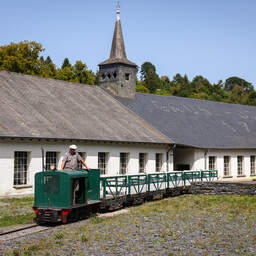
Visitors can also take a train across the eight hectares and 22 buildings of the Slate Museum © Photo credit: Marc Wilwert
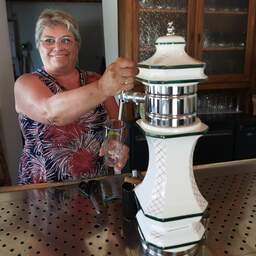
The visitors, the blacksmiths and René Risch are all there, and everyone sits either inside or outside on the terrace to have a drink or an ice cream.
Agnes Hoogenhout, president of the Frënn vun der Lee since 2010 and a volunteer since 2003, is on bar duty. The Dutchwoman has just returned from a guided tour, where she always takes responsibility for the Dutch groups.
Explaining her enthusiasm for the site, she says: “You’re infected after just a short time here. You feel like you’re in another world.”
The budding UNESCO World Heritage site has also served as a location for several film shoots, the most famous of which is Colonia Dignidad about the German sect of the same name in Chile, which was shot in 2014 with actors such as Emma Watson and Daniel Brühl.
The restored Villa Rother will open to the public in June 2026. It will host a photography exhibition with works by Nic Molitor © Photo credit: Marc Wilwert
The villa’s owner, August Rother from Frankfurt, had a hunting lodge built next to the property © Photo credit: Marc Wilwert
The view of the villa’s meeting room shows a portrait of August Rother on horseback. Eother loved to visit the grounds of his property on horseback © Photo credit: Marc Wilwert
At the end of our tour, we take a look at the villa of the owner, August Rother from Frankfurt/Main. The restored house will open in June 2026. There will then be a photo exhibition with works by a friend of the family, Nic Molitor. The hotelier from Bauschleiden was passionate about photographing the area and what happened there and left behind over 2,500 glass plates, which are now in the museum’s possession.
At the end of our tour, we take a look at the villa of the owner, August Rother, a native of Frankfurt. The restored house will open in June 2026, featuring a photo exhibition of works by a friend of the family, Nic Molitor. The hotelier, from Boulaide, was passionate about photographing the area and its events, leaving behind over 2,500 glass plates, which are now in the museum’s possession.
Museum opening hours and information
The museum is open all year round from Tuesdays to Sundays from 10:00 to 18:00, with the exception of 25 December and 1 January.
There are guided tours, but you can also explore the area on your own, as access to the grounds is free. To visit the underground area for a fee, there are certain time slots every 45 minutes or so when visitors are admitted. Sturdy shoes and a jacket are recommended.
Various workshops for children, adults and school classes are also organised on the site. In addition, various rooms such as the “Bopebistroâ€�, the former owner’s hunting lodge or the sawmill can be hired for events such as children’s birthday parties. The “Koll an Aktioun” events and the Christmas market are also always well attended.
Further information and prices can be found at ardoise.lu.