Editor’s Note: Sanda Sandu is a security expert at the Konrad Adenauer Foundation, Republic of Moldova. She is the co-founder of the Platform for Security and Defence Initiatives and has extensive experience in security-sector governance, disinformation, and human rights. Sandu has authored and coordinated multiple studies on human rights, integrity building, disinformation, and security in Moldova and Eastern Europe, contributed to the development of the National Security Strategy of the Republic of Moldova, and is actively involved in shaping national security policies.
By Rachel Stohl, Director, Conventional Defense Program
Introduction
On September 28, 2025, Moldovan citizens delivered a decisive vote in parliamentary elections shaped by one of the most aggressive hybrid interference campaigns Russia has coordinated in Moldova and in the region. Despite Moscow’s sustained efforts to destabilize the process through illicit financing, disinformation, cyber attacks, bomb threats, orchestrated protests, and institutional sabotage, the pro-European Party of Action and Solidarity (PAS) secured 55 seats in parliament, thereby gaining a majority by surpassing the 51 seat threshold. The result ensured that Moldova’s trajectory toward European Union integration remains on track, with accession negotiations that should start and accelerate in advance of the 2029 European elections.
For the United States, the significance extends well beyond Moldova’s borders. The vote represents a democratic victory in a fragile state but also a critical test case in resisting Russian hybrid warfare. Moldova is where Moscow deployed its most advanced tools, including cryptocurrency, deepfake-driven disinformation, and even paramilitary-style training abroad for protest escalation. The resilience shown by Moldovan institutions, voters, and diaspora communities offers lessons for ensuring resilience and defense against hybrid threats.Â
Parliamentary Elections and Democracy Under Siege
The September elections were held under extraordinary pressure. Russian operatives deployed vast resources, expending more than 100 million dollars, for an interference campaign designed to tilt the balance away from pro-European forces. Ilan Șor, a fugitive oligarch operating from Moscow, played a central role by financing anti-government protests, experimenting with a ruble-based cryptocurrency (A7A5), and channeling money through black-market exchanges in Turkey, the UAE, and Lebanon. Although U.S. sanctions ultimately crashed the coin and disrupted financial pipelines, the scale of illicit resource flows highlights the Kremlin’s determination.
Beyond money, Russia invested in shaping the information environment. Moldova was subjected to massive disinformation operations that included deepfakes, bot networks, fabricated news stories, and micro-targeting campaigns that reached even adolescents as young as 12. These operations were reinforced through the Orthodox Church, which was aligned with the Moscow Patriarchate, acting as both a civic mobilization hub and a vector for legitimizing pro-Russian narratives. The hybrid operations included false bomb threats and planning street violence aimed at portraying the state as fragile and incapable of securing elections. Evidence from police and intelligence investigations also emerged that Moldovans were trained in Serbia by Russian special services in tactics of resistance and confrontation with law enforcement, which represents an alarming sign of how Moscow seeks to convert social protests into destabilizing paramilitary pressure.
However, a significant blow to pro-Russian campaigning may have come from an entirely different front. Just three days before the vote, Greece authorized the extradition of oligarch Vladimir Plahotniuc, the central figure in the 2014 “theft of the billion� scandal that drained Moldova’s banks of roughly $1 billion. For Moldova’s President, Maia Sandu, who has built her political career on fighting corruption, and the political party PAS, this moment reinforced her credibility and provided a powerful narrative boost at the final stage of the campaign.
On September 23, Russian foreign intelligence stated that the European Union allegedly intends to “…keep Moldova in line with its Russophobic policy. This is to be done at any cost, up to and including the introduction of troops and the actual occupation of the country.� The Russian Foreign Intelligence Service also reported that NATO forces were allegedly preparing a “landing� in Odessa to intimidate pro-Russian residents of Transnistria and destabilize Moldova. Despite the disinformation, Moldovan voters appeared unswayed. Out of 1,608,518 ballots cast (52.21% turnout), the pro-European party secured 55 mandates, supported strongly by the diaspora — a consistently a pro-European constituency — that cast over 281,000 votes.
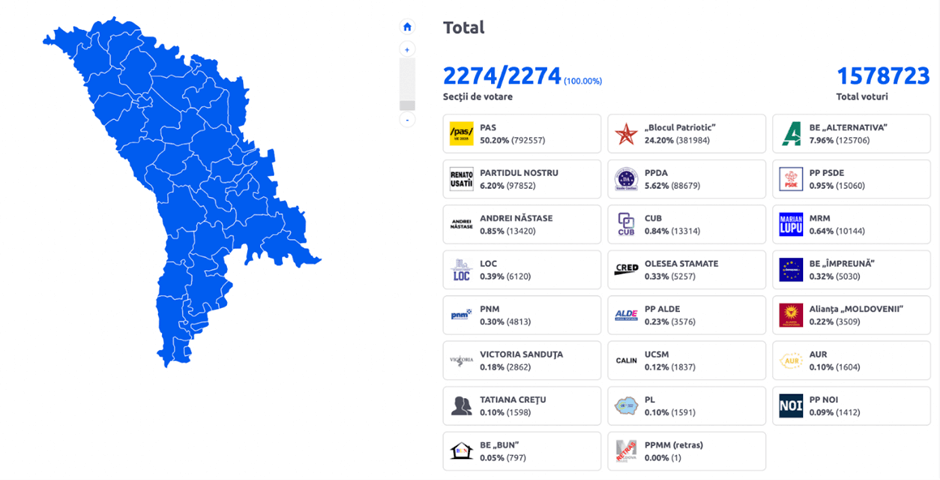
Source: Central Electoral Commission, vote results, parliamentary elections, 2025
Impact: What Comes Next?
The pro-European victory stabilizes Moldova’s course, but challenges remain acute. Three broad implications stand out for Moldova, Europe, and the United States.
The victory strengthens Moldova’s integration process into the European Union. European Commissioner for Enlargement, Marta Kos, confirmed that Moldova’s integration vector will continue, and negotiations could accelerate and even be finalized ahead of the 2029 European elections. However, Russia will not abandon its campaign. Instead, Moscow is likely to recalibrate, moving from overt electoral manipulation toward sustained efforts to exploit state vulnerabilities and social polarization. The task for Moldova’s government will be to maintain reform momentum, particularly in the areas of justice and anti-corruption, while building resilience in the information space.
Moldova served as a laboratory for the Kremlin. The use of cryptocurrency laundering, massive disinformation, and paramilitary and protest training all mark an evolution in hybrid interference. These methods are likely to be exported to other vulnerable states, from Georgia to the Western Balkans, as well as to EU and NATO countries. There are already indicators. Examples include incidents involving drones flying in Denmark’s airspace and planes flying into Estonian airspace. For Washington, the key lesson is that Russian hybrid warfare adapts quickly, incorporating new technologies and exploiting specific vulnerabilities in target states. Moldova provides an early warning of what may be attempted elsewhere.
For the United States and its allies, Moldova’s successful resistance strengthens the credibility of the transatlantic project. U.S. support, through sanctions on illicit financial channels, strengthening cyber capacities, cooperation, and public diplomacy, is a key factor in limiting Russian influence. Sustaining and even strengthening this support will demonstrate that democratic resilience is possible, even under the most sophisticated hybrid attacks.
Conclusion
Moldova’s parliamentary elections in September 2025 represent a turning point. Despite the Kremlin’s most advanced hybrid campaign to date, Moldovan voters delivered a clear majority for the pro-European party, ensuring that the country’s integration into the European Union will continue. This outcome consolidates Moldova’s place in the Western community and offers a blueprint for resisting Russian interference.Â
As expressed by Siegfried Mureșan, Member of the European Parliament and Vice-President of the European People’s Party, “Moldova’s pro-European victory is a lesson for all of Europe on how to defend against Russian interference.�
For the United States, the stakes extend far beyond Moldova. Russia tested new methods of hybrid warfare. Washington should draw from the lessons learned, noting that sanctions on illicit finance appear to work, diaspora engagement can reinforce democratic outcomes, and coordinated support with European allies is key. Supporting Moldova and the transatlantic partnership is a strategic investment in protecting and strengthening democratic resilience.Â
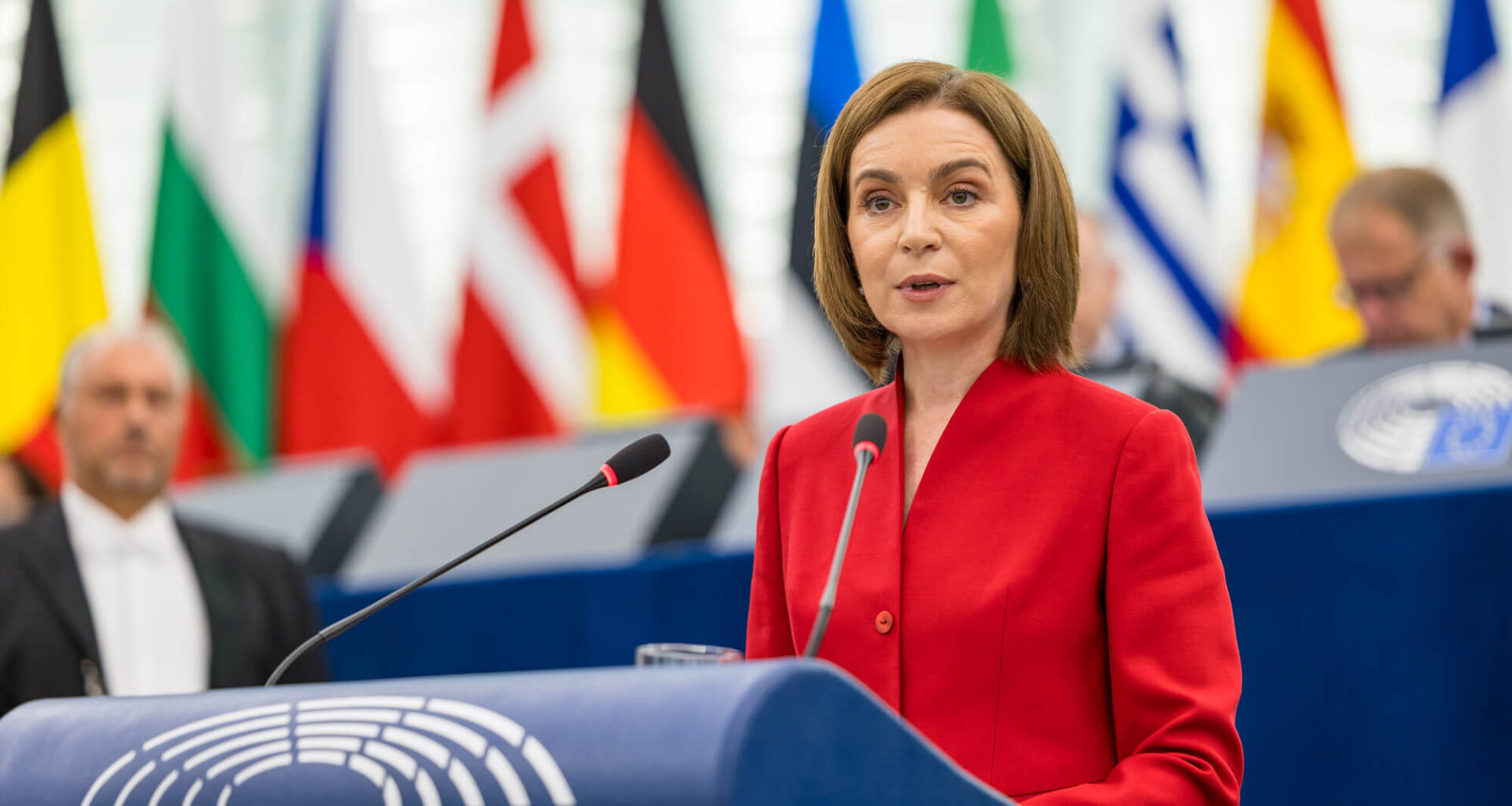
Header image: EPP Group/Flickr; Moldovan President Maia Sandu addresses the European Parliament on 9 September 2025.