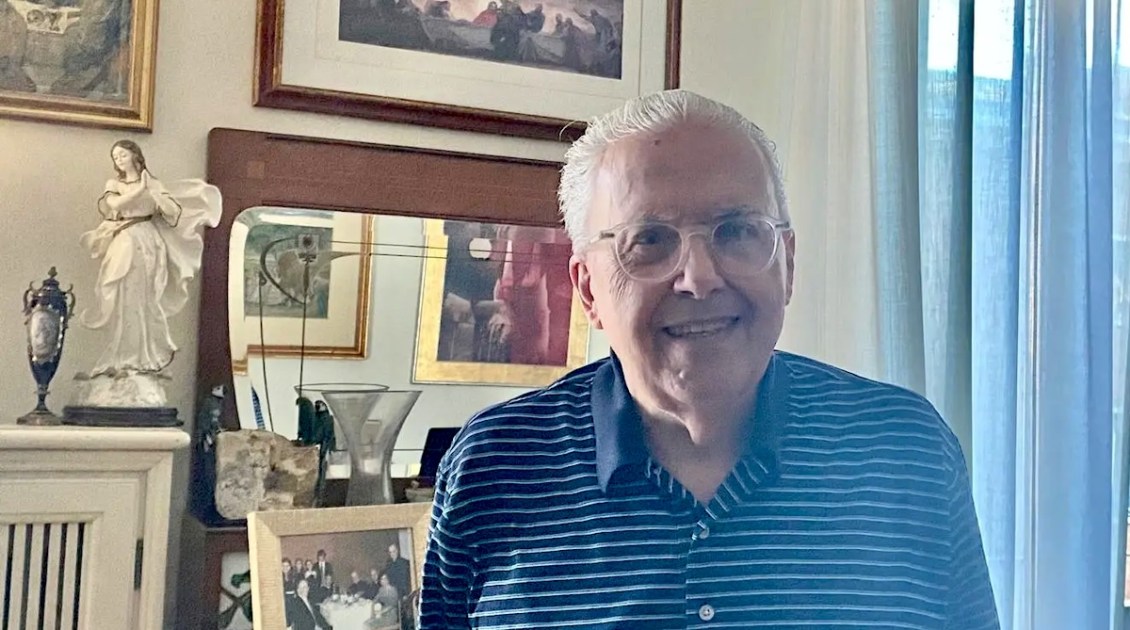
At the age of 81, Uruguayan Guzmán Carriquiry Lecour has just published his memoirs in Italian about his 48 years of service in the Vatican (Il Testimone, Cantagalli editions). This lawyer has known and served five popes, from Paul VI to Francis. For nearly half a century, he has been a pioneer in the integration of lay people into positions of responsibility in the Roman Curia, in the world’s smallest state. Working in several Vatican entities, he was particularly involved in the Pontifical Council for the Laity and the Pontifical Commission for Latin America.
In this interview with I.MEDIA, he analyzes developments in terms of the promotion of lay people since the Second Vatican Council, considers possible developments, and also offers his thoughts on Pope Francis‘s reforms.
In addition, the former Uruguayan ambassador to the Holy See discusses the “immense and delicate” task facing the new Pope Leo XIV in establishing peaceful relations between Rome and the Americas.
A pioneer of lay presence at the Vatican
I.MEDIA: You were the first lay person appointed head of office in the Vatican, the first lay undersecretary, the first lay secretary, and the first lay secretary in charge of the vice-presidency of a Vatican body. One might say: what a wonderful ecclesiastical career… How do you see the Vatican’s overall progress on the inclusion of lay people since Vatican II?
Guzmán Carriquiry Lecour: “Ecclesiastical career” is an expression I hate, but I recognize that, surprisingly, I was the first lay person appointed to various positions, and always under different pontificates. In a sense, I was a pioneer of the lay faithful being present in the Roman Curia.
Since Vatican II, a virtuous path has opened up for the presence of all components of ecclesial communion. But it was especially during the pontificate of Pope Francis that there was a “qualitative and quantitative leap.”
Today, there are many more lay people working in positions of responsibility in the Curia. Fifty years ago, when I started under Paul VI, the positions of superiors of the dicasteries were all reserved for ordained ministers. Today, this is no longer the case.
Another important element of Francis’ pontificate is that he has opened these leadership positions to women. He did this to such an extent that, jokingly, one could say that today, being a woman is an additional asset for accessing positions of responsibility within the Holy See. A virtuous path has been traveled. Even if, in the Curia, there still remains a certain residual, ingrained clerical mentality.
Clericalization of the laity
Precisely, you write that lay people in the Church sometimes risk being “more clerical than priests…”
Lecour: Lay people are more clericalized than priests when they are obsessed with fighting for and conquering more power within the Church. Often, when the term “empowerment” is used in English, it actually refers to ecclesiastical power reduced to worldly power, rather than the power of the Holy Spirit.
The lay person is consequently defined by the position he or she manages to occupy and not by being a disciple and witness of Christ, by his or her vocation to holiness lived in the circumstances given to him or her, and by his or her commitment as a builder of the secular city.
One of the great gifts of the Council was what is known as the promotion of the laity: a profound rediscovery, based on solid theology, of the dignity and participation of the laity in the life and mission of the Church. However, in the immediate aftermath of the Council, a minority of more active lay people often thought that their task was to fight against a clerical Church, and thus to open up spaces of rights, functions, and powers within the Church. This was an important phase, but a somewhat adolescent one for the laity, which still persists in a residual way.
The future of laity at the Vatican
How do you imagine the role of the laity in the Vatican in the future? Following Francis’ appointments, which dicasteries could have a lay prefect?
Lecour: I very much appreciate the fact that a lay person is prefect of the Dicastery for Communication, even if the fact that a prefect can be a lay person is not yet fully accepted in the Roman Curia.
However, I believe that the positions of prefect of the dicasteries that have a governing function in the Church (bishops, clergy, institutes of consecrated life, education and culture, etc.), since they exercise powers delegated by the pope, should be entrusted to cardinals—who are the pope’s closest collaborators. This is a very important distinction that most people do not make.
A challenging change of mindset
In 1982, John Paul II wanted to appoint me undersecretary of the Pontifical Council for the Laity [third person in charge, editor’s note]. The Secretariat of State had to form a commission of canonists who worked for a year to determine whether a lay person could hold such a position.
They were unable to reach an agreement. I was then asked to sign a document stating that I would be undersecretary while renouncing the two governing powers specific to the dicastery (decrees recognizing ecclesial movements and new communities; and administrative rulings concerning appeals by lay people against decisions made by bishops).
Later, when Benedict XVI wanted to appoint me vice-president of the Pontifical Commission for Latin America, Cardinal Secretary of State Tarcisio Bertone summoned me again to tell me that a lay person could not be vice-president. I stood up and said to him, “That’s ridiculous, because the Pontifical Commission for Latin America has no governing power.” It does have a cardinal president, because it is attached to the Dicastery for Bishops, but it could very well have a lay president.
There are many other bodies in the Roman Curia, such as the Pontifical Academies, which have no governing function and can perfectly well have lay presidents. I’m aware that Pope Francis has appointed a religious sister as prefect of the Dicastery for Institutes of Consecrated Life. I believe that, in this case, the Pope wanted to question the Church in depth on the issue of women. He wanted to make a surprising gesture to force people to think more seriously about the place of women.
Papal continuity in diversity
You’ve worked with five popes. Was there a moment when you felt a real break, a decision that profoundly changed the course of the Church’s history, experienced “from within”?
Lecour: No. I’ve never perceived such a dramatic break that would risk breaking the links in the indestructible chain of Peter’s successors, who guarantee the continuity of the great tradition of the Church and its deposit of faith.
I’ve served five popes—five popes who were so different: different origins, different temperaments, different backgrounds, different sensibilities, different styles. And through this diversity there remains the continuity of the successors of Peter, a continuity that is enriched at the same time by this diversity.
I’ve always hated comparisons and contrasts between the successors of Peter. There have been many people who were very nostalgic for John Paul II and Benedict XVI, who resisted the experience of Pope Francis. And there were others, on the contrary, who felt that Pope Francis was so fundamental in the history of the Church that they came to disparage and despise John Paul II and Benedict XVI. Pope Benedict once said that some of those who loved him dearly and went to visit him as pope emeritus were fanatics.
Curial reform
What do you think is most urgent today in order to bring about a genuine reform of the Vatican, and not just a few structural adjustments?
Lecour: I want to emphasize one fundamental thing: the priority of reform is to renew each and every one of those who work in the Roman Curia, with an emphasis on holiness and true ecclesial communion.
The Curia needs a “baptism of the Gospel” and a certain “slimming down.” To humorously echo a remark made by John XXIII: when asked how many people worked in the Curia, he replied, “half.” I don’t wish to fire anyone—the Holy See never fires anyone, except in cases of serious misconduct. But I’m convinced that by choosing officials more carefully, reorganizing offices, and avoiding duplicate roles, we can work much more efficiently with fewer employees. It would suffice not to replace those who die and not to fill certain vacant positions.
Another crucial reform would be to gradually bring priests working in certain Roman services to live in community. Not in impersonal residences, but in priestly communities, to pray together, share meals, and take stock of their lives.
Transitioning to a new pope
Today, you’re watching the pontificate of Leo XIV. How do you perceive Leo XIV’s first actions and priorities?
Lecour: It would be absurd to draw conclusions at the beginning of a pontificate. The first attitude to adopt towards a new pope is one of obedience, hope, and prayer. The second is to discern how the pontificate will evolve, not out of curiosity or criticism, but in order to better enter into communion and fidelity.
This pontificate inherits an immense and delicate task, a crucial responsibility for the life and mission of the Church in a troubled and fragmented world. I am certain that the cardinals entrusted Pope Leo XIV with the mission of rebuilding the unity of the Church, which has been deeply affected by the tensions and polarization of our world.
The new pope is moving forward step by step, thoughtfully, in contrast to the more impulsive and surprising style of Pope Francis. He’s young—70 years old—and succeeding Bergoglio is not easy. We must give him time.
To evaluate his pontificate, two elements are essential. First, his collaborators: what changes will he make? It’s crucial that he choose holy and competent collaborators.
Then his first major documents, encyclicals, and apostolic exhortations. Pope Francis opened his pontificate with the programmatic exhortation Evangelii gaudium. Pope Leo will certainly prepare a similar document, which will clarify his main orientations.
Unique challenges facing Leo XIV
As an expert on Latin America, how do you view the election of an American-Peruvian pope?
Lecour: I find it extraordinary. In my book, I point out that Latin America didn’t take full advantage of the first Latin American pontificate and that Pope Francis could have done more for this region, which remains a major concern for me.
Pope Leo is an American citizen, educated and raised in the United States, but his experience in Chiclayo gave him a Latin American heart. He lived with the poor, understood religious sentiments, and observed how the Church is built in the region, as well as what it lacks. Leo XIV can therefore extend Francis’ pontificate by enriching what Francis was unable or did not know how to accomplish.
He must take up this challenge in a delicate context. Latin America suffers from brutality towards its migrants and the United States’ lack of interest in true regional development, while military interventions and the Chinese presence are exacerbating tensions.
Another key point is that Francis had a somewhat simplified view of the United States, seeing it through the lens of American imperialism and bureaucracy. Leo XIV, on the other hand, has a deep understanding of the complexity of American history, society, and the Church.
This will enable him to rebuild ties between Rome and the North American episcopate and to promote unity among the bishops, beyond the divisions between ultra-reactionary and ultra-liberal Catholics.
Relations between the Americas are a minefield, but Leo has the experience and vision necessary to approach them with discernment and promote true communion between Churches and peoples.
Potential papal visits to South America
In addition to your long career in the Vatican, you also have experience as Uruguay’s ambassador to the Holy See. Does Leo XIV have ties to Uruguay? Could he make a trip there soon? Has he been invited?
Lecour: I was very much hoping that Pope Francis would visit Uruguay and Argentina, because it would’ve done a lot of good. He was the only one capable of awakening the conscience of Argentinians at a dramatic moment for Argentina. There remains this strange debt that the pope owes to his people, to his homeland, which he loved so much.
He visited almost all of Latin America, but in South America he did little. I think it would be very wise—I would almost say a “duty”—for Leo XIV to undertake a trip to Brazil, Uruguay, and Argentina—that is, to these three Mercosur countries that share cultural, economic, and political continuity.
In the pope’s conversations with Cardinal Daniel Fernando Sturla Berhouet [Archbishop of Montevideo], the pope discreetly hinted that there was this possibility of a trip to Uruguay. This would undoubtedly include Argentina and probably Brazil as well. Nothing has been decided.
I know that the cardinal asked the new president of Uruguay, Yamandú Orsi, during their most recent meeting, to prepare an official letter of invitation to the Pope. The invitation from the bishops has already been received.