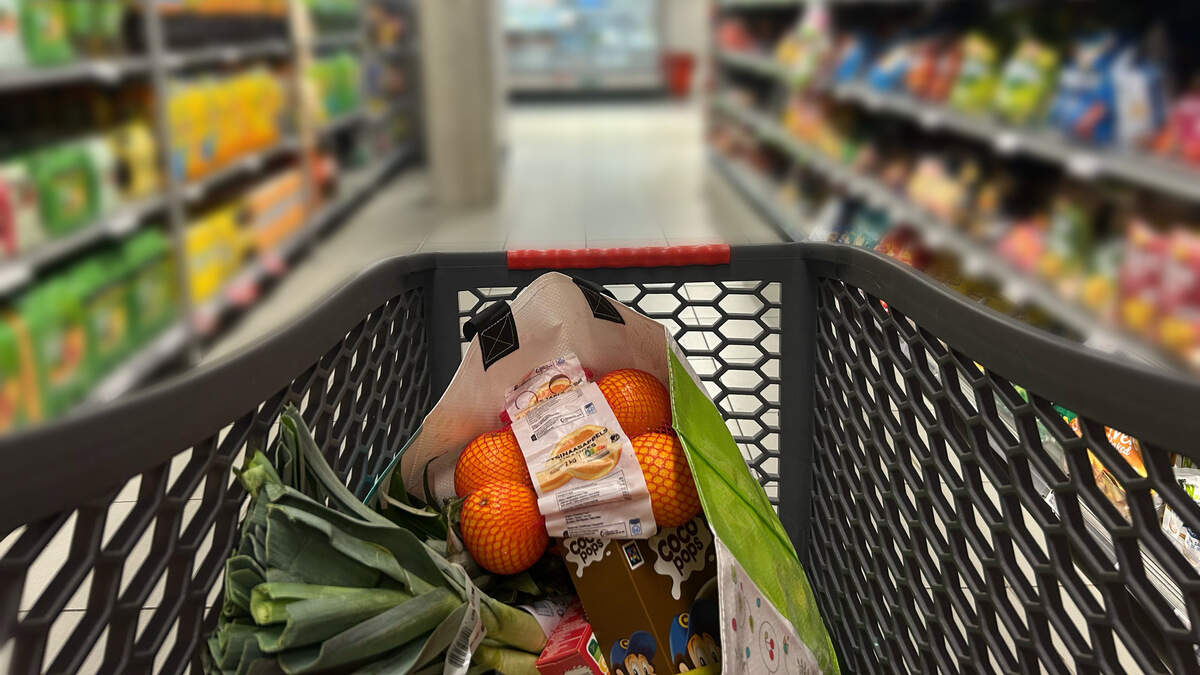
€5 for shampoo, almost €3 for crisps and more than €5 for toilet paper. The total on the receipt in Luxembourg supermarkets can quickly reach a high double or even triple-digit amount – even though the shopping trolley is not even half full.
Customers in Luxembourg have a wide range of shops to choose from – Cactus, Delhaize, Auchan or E.Leclerc. However, some consumers are drawn across the border to Germany to do their shopping, where many products are significantly cheaper.
With such a wide choice of stores and facilities, Luxembourg is a shoppers’ paradise, according to an analysis carried out last month by the Observatoire National des PME (National Observatory of Small and Medium-Sized Enterprises), although social media users strongly disagree. “Where is the paradise?,” asked one reader on Facebook, to which another replied: “That’s why Perl on the Moselle opposite Schengen has become an absolute shopping paradise”, where the shops are always full and the majority of customers come from Luxembourg.
Also read:Number of new businesses increased in Luxembourg last year
But is the difference between some products really that big? The Luxemburger Wort decided to compare the prices of some items from different categories.
For the analysis on the German side, the same products were assessed in the discount chain Lidl and in the supermarket Rewe. For Luxembourg, Cactus and Delhaize were selected. Both own brands and branded products were analysed.
It is noticeable that, although there are price differences for own brands, these are significantly lower than for better-known brands, some of which are sold at almost twice the price in the Grand Duchy.
One example of this is the Pantene Pro-V brand shampoo. In Germany, you can buy 500 millilitres of shampoo for just under €6; the price in Luxembourg supermarkets is close to this, but the content is significantly lower at 250 millilitres.
It can also be noted that some individual products are cheaper in Luxembourg – 500 grams of Barilla pasta costs €1.29 at Delhaize and €1.48 at Cactus, while it costs €1.99 at Lidl in Germany. However, most examples show that shopping in Luxembourg is significantly more expensive.
For 1.5 litres of own-brand iced tea, Rewe and Lidl both charge €0.79. At Delhaize, the same amount of own-brand iced tea costs more than twice as much. Consumers also have to dig deeper into their pockets for Pringles crisps. So it’s no wonder that many Luxembourgers make the leap across the Moselle.
Belgian wholesalers benefit
This is a serious problem for the Luxembourg retail sector, as it is losing customers. Especially as the high prices in the Grand Duchy are scarcely based on understandable reasons – such as the higher labour costs, said Tom Baumert, head of the trade organisation Luxembourg Confederation. The real causes are much more complex, he explained, blaming the fact that “a trader cannot freely supply himself in Europe”.
Luxembourg shops are often forced by multinational brands and their own wholesalers to source their supplies from Belgium instead of cheaper competitors in Germany or France, said Baumert, who described the situation as “a failure of the EU internal market”.
Economy Minister Lex Delles told the Luxemburger Wort he is aware of the problem. “I am aware of extreme cases in which the purchase prices for Luxembourg retailers are more expensive than consumer prices in Germany or France,” he said.
Baumert claims that multinational companies and wholesalers divide up the European market as they see fit and present businesses in Luxembourg with a fait accompli. As a result, Luxembourg shops often have no choice but to use Belgian wholesalers.
The brands and wholesalers would then justify this practice with flimsy excuses – for example because of the different languages on the packaging, said Baumert, or by citing logistical reasons. “All of these reasons are rarely comprehensible,” he said. “Under the pretext of language, Luxembourgers are forced to buy products labelled in Dutch.”
Call to tighten rules
In fact, such trade practices appear to contradict the requirements of a free European market. That is why Lex Delles is urging the EU Commission to tackle the problem. So-called “restrictions territoriales de l’offre” (RTOs) as the phenomenon is known in technical jargon, “are fundamentally a cross-border problem and therefore cannot be eliminated by measures at national level,” said Delles.
And it also seems to be a politically favourable moment to do so. With inflation sticky and the associated loss of purchasing power, many EU governments are recognising the widespread problem.
Luxembourg, which has been drawing attention to the problem for years, is now receiving support from other EU countries – and the commission has even promised to put concrete measures on the table soon, according to Delles.
However, not everyone agrees on how exactly the problem should be tackled. Delles would like to “introduce an EU-wide harmonised ban on unjustified restrictions” – but it remains unclear what exactly this could look like.
There are no clear comprehensible reasons why prices are so high in the Grand Duchy, said trade expert Tom Baumert © Photo credit: Melanie Ptok
Do we really need additional rules that make everything even more complicated?
Tom Baumert
Luxembourg Confederation
Other countries, while recognising the problem of RTOs, are resisting new regulations. Baumert agrees: “Do we really need additional rules that make everything even more complicated? Let’s enforce the rules that already exist.”
“Experience shows that the existing rules at national and EU level are not sufficient,” said Delles.
The reaction of the European Brands Association (AIM), the EU lobby organisation for major brands, to an enquiry from the Luxemburger Wort shows that this is true.
As there have been hardly any successful complaints lodged against brands to date, it is easy for the association to deny any blame. “Trademarks do not restrict supply,” an AIM spokesperson said. “Out of 166,000 trademark companies for consumer goods in the EU, only three have ever been fined for territorial restrictions.” Instead, AIM points the finger at the growing power of wholesalers.
Luxembourg residents resigned to high prices
For Bob Schmitz, representative of the Union Luxembourgeoise des Consommateurs (Luxembourg Consumers’ Association, ULC), there are several reasons for the reluctance to find common solutions.
Firstly, he said, “there is no legal magic solution” to the practices of wholesalers. Apart from lowering the hurdles to allow EU competition law to take effect, he does not see any measures that could directly stop the phenomenon.
According to Schmitz, this lack of clarity also has to do with the fact that politicians and retailers find it difficult to clearly identify the trend. “Retailers seem to be afraid of the big brands and don’t want to name them,” he said.
As if to underline this point, Baumert is cautious when it comes to naming specific brands that put Luxembourg retailers in a difficult position.
“Our negotiating power is not huge – especially not if you are only active on the Luxembourg market,” he explained. “We would risk our own business model if a well-known brand no longer wanted to work with us.”
Retailers seem to be afraid of the big brands and don’t want to name them
Bob Schmitz
Union Luxembourgeoise des Consommateurs (ULC)
Schmitz also believes that retailers have not yet managed to get consumers on their side on this issue. “There is a lack of evidence that prices for consumers would actually fall if such practices were prohibited,” he said.
He also has the feeling that most Luxembourg consumers see the situation as less urgent than retailers and the economy ministry. “Most Luxembourg consumers have come to terms with the situation and therefore go shopping across the border several times a year,” he said.
From a purely Luxembourgish point of view, Delles’ actionism on the issue also has another side to it: as the economy minister of a country whose tax income heavily depends on cheap tobacco and fuel, can he really complain about national price differences?
“These are two fundamentally different issues that should not be mixed up and have completely different starting points,” Delles said. “Territorial restrictions have no legal basis and result from the behaviour of private companies, in this case wholesalers.”
One thing is certain: For retailers – and perhaps also for consumers – there is a lot of money at stake. The commission recently calculated that eliminating the territorial restrictions would result in potential savings of €14 billion for consumers across the EU.
(This article was originally published by the Luxemburger Wort. Machine translated, with editing and adaptation by John Monaghan.)