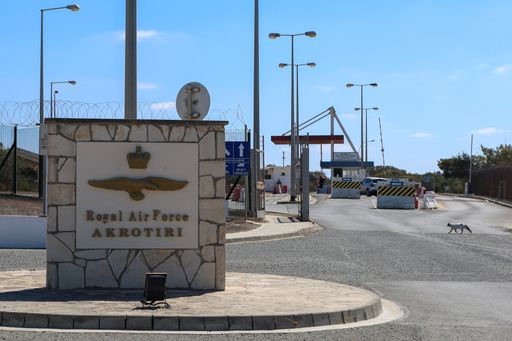
This gives the US and UK near real-time access to information flows from both air and land, allowing them to provide intelligence and logistical support to allies in regional conflicts, as seen in the recent Israeli operations in Qatar.
The US U-2 reconnaissance aircraft also operates out of Akrotiri.
Given that Israel’s strike on Hamas officials in Qatar reportedly relied on aerial refuelling from UK tanker aircraft based in the region, one must carefully consider whom these bases might support, and under what circumstances, in scenarios of conflicting interests.
The EEZ and maritime disputes
From another perspective, the status of the SBAs, Akrotiri and Dhekelia, was the subject of lengthy and serious negotiations, especially regarding their size in an island geography with limited resources.
These negotiations led to the legal recognition that both areas, with their coastal access, would also possess territorial waters—provisions explicitly included in the agreements.
In the 1960 agreement establishing the “Republic of Cyprus” and the SBAs, it was also included that the SBAs, due to their coastal zones, possess territorial waters.
This has led some circles to interpret that, in addition to territorial waters, an Exclusive Economic Zone (EEZ) could also be declared.
However, one of the conditions for declaring an EEZ is to possess the status of an independent state. Yet the 1960 Agreement is clear: it proclaimed the SBAs under the sovereignty of the United Kingdom.
Related
These areas are military zones, not states, and therefore cannot claim or negotiate rights that belong exclusively to states.
Moreover, such a development might bring new dimensions to ongoing questions of delimitation in the Eastern Mediterranean, where maritime boundaries remain largely unsettled.
Questions also concerning maritime delimitation would require negotiations, where different actors on the island could seek to protect their own interests through bilateral talks or early initiatives.
For instance, the EastMed project, designed to bypass Türkiye and the Turkish Republic of Northern Cyprus (TRNC), collapsed after Ankara signed the November 2019 Memoranda of Understanding with Libya on ‘delimitation of maritime jurisdiction areas’ and on ‘security and military cooperation’.
The Akrotiri and Dhekelia regions also face the coasts of Syria, Lebanon, Palestine, Israel, Egypt, Libya, and Greece.
If Türkiye and its neighbours fail to conclude delimitation agreements, any agreement signed by the SBAs as an independent state could affect both Türkiye’s ‘Blue Homeland’ maritime map and those of other countries in the region.
Enclaves and communities inside the cases
Another noteworthy issue within the SBAs is the enclaves’ settlements.
The Dhekelia base surrounds three Greek Cypriot villages, while the boundary of an SBAs bisects one Turkish settlement.
Together with British military personnel and their families, the Greek and Turkish Cypriots in these areas form a population of around 20,000.
All inhabitants of the Sovereign Base Areas are subject to the rules and laws of the bases, and legal proceedings fall under British jurisdiction, although certain civil matters may be coordinated with the local authorities.
This has occasionally led to disputes, particularly among the Greek Cypriot community, which sometimes seeks recourse through third parties. In recent years, residents voiced concerns over land use, claiming that the bases occupied excessive space.
In response, the UK government swiftly placed on the agenda the transfer of certain reserved areas, originally held back for military use, to local inhabitants, thus defusing tensions before they could escalate.
For the UK, past, present, and future, its presence on the island is non-negotiable due to the immense military and economic reasons outlined above.
In conclusion, Britain maintains both a hidden and visible presence in Cyprus island through its SBAs. By virtue of these bases, it occupies a central position in the island’s and indeed the region’s military and economic dynamics.
In an environment of increasingly dynamic and polarised alliances, intelligence operations, and economic cooperation, the British continue to place themselves, whether invited or not, at the very heart of every negotiation and dispute.