
Archaeologists working in the ancient city of Colossae, located in Turkey’s southwestern Denizli province, have uncovered 60 tombs dating back around 2,200 years. These tombs, found in an area of extraordinary archaeological importance, offer a rare and insightful glimpse into burial practices from the ancient world. The discovery is not only significant for its historical value but also for the potential it holds to enrich our understanding of ancient societies and their beliefs. As reported by Anadolu Agency (AA), the ongoing excavations continue to reveal artifacts and new information that fill critical gaps in the region’s history.
A Glimpse Into the Necropolis of Colossae
The recent excavation in Colossae has uncovered what is believed to be the largest necropolis in Anatolia. The discovery of 60 well-preserved tombs in such a confined area is rare, with similar burial structures found in other parts of Anatolia but never in such a dense arrangement. According to Barış Yener, an archaeologist leading the project,
“In Colossae, we discovered what appears to be the largest necropolis in Anatolia, featuring rock-cut, trough-shaped tombs. After removing the surface soil, we identified around 65 tombs, of which we excavated 60.”
These tombs, carved directly into the rock, provide valuable insights into the funerary customs and burial practices of the people who lived here over two millennia ago. Alongside skeletal fragments, the archaeologists uncovered significant archaeological data that promises to enhance our understanding of ancient Anatolian societies.
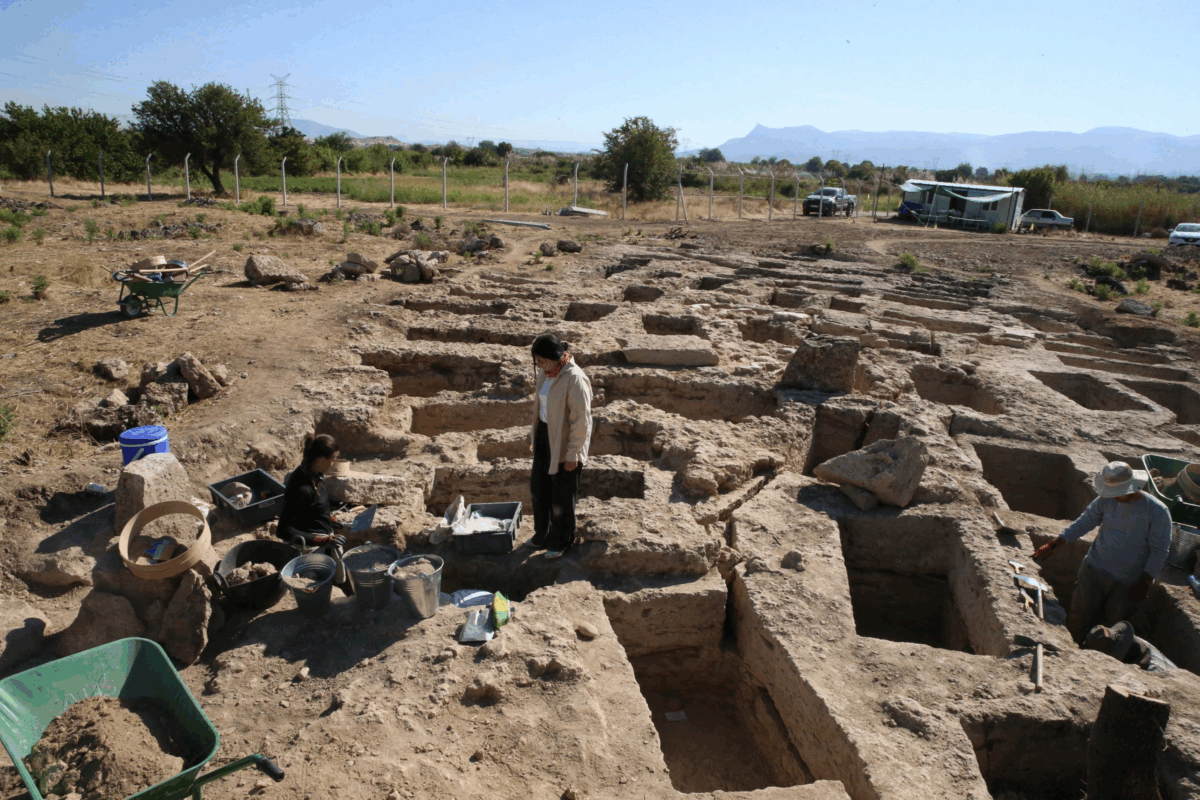 Excavation site in Denizli, Türkiye. Image credit: AA
Utilization of Natural Features in Ancient Burial Practices
One of the most striking aspects of this discovery is how the ancient inhabitants of Colossae utilized their environment for burial practices. The site is located near natural travertine rock formations, which were strategically used to preserve fertile agricultural land. This decision reflects the people’s understanding of their topography and their ability to efficiently use available resources.
“The people of the ancient period made remarkable use of the geological and topographical features of the site. They sought to use the travertine rock formations efficiently, since agriculture – particularly grain production – was practiced at the time. To preserve arable land, they designated the rocky travertine areas as burial grounds,” Yener explained.
This approach not only preserved the land for farming but also demonstrates the interplay between religion, land use, and daily life in ancient times.
Insight into the Spiritual and Protective Beliefs of the Colossae People
Beyond the physical remains, the excavations have uncovered fascinating insights into the spiritual practices of the Colossae people. Among the grave goods discovered were numerous amulets, charms, and stones believed to have protective and healing powers. These items suggest that the people of Colossae placed great importance on ensuring their protection in the afterlife and possibly on the journey beyond death.
“The findings reveal how much the people of Colossae valued magic, talismans, and objects believed to have protective powers. In the tombs, we uncovered numerous amulets, charms, and stones thought to possess healing qualities,” Yener remarked.
These artifacts offer a glimpse into the belief systems that guided the daily and spiritual lives of the people. The fact that these protective items were placed in graves reveals how intertwined religion, magic, and societal practices were during this period.
Colossae’s Role in Ancient Trade and Its Decline
Historically, Colossae was one of the most prominent cities during the Persian period and held significant importance in the Roman and Byzantine eras. It was especially known for its wool and textile production, making it a key trade center in the region. The city flourished for centuries but eventually began to lose prominence as neighboring cities such as Hierapolis and Laodicea emerged and developed. Additionally, a catastrophic earthquake in the 1st century A.D. led to significant destruction, further contributing to the decline of Colossae.
In the 7th century, Colossae was rebuilt under the name Chonae but was once again abandoned following another earthquake in A.D. 787. These events highlight the fragility of ancient cities and how natural disasters shaped their rise and fall. Today, the excavation work continues under the leadership of Barış Yener from Pamukkale University, part of Turkey’s Ministry of Culture and Tourism’s Heritage for the Future Project.