Luxembourg may be small, but it thinks big. Rather than trying to compete on every front, the country has chosen to concentrate its efforts on strategic sectors where it can punch above its weight. Among these are automobility, biotech and space – each with its own dedicated “campus” to foster innovation and growth.
The Luxembourg Times speaks with key figures behind these initiatives to understand why they matter – and what’s at stake.
This week: the health campus in Esch-Belval.
The campus site with labels. © Photo credit: HE:AL Campus
The HE:AL (Health and Advanced Lifescience) Biotech Campus is a work in progress. Billed as over 100,000 square metres of infrastructure for digital healthcare companies, it will comprise offices, laboratories and common spaces. The aim is to bring together a community of businesses to innovate and make the Luxembourg ecosystem flourish, to the benefit of patients and the economy alike.
While the space and automotive campuses are government initiatives designed to support private sector growth and innovation, the HE:AL campus is a private initiative, which only later gained government recognition and support.
Building on existing success
The idea for the campus is closely intertwined with the House of Biohealth – an existing office and lab space that is now at capacity.
“As the House of Biohealth filled up, the co-founders realised they wanted to expand and make it bigger,” said Loïc Hoffmann, the campus’s business developer. “They came to the idea of making a community, ‘let’s build a campus of sorts’. And that’s where the HE:AL campus came out of.”
What is the difference between the two? It is a question of scope and ambition, Hoffmann said, explaining that the House of Biohealth will form the first part of the HE:AL campus. “It will be integrated into the campus officially when we start building the next building.”
The House of Biohealth. © Photo credit: Pierre Matgé
The HE:AL campus is a private initiative led by Romain Poulles, Jean-Paul Scheuren and Jeannot Schroeder. It is endorsed by the government and promoted by ministers and ministries alike as part of the nation’s economic development strategy.
Crucially, though, the state is not investing money in the campus. “We are closely working together with the ministry because we always have questions about digital health companies. You know, they have their department on digital health in the Ministry of the Economy, so we work closely with them,” Hoffmann said.
The success of the House of Biohealth has proven the demand for facilities and meant the campus can progress without government investment. “We don’t need any investors for the moment,” Romain Poulles said in an interview last year. The House is a Public-Private Partnership that enjoys some backing guarantees from the state, though not active funding. The PPP launched in 2015 and was extended in 2023.
The HE:AL campus project has an estimated budget of €500-600 million to build.
In his speech at HealthCare Week Luxembourg on 7 October 2025, the Minister of Economy, SMEs, Energy and Tourism, Lex Delles, announced that the Luxembourg health tech sector, over the last five years, has created more than 600 jobs and thus reached a total of 2,500 jobs spread across 130 companies. The sector is on something of a roll, in other words.
Why ambition matters
The House of Biohealth is no mere office block. It acts as an inclubator for the companies working there, but lacks capacity. The campus will become an accelerator as well as an incubator, and plans to leverage its location between the House of Biohealth, the future Südspidol hospital and the Cité des Sciences in Belval, “thus enabling a geographical proximity between research, innovation, and the medical field,” its website states.
“The objective for HE:AL campus is of course to be a world-recognised campus for innovative companies in health, with a digital component,” Hoffmann said. “Health is evolving at such a rapid pace and we want this campus to exist for the next hundred years, so we don’t want to stick to one thing. We said we want to focus on digital health companies, or innovative companies with a digital component, a data component, that have a positive impact on humans.”
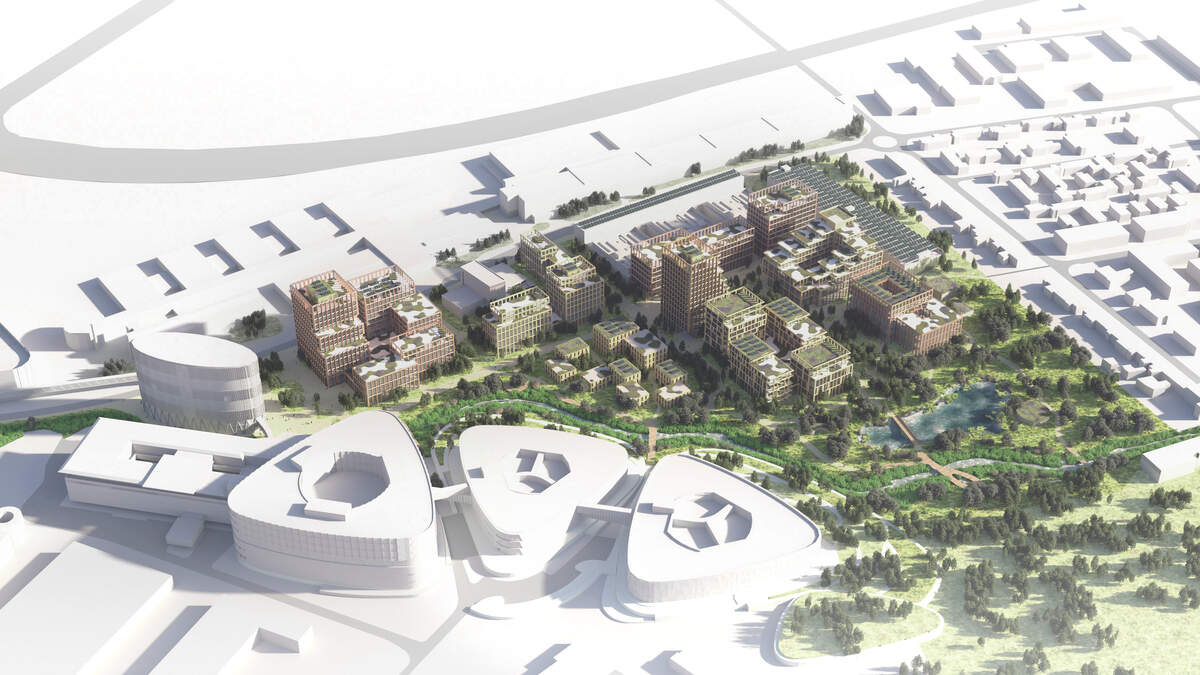
Artist’s impression of part of the campus. The pond exists today, the buildings do not. © Photo credit: HE:AL Campus
In keeping with the other two special campuses, HE:AL companies will benefit from access to supercomputing facilities under an agreement between Meluxina supercomputer operator Luxprovide and the House of Biohealth. “More and more companies need this kind of computing power and that’s why we are also closely connected to them,” said Hoffmann.
Luxembourg, Hoffmann says, is special for the fact that it offers supercomputer access to worthy start-ups that are not directly linked to academia or other medical research institutions. “In Luxembourg it’s quite unique, as a private company you have access to Meluxina yourself.”
Petrie dish of companies
Why does it matter if biotech companies cluster on a campus or set up shop all over the Grand Duchy? “Because with community you can promote these interactions between each other and that’s where many ideas come from, where new partnerships and collaborations come from,” said Hoffmann.
A good example came during the pandemic, he said, when a casual encounter at the House of Biohealth between a fast-track testing company and the Luxembourg Institute of Health (LIH) helped to unlock capacity and kickstart the country’s mass testing programme. “They came together and that’s how we were so rapid on that response, because they got to know each other,” Hoffmann said.
A review by Luxembourg’s Court of Auditors, a budget watchdog under the auspices of parliament, earlier this year concluded public procurement shortcomings by the government in its large-scale testing programme.
Loïc Hoffmann, Business Developer, HE:AL Campus © Photo credit: House of Biohealth
The HE:AL campus is focused on private enterprise but maintains close ties with public bodies like the University of Luxembourg and the LIH, which is a member of its advisory board. “We just think it’s natural that they are part of it as the biggest institution in Luxembourg,” said Hoffmann.
Community may be the heart of HE:AL, but that naturally comes easier to Luxembourg companies than those moving into the country. “For those that are coming from outside, we want to facilitate that together with Luxinnovation. I mean, this is their main activity, right? Connecting these people to the right institutions. Adding to this, we created another company called Hive Services, a community of a network of health players to help them reach the right person at the right time.”
All three of Luxembourg’s speciality campuses draw on the idea of the Grand Duchy as a European hub: “Luxembourg may be a smaller market,” Hoffmann said, “but we are very good at penetrating other markets because we speak their languages, we have done business with them for many years, we are very knowledgeable in that sense.” It is therefore a logical place for biotech companies to settle and grow across borders, he said.
We are very well connected […] whereas in maybe Germany or France, you have to go to many different departments to reach the right person
Loïc Hoffmann, Heal campus Business Developer
“We are very well connected to the Ministry of the Economy. I’m one phone call away from getting the director of that department, whereas in maybe Germany or France, you have to go to many different departments to reach the right person,” Hoffmann said. This matters because the authorities are better able to react to industry needs when communication lines are short, and the advice they give is often applicable across the whole EU.
Long-term thinking
Asked to look forward 20 years, Hoffmann says the campus will “hopefully” be fully constructed – though the estimated total project time is actually 20 to 25 years. “I mean, 120,000 square metres, it’s a large project. Next year we are going to actually start building the first building – or the next building in that sense, because House of Biohealth is already the first building.”
Artist’s impression of part of the Heal campus. © Photo credit: HE:AL Campus
The ambition is simply “to have a thriving community,” he said. “We will have good connections with the different institutions, we will have already attracted many innovative companies to Luxembourg. And definitely also something we are looking forward to is that our neighbours will be the Südspidol, the new hospital in the south, and we will have good collaborations with them.”
It is not clear how many companies will eventually live on the campus, “But the House of Biohealth is around 20,000 square metres, so we’ll have at least five-times that, and currently at the House of Biohealth we have 500 to 600 people working at I think 42 companies.” Multiplied by five, that would be 3,000 to 4,000 people, give or take.
The campus wants to have a mix of roughly 200 small, medium and large companies, including start-ups, scale-ups and established players. That breadth would boost resilience but make employee density hard to forecast.
In health there’s so much data. So much data that is sometimes not even captured
Loïc Hoffmann, Heal campus Business Developer
The speed of technological change also makes the future hard to predict. “We need to focus on these data-driven companies just because in health there’s so much data. So much data that is sometimes not even captured,” Hoffmann said. “We have to find ways to capture all the data and to clean the data, to make it compatible with all the different structures we have and all the different systems.”
Bad data means bad results, he says, so ‘cleaning’ is paramount “because everything is running on data around us”. Thanks to AI and access to supercomputing for even small start-ups, the development will continue.
“On a daily basis I see so many innovative solutions. I’m just immersed in innovation on a day to day basis and it’s very interesting,” said Hoffmann, who is a health economist by training.
“The government is always very important in healthcare. They build the hospitals, they’re the backbone of health. The private sector brings in new innovative ways of modelling certain things, to introduce new treatments, new solutions that are more cost-effective. The private sector is in many ways also faster than the public sector.” Together, he says, they can make Luxembourg, Europe and the world healthier.
Also read:Automotive campus wants to bring A and B together
Also read:Space campus mission to help sector reach for the stars