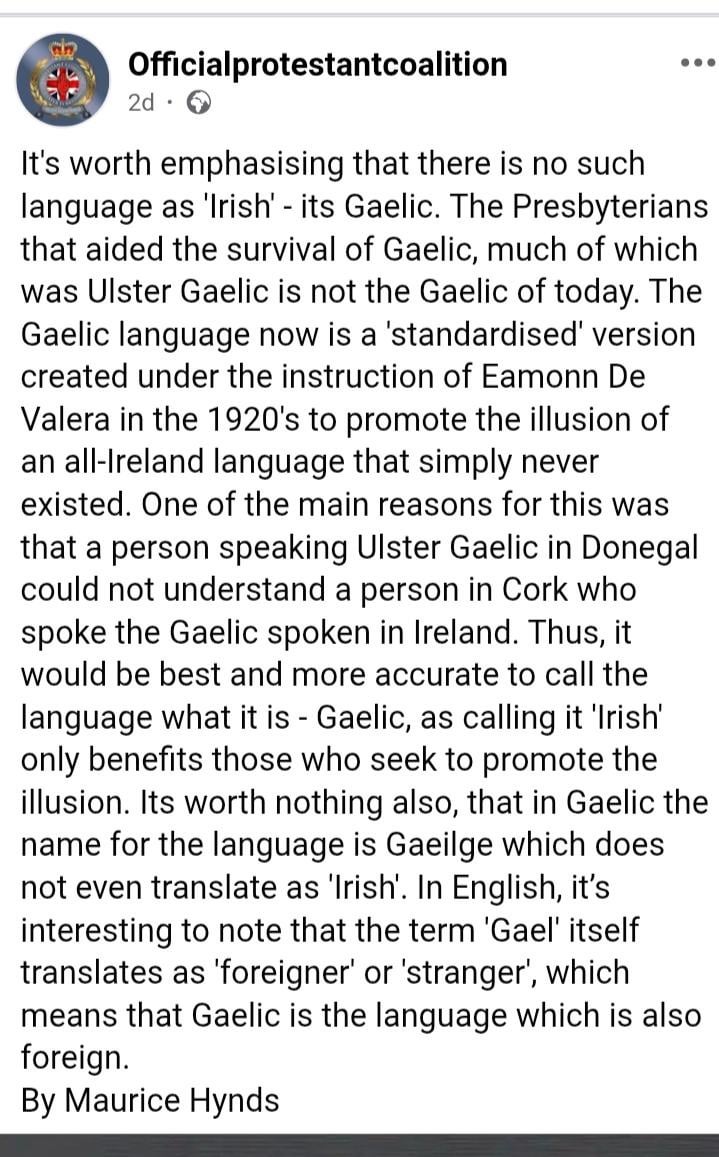
So completely wrong it’s unbelievable. Of course there’s a language called Irish. If enough people call something a thing then it is called that thing, it’s as simple as that.
And on standardisation, the same thing happened in Italy where “standard Italian” is based on the Florentine dialect, and different dialects of Italian (often considered languages in their own right) have various levels of mutual intelligibility. Italian is no less a language because of this, neither is Irish.
Dia duit, labhraim Gaelige agus Béarla!
That probably makes me a shitty prod but so be it. Sod off, Maurice.
While it is true that people down in Cork spoke differently, to let’s say someone in Donegal or other parts of Ulster, that’s just dialects – do people in Newcastle upon Tyne speak exactly the same as someone in Bristol? Does someone from Milano sepsi the same as someone from Roma?
I think it’s less “there was never such a thing as Irish, it was Gaelic” – and more the posters ingrained hatred of anything “Irish”, that they can’t acknowledge that there was, and is a language called Irish.
Its hilarious that they think “Gael” having roots in foreigner is a gotcha. It’s literally cannonized into Irish mythology that the Gaels were invaders.
If loyalists start speaking “Ulster Gaelic” I’d be grand with that.
Firstly, it’s called gaelige and there’s at 3 different versions still in use, but they’re close enough that you can still understand each other 😂 I love when ignorant people are so confident about things the know nothing about. It’s like a vegan telling you how to cook a steak
Edit: misspelled gaeilge in my original comment
Français is called French in English
Gaeilge is called Irish, in the same way.
Dialects exist everywhere 😂
If these people had brains they would be dangerous.
Is Protastúnach mé, agus tá Gaeilge agam. B’fhéidir go bhfuil Protastúnach lofa mé mar sin, ach is cuma liom.
Cuirigí ainm ‘Lundy’ orm, bígí fearg, agus scréachaigí oiread agus is féidir libh. Is cuma. Go n-ithe an diabhal sibh.
Had a quick look at the page there.
It’s ‘auld granda’ ranting and photos of hospital food up at the Royal. People follow this guff? What an odd bunch they are.
Ooooh, I’m very happy about this! If our Protestant and Dissenter brothers and sisters in the northern province start to take ownership of Gaeilge, this would be fabulous and fantastic and wonderful, go h-iontach ar fad fad!
Loyalists: “Free speech!”
Also Loyalists: “Don’t you dare talk in that language.”
Well ya know he learnt a few things in his research. Even done a few translations. I’m taking this as a win for the Irish language.
Step by step, road by road. We are getting there. 🇮🇪
I bet wee Maurice didn’t eat his greens
Why is their entire culture just opposing the cultures they choose to live within?
TIL Donegal isn’t in Ireland.
That’s not the only thing, talk about being wrong so confidently
The word Gaeilge simply means “Irish (language)” and comes from Goídelc, the Old Irish term for the language of the Gaels, the native people of Ireland and parts of Scotland and the Isle of Man.
Over time, Goídelc evolved into Gaeilge, the modern Irish name for the language. Some confusion arises because Gaeilge sounds similar to words like gal or gall, which meant “foreigner” in Old Irish and were used to describe Norsemen or Normans, such as in Dún Laoghaire na nGall (“Fort of Laoghaire of the Foreigners”).
However, Gaeilge is not related to those words and has nothing to do with being foreign; it’s rooted in the identity of the Gaels themselves.
Love the way these sectarian knuckle draggers (this cunt and the TUV guy on Nolan, Ron McDowell?) all try to establish that Presbyterians aided the survival of the language and they are at pains to point out members of the Orange Order spoke it. Then they say they have no interest in it, they don’t want to learn it and they want zero money spent on it.
So they establish that prominent Presbyterians in the past thought it had value, value which they now reject. And they establish their own lack of knowledge and authority to speak on the subject.
Of course if we go back further it begs the question; why did anyone need to revive the language? What happened to the language? Who came from where and did what to the native speakers? Where did all the Irish speakers go? Why? What happened? Any clues? Any involvement from Presbyterians in that regard or Protestants? Or the Orange Order??
Where did they all go Maurice? What the fuck happened Maurice? Who murdered hundreds of thousands of people, murdered hundreds of thousands more through enforced famines and condemned hundreds of thousands more again to death due to forced exile from their homes Maurice?
Or does history not go back to the 1600’s? Does the history of the Irish language, like the Troubles only start when Unionists decide? Ok…let’s ignore all the context. What about modern history and the treatment of “GAELIC” by Protestants / Presbyterians / Unionissts in what Irish speaker and father of Northern Ireland Lord Carson called the “Six Plantation counties” (there’s a clue in the name there).
1893: Thomas Lea, Unionist MP, South Derry – Proposes that Irish should be banned in National Schools and in Courts.
1899: Dr John Mahaffy, Unionist based in Trinity College – Discourages teaching of Irish in Palles Report, suggesting it a mischievous waste of time and that Irish language literature had no academic or education value
1900: James Rentoul. Unionist MP for South Down – Expresses Irish has no value, opposes bilingual signage, and expresses a desire for Irish to die out.
1912: Unionist politicians bring forward a proposal that only English be used in any new parliament, in the courts, and in the Civil Service.
1922: New Unionist Government post partition states: “What do we want with the Irish Language here? There is no need for it at all.”
1922/23: Grants paid to the Irish Teacher Training Colleges in Belfast removed; bilingual programme ceased in the Tyrone Gaeltacht.
1923: Lyn Report: Irish restricted to 90 minutes per week teaching in Primary School: “Irish occupies a preferential position for which, in our judgement, there is no justification.”
1923: New Education Act for Northern Ireland: Irish banned as an optional subject in 5th Standard. Numbers studying Irish decline by 50% within two years.
1926: Irish banned as an optional extra in Standards 3 and 4. 70% of students studying Irish have to cease their study of the language.
1933: All payment towards the teaching of Irish in Primary Schools ceased.
1936: Lord Craigavon: “What use is it here in this progressive busy part of the Empire to teach our children the Irish Language? What use would it be to them? Is it not leading them along a road which has no practical value? We have not stopped such teaching; we have stopped the grants – simply because we do not see that these boys being taught Irish would be any better citizens*
1942: Grand Lodge of Ireland (Orange Order): “That the Government of Northern Ireland be asked to remove from the Curriculum of the Ministry of Education the Irish language, and that no facilities be given in public, secondary or elementary schools for the teaching of such”.
Jesus Christ, that sounds like Ai slop in its finest. Confidently incorrect
Isn’t calling the Irish language gaelic more or less the same as calling the English language Germanic?
This is another one of those Loyalist “Gotchas” that isn’t a Gotcha by any means whatsoever
Irish language activists regularly cite and praise the Presbyterians who breathed life back into the language. Mr Hynds appears to be ignorant of that
Why did they need to breathe life back into the language? Because of systematic efforts to kill it. Mr Hynds appears to be ignorant of that
Dialects are a common factor in all languages the world over. There’s an entire region of France called Languedoc, “the language of oc”, because the word for yes in the local dialect was Oc rather than Oui. Political and socio-economic developments have driven the need to standardise language. Mr Hynds appears to be ignorant of that
TLDR – Mr Hynds appears to be ignorant
There’s a lot of confusion in that post that comes from mixing up history and linguistics. The simple truth is this: the language spoken in Ireland for over a thousand years is called Gaeilge in Irish and Irish in English. That’s just how translation works — the same way Deutsch becomes German, or Español becomes Spanish. Calling it “Gaelic” in English is actually imprecise, because “Gaelic” also refers to the Scottish and Manx versions of the same old Gaelic family of languages. So if you say “Gaelic” without context, most people will think you mean the Scottish language, not the Irish one.
Ulster Irish (spoken in Donegal, for example) is not a separate language any more than a Belfast accent makes someone’s English “different from” a Dublin accent. There are three main dialects of Irish — Ulster, Connacht, and Munster — all mutually understandable with small differences in pronunciation and a few words. The modern Caighdeán Oifigiúil or “Official Standard” wasn’t created by De Valera in the 1920s; it was developed in the 1940s and 50s by linguists to make spelling consistent, just as English once standardised its spelling after centuries of dialect variation. Standardising a language doesn’t invent it — it just makes it easier to teach and use formally.
And finally, the word Gael never meant “foreigner.” That’s Gall. The Gaels were the native Irish and Scottish Gaelic people; the Gaill were the outsiders — Norsemen and later Normans. So the claim that “Gaelic means foreign” is completely backward. Irish is one of Europe’s oldest written languages, directly descended from Old Irish that appears in manuscripts over a millennium old. It was the everyday language of the whole island before English ever arrived. If anything, it’s English that was once the foreign language here.
Loyalists were also found among the Irish population, who still referred to themselves at the time as Irish, and spoke Irish, eventually breaking away to embrace their British identity. As someone who grew up in the loyalist community, I find it very sad that we never got to learn the Irish language. I’m so happy to see more revival and hope to someday see it spoken among the young generation, who may be able to teach their idiot grandparents like this a thing or two. I don’t believe it should be forced, but at least allow the option throughout schools, not just catholic orientated schools. The Irish language when heard spoken is beautiful. It’s about time in this day and age we saw an end to this bigoted bullshit.
What a pile of steaming bullshit with sweetcorn in it. Was Ireland just communicating with hand gestures waiting for the English to turn up with their bastardised hot mess of a language?
Laughing in bad Welsh over here, they try it with us too 😆
Its worth emphasising that there is no such language as ‘English’ – its Anglic. The lower classes that aided the survival of Anglic, much of which was the Wessex Anglic is not the Anglic of today. The Anglic language now is a ‘standardised’ version created under the instruction of the Court of Chancery in Westminster to promote the illusion of an all English language that simply never existed. One of the main reasons for this was that a person speaking Anglic in Wessex could not understand a person in Newcastle who spoke the Anglic spoken in the North. Thus it would be best and more accurate to call the language what it is – Anglic, as calling it ‘English’ only benefits those who seek to promote the illusion. Its worth nothing (sic) also, that in Anglic the name for the language is Anglic which does not even translate as ‘English’. In English, it’s interesting to note that the term ‘Angle’ itself translates as “to use some bait or artifice”.
30 comments
Loyalists would do anything not to say the word “Irish”.
Ok then. Gaelic and Ulster Scots street signs it is. We in agreement?
Well do you know what is so odd about that Maurice?
Take this Hynds family who lived on the Shankhill Road in 1901, very possibly your family.
On the census form they filled in that they speak Irish.
https://www.census.nationalarchives.ie/pages/1901/Antrim/Shankhill/Keswick_Street/948968/
Anyone know if Maurice is from the Shankill?
So completely wrong it’s unbelievable. Of course there’s a language called Irish. If enough people call something a thing then it is called that thing, it’s as simple as that.
And on standardisation, the same thing happened in Italy where “standard Italian” is based on the Florentine dialect, and different dialects of Italian (often considered languages in their own right) have various levels of mutual intelligibility. Italian is no less a language because of this, neither is Irish.
Dia duit, labhraim Gaelige agus Béarla!
That probably makes me a shitty prod but so be it. Sod off, Maurice.
While it is true that people down in Cork spoke differently, to let’s say someone in Donegal or other parts of Ulster, that’s just dialects – do people in Newcastle upon Tyne speak exactly the same as someone in Bristol? Does someone from Milano sepsi the same as someone from Roma?
I think it’s less “there was never such a thing as Irish, it was Gaelic” – and more the posters ingrained hatred of anything “Irish”, that they can’t acknowledge that there was, and is a language called Irish.
https://preview.redd.it/5xpa7cpjv1uf1.jpeg?width=415&format=pjpg&auto=webp&s=ff13971fb840717ea7ecd483936bc14e1e0af664
Its hilarious that they think “Gael” having roots in foreigner is a gotcha. It’s literally cannonized into Irish mythology that the Gaels were invaders.
If loyalists start speaking “Ulster Gaelic” I’d be grand with that.
Firstly, it’s called gaelige and there’s at 3 different versions still in use, but they’re close enough that you can still understand each other 😂 I love when ignorant people are so confident about things the know nothing about. It’s like a vegan telling you how to cook a steak
Edit: misspelled gaeilge in my original comment
Français is called French in English
Gaeilge is called Irish, in the same way.
Dialects exist everywhere 😂
If these people had brains they would be dangerous.
Is Protastúnach mé, agus tá Gaeilge agam. B’fhéidir go bhfuil Protastúnach lofa mé mar sin, ach is cuma liom.
Cuirigí ainm ‘Lundy’ orm, bígí fearg, agus scréachaigí oiread agus is féidir libh. Is cuma. Go n-ithe an diabhal sibh.
Had a quick look at the page there.
It’s ‘auld granda’ ranting and photos of hospital food up at the Royal. People follow this guff? What an odd bunch they are.
Ooooh, I’m very happy about this! If our Protestant and Dissenter brothers and sisters in the northern province start to take ownership of Gaeilge, this would be fabulous and fantastic and wonderful, go h-iontach ar fad fad!
Loyalists: “Free speech!”
Also Loyalists: “Don’t you dare talk in that language.”
Well ya know he learnt a few things in his research. Even done a few translations. I’m taking this as a win for the Irish language.
Step by step, road by road. We are getting there. 🇮🇪
I bet wee Maurice didn’t eat his greens
Why is their entire culture just opposing the cultures they choose to live within?
TIL Donegal isn’t in Ireland.
That’s not the only thing, talk about being wrong so confidently
The word Gaeilge simply means “Irish (language)” and comes from Goídelc, the Old Irish term for the language of the Gaels, the native people of Ireland and parts of Scotland and the Isle of Man.
Over time, Goídelc evolved into Gaeilge, the modern Irish name for the language. Some confusion arises because Gaeilge sounds similar to words like gal or gall, which meant “foreigner” in Old Irish and were used to describe Norsemen or Normans, such as in Dún Laoghaire na nGall (“Fort of Laoghaire of the Foreigners”).
However, Gaeilge is not related to those words and has nothing to do with being foreign; it’s rooted in the identity of the Gaels themselves.
Love the way these sectarian knuckle draggers (this cunt and the TUV guy on Nolan, Ron McDowell?) all try to establish that Presbyterians aided the survival of the language and they are at pains to point out members of the Orange Order spoke it. Then they say they have no interest in it, they don’t want to learn it and they want zero money spent on it.
So they establish that prominent Presbyterians in the past thought it had value, value which they now reject. And they establish their own lack of knowledge and authority to speak on the subject.
Of course if we go back further it begs the question; why did anyone need to revive the language? What happened to the language? Who came from where and did what to the native speakers? Where did all the Irish speakers go? Why? What happened? Any clues? Any involvement from Presbyterians in that regard or Protestants? Or the Orange Order??
Where did they all go Maurice? What the fuck happened Maurice? Who murdered hundreds of thousands of people, murdered hundreds of thousands more through enforced famines and condemned hundreds of thousands more again to death due to forced exile from their homes Maurice?
Or does history not go back to the 1600’s? Does the history of the Irish language, like the Troubles only start when Unionists decide? Ok…let’s ignore all the context. What about modern history and the treatment of “GAELIC” by Protestants / Presbyterians / Unionissts in what Irish speaker and father of Northern Ireland Lord Carson called the “Six Plantation counties” (there’s a clue in the name there).
1893: Thomas Lea, Unionist MP, South Derry – Proposes that Irish should be banned in National Schools and in Courts.
1899: Dr John Mahaffy, Unionist based in Trinity College – Discourages teaching of Irish in Palles Report, suggesting it a mischievous waste of time and that Irish language literature had no academic or education value
1900: James Rentoul. Unionist MP for South Down – Expresses Irish has no value, opposes bilingual signage, and expresses a desire for Irish to die out.
1912: Unionist politicians bring forward a proposal that only English be used in any new parliament, in the courts, and in the Civil Service.
1922: New Unionist Government post partition states: “What do we want with the Irish Language here? There is no need for it at all.”
1922/23: Grants paid to the Irish Teacher Training Colleges in Belfast removed; bilingual programme ceased in the Tyrone Gaeltacht.
1923: Lyn Report: Irish restricted to 90 minutes per week teaching in Primary School: “Irish occupies a preferential position for which, in our judgement, there is no justification.”
1923: New Education Act for Northern Ireland: Irish banned as an optional subject in 5th Standard. Numbers studying Irish decline by 50% within two years.
1926: Irish banned as an optional extra in Standards 3 and 4. 70% of students studying Irish have to cease their study of the language.
1933: All payment towards the teaching of Irish in Primary Schools ceased.
1936: Lord Craigavon: “What use is it here in this progressive busy part of the Empire to teach our children the Irish Language? What use would it be to them? Is it not leading them along a road which has no practical value? We have not stopped such teaching; we have stopped the grants – simply because we do not see that these boys being taught Irish would be any better citizens*
1942: Grand Lodge of Ireland (Orange Order): “That the Government of Northern Ireland be asked to remove from the Curriculum of the Ministry of Education the Irish language, and that no facilities be given in public, secondary or elementary schools for the teaching of such”.
Jesus Christ, that sounds like Ai slop in its finest. Confidently incorrect
Isn’t calling the Irish language gaelic more or less the same as calling the English language Germanic?
This is another one of those Loyalist “Gotchas” that isn’t a Gotcha by any means whatsoever
Irish language activists regularly cite and praise the Presbyterians who breathed life back into the language. Mr Hynds appears to be ignorant of that
Why did they need to breathe life back into the language? Because of systematic efforts to kill it. Mr Hynds appears to be ignorant of that
Dialects are a common factor in all languages the world over. There’s an entire region of France called Languedoc, “the language of oc”, because the word for yes in the local dialect was Oc rather than Oui. Political and socio-economic developments have driven the need to standardise language. Mr Hynds appears to be ignorant of that
TLDR – Mr Hynds appears to be ignorant
There’s a lot of confusion in that post that comes from mixing up history and linguistics. The simple truth is this: the language spoken in Ireland for over a thousand years is called Gaeilge in Irish and Irish in English. That’s just how translation works — the same way Deutsch becomes German, or Español becomes Spanish. Calling it “Gaelic” in English is actually imprecise, because “Gaelic” also refers to the Scottish and Manx versions of the same old Gaelic family of languages. So if you say “Gaelic” without context, most people will think you mean the Scottish language, not the Irish one.
Ulster Irish (spoken in Donegal, for example) is not a separate language any more than a Belfast accent makes someone’s English “different from” a Dublin accent. There are three main dialects of Irish — Ulster, Connacht, and Munster — all mutually understandable with small differences in pronunciation and a few words. The modern Caighdeán Oifigiúil or “Official Standard” wasn’t created by De Valera in the 1920s; it was developed in the 1940s and 50s by linguists to make spelling consistent, just as English once standardised its spelling after centuries of dialect variation. Standardising a language doesn’t invent it — it just makes it easier to teach and use formally.
And finally, the word Gael never meant “foreigner.” That’s Gall. The Gaels were the native Irish and Scottish Gaelic people; the Gaill were the outsiders — Norsemen and later Normans. So the claim that “Gaelic means foreign” is completely backward. Irish is one of Europe’s oldest written languages, directly descended from Old Irish that appears in manuscripts over a millennium old. It was the everyday language of the whole island before English ever arrived. If anything, it’s English that was once the foreign language here.
Loyalists were also found among the Irish population, who still referred to themselves at the time as Irish, and spoke Irish, eventually breaking away to embrace their British identity. As someone who grew up in the loyalist community, I find it very sad that we never got to learn the Irish language. I’m so happy to see more revival and hope to someday see it spoken among the young generation, who may be able to teach their idiot grandparents like this a thing or two. I don’t believe it should be forced, but at least allow the option throughout schools, not just catholic orientated schools. The Irish language when heard spoken is beautiful. It’s about time in this day and age we saw an end to this bigoted bullshit.
Loyalists stealing zionist propaganda tactics lol.
What a pile of steaming bullshit with sweetcorn in it. Was Ireland just communicating with hand gestures waiting for the English to turn up with their bastardised hot mess of a language?
Laughing in bad Welsh over here, they try it with us too 😆
Its worth emphasising that there is no such language as ‘English’ – its Anglic. The lower classes that aided the survival of Anglic, much of which was the Wessex Anglic is not the Anglic of today. The Anglic language now is a ‘standardised’ version created under the instruction of the Court of Chancery in Westminster to promote the illusion of an all English language that simply never existed. One of the main reasons for this was that a person speaking Anglic in Wessex could not understand a person in Newcastle who spoke the Anglic spoken in the North. Thus it would be best and more accurate to call the language what it is – Anglic, as calling it ‘English’ only benefits those who seek to promote the illusion. Its worth nothing (sic) also, that in Anglic the name for the language is Anglic which does not even translate as ‘English’. In English, it’s interesting to note that the term ‘Angle’ itself translates as “to use some bait or artifice”.
By Willem Shakespeare, age 13 and a half.
Comments are closed.