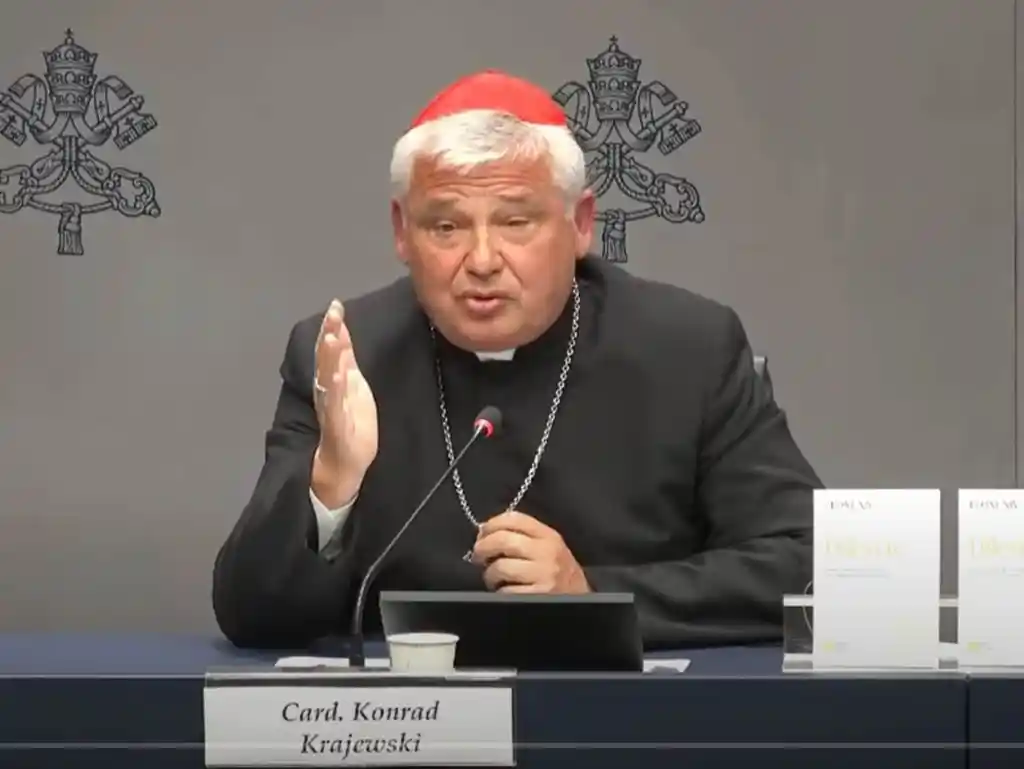
“It is beautiful to see how Pope Leo and the Church’s millennia-long history of caring for the poor and with the poor demonstrate that it is an essential part of the Church’s uninterrupted journey.”
Cardinal Konrad Krajewski stated this during the presentation of the apostolic exhortation Dilexit te, released this Thursday in the Holy See Press Office.
And how this document “shows us that love for the poor, and how these poor are the evangelical guarantee of a Church faithful to the heart of God.”
Pope Leo spoke to me about the work of almsgiving and said, “Keep going.” Thus, the document from the Peruvian pontiff, born in the United States, “is the seal of guarantee for everything we do.”
And regarding the immediacy of aid, he noted: “He healed the needy immediately—the suffering, the marginalized, the refugees—on the same day. He didn’t send Peter or Mary Magdalene to have a preliminary conversation, ‘and we’ll see.’ Come back and see me in two weeks to see what we can do.”
The Vatican almoner confessed that one night, tired, he said to Francis: “Your Holiness, you don’t know what’s going on in the heart of St. Peter’s Square, under the colonnade. We have showers here; 200 people use them a day, that’s 6,000 a month.” He then continued: “In the infirmary, there are about 100 visitors a day; that’s 2,000 people treated a month. Do you know how much medicine we have to give away for free, because everyone leaves with their medicines: 20,000, 25,000 euros just for the medicines.” Furthermore, confiding his concerns to Pope Francis, he added: “Every month we need a truck full of T-shirts, diapers, etc….”
And Francis answered me: “Rude, you’re outside the Gospel.” Don’t you realize that you’re dealing with Christ, that you’re dressing Christ, that you’re cutting the hair of your own Christ who comes under the colonnade, under different faces of the world, but who is Himself? So you help Christ first and now you complain? The cold shower came to me immediately…
Commenting on Pope Leo’s new exhortation, Cardinal Krajewski emphasized Chapter III, which deals with the Church Fathers, numerous saints, including Mother Teresa, and how Jesus was recognized in the person of the poor.
And he remembered what Pope Francis had told him at the beginning: “You must leave your desk, leave the Vatican, don’t stand behind me. I don’t want you in the Vatican. That way, you will know what the poor need and find yourself at the center of the Gospel. At first, it will be difficult, but then it will be the most beautiful thing that can happen to us in the Church: recognizing Jesus in the poor.”
He also joked: “If I’m here, it’s the Holy See spokesperson’s fault. For 13 years, I never opened my mouth. Pope Francis wanted it that way: more actions than words.” He told me: “Don’t talk to journalists; you have to do things, and then they’ll have to find out what you’ve done.”
In the Church, we must be very up-to-date. The past few years have shown us that we must be very flexible.
For example, at the beginning of Francis’s pontificate, we had many migrants, almost a thousand every day at Tiburtina station. Hungry, invisible to the State, undocumented, with nothing. By being with them, we knew what they needed. Not just sandwiches, but also phone cards to call their families and tell them: ‘I survived, don’t worry, I’m in Rome.’ Of 350 dead, 150 of us survived. Do you remember that case in Lampedusa?
“Then COVID hit, which was totally different for the poor. For the first time, I saw them suffering from hunger here in Rome. Bars and restaurants were closed, and they couldn’t eat anywhere… there were no options to vaccinate them, because they were undocumented, without health cards. We had to help them differently: 6,000 were vaccinated in the Paul VI Hall, even in ambulances,” he explained.
“The document demonstrates,” the cardinal continued, “how, over the centuries, aid has varied, but the Church has always recognized the face of Jesus among the poor.”
“Now war is knocking on Europe’s door, and it’s completely different; just think of the generosity of the Romans: 250 trucks left from the Greek Catholic Basilica of Hagia Sophia.”
And in the final pages of this document, the cardinal explained, there is talk of almsgiving. “The Holy Father says that this word doesn’t enjoy a good reputation today, that prayer is important, fasting is important.” But this document emphasizes that “almsgiving erases sins.”