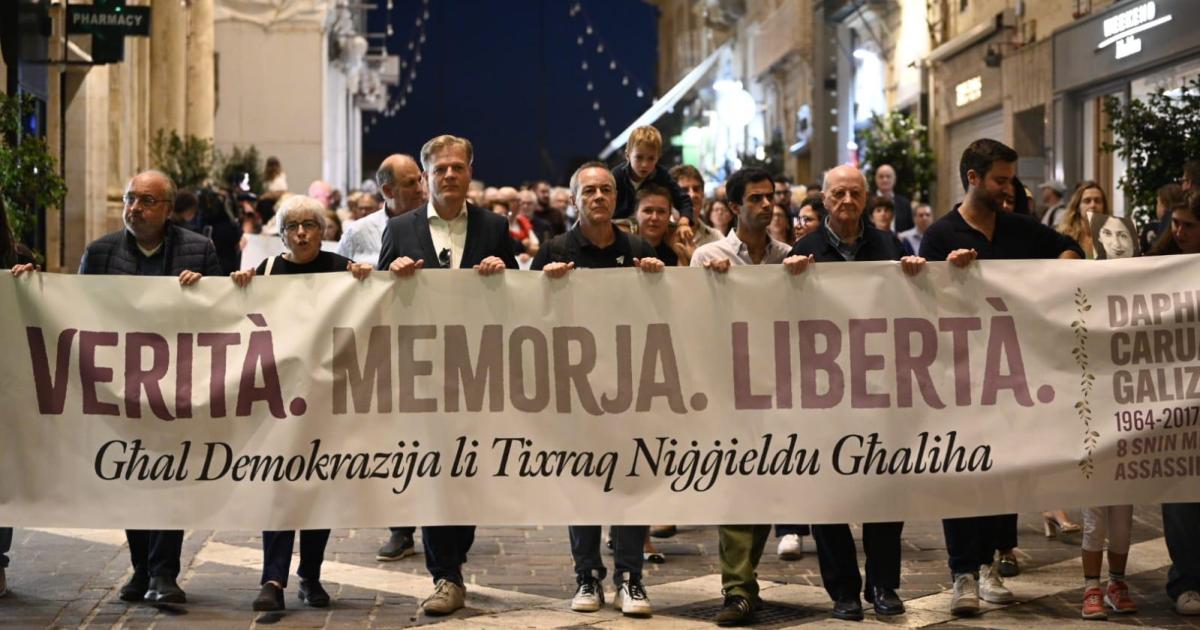
The man who wrote the Council of Europe report on Daphne Caruana Galizia’s assassination compared the “minor visible memory” for the slain journalist in Malta with the way she is regarded in Europe.
“This visible memory in Malta is minor in comparison to Europe. Few people have a room in the European Parliament, a prestigious prize and European legislation named in honour of them,” Pieter Omtzigt said.
A former Dutch MP, Omtzigt was the Council of Europe rapporteur tasked with ensuring justice for Daphne Caruana Galizia and bolstering the rule of law in Malta.
Omtzigt was speaking during a vigil in Valletta marking eight years since Caruana Galizia’s murder.
Besides the rapporteur, five members of Malta’s civil society also delivered speeches on Thursday evening.
RELATED STORIES
On Thursday evening, vigil attendees marched from City Gate to the Great Siege Memorial, which since Caruana Galizia’s assassination has become a de facto memorial.
They were led by Caruana Galizia’s father, Michael Vella, and two of Caruana Galizia’s sons, Paul and Matthew, as well as Repubblika president Vicki Ann Cremona and Omtzigt.
They were holding a banner reading “Truth, Memory, Liberty”.
In front of them was Caruana Galizia’s granddaughter carrying a photo of Daphne.
In his speech, Omtzigt said that just like “prophets and dissidents in totalitarian regimes”, Caruana Galizia is honoured in the hearts of many people but not by the authorities.
People like Caruana Galizia are “hated by the powers of the day. That hate is a hate for the truth she exposed. For those that still have a conscience, that truth hurts a lot,” he said.
“Usually, a society comes together after a prominent member has been assassinated and agrees that whatever the controversies, killing somebody for writing or thinking is such a gross violation of human rights, it should be condemned forcefully, unanimously and without hesitation, from the highest office in a society,” he said.
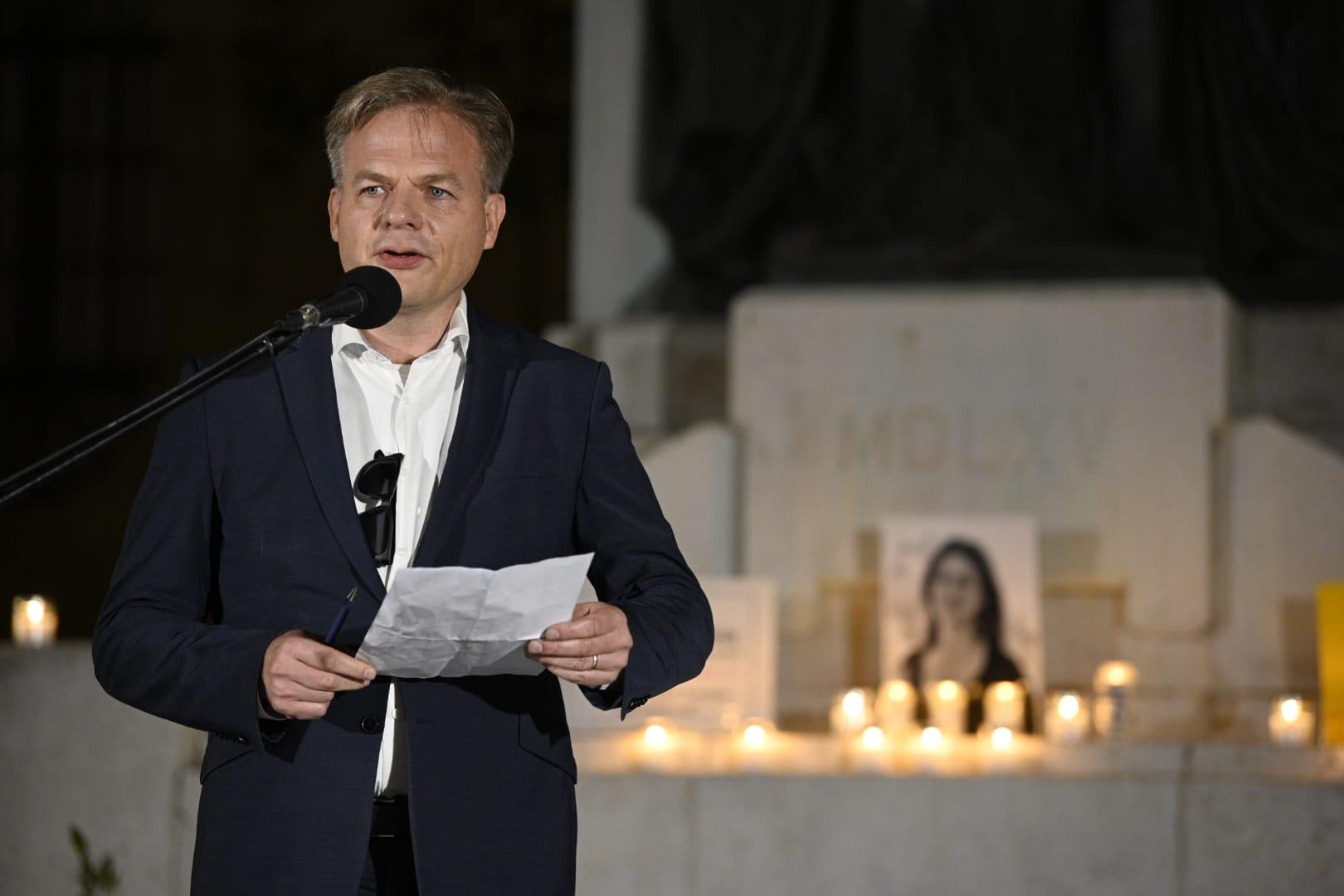 Pieter Omtzigt. Photo: Matthew Mirabelli
Omtzigt said that Malta is facing an erosion of democratic norms. He said the government has made it more difficult for private citizens to request a judicial inquiry and that Malta’s whistleblower law has “big holes” and offers no protection for those who step forward.
“Daphne’s Law”, a European directive aimed at legal action intended to intimidate and silence critics (SLAPP), was implemented in Malta in such a way that local SLAPPs remain possible.
Caruana Galizia’s murder in 2017 shook the nation.
The first arrests occurred almost a year later, after which brothers George and Alfred Degiorgio and Vince Muscat were charged with her murder.
In November 2019, businessman Yorgen Fenech was arrested while attempting to leave Malta, and was charged with complicity in the murder, a charge he denies.
The fallout from the arrest, and Fenech’s close relationships to people in the highest corridors of power, sparked unprecedented protests that led to various resignations including that of Prime Minister Joseph Muscat.
In her speech, Repubblika president Vicki Ann Cremona pointed to the work of Caruana Galizia in exposing corruption.
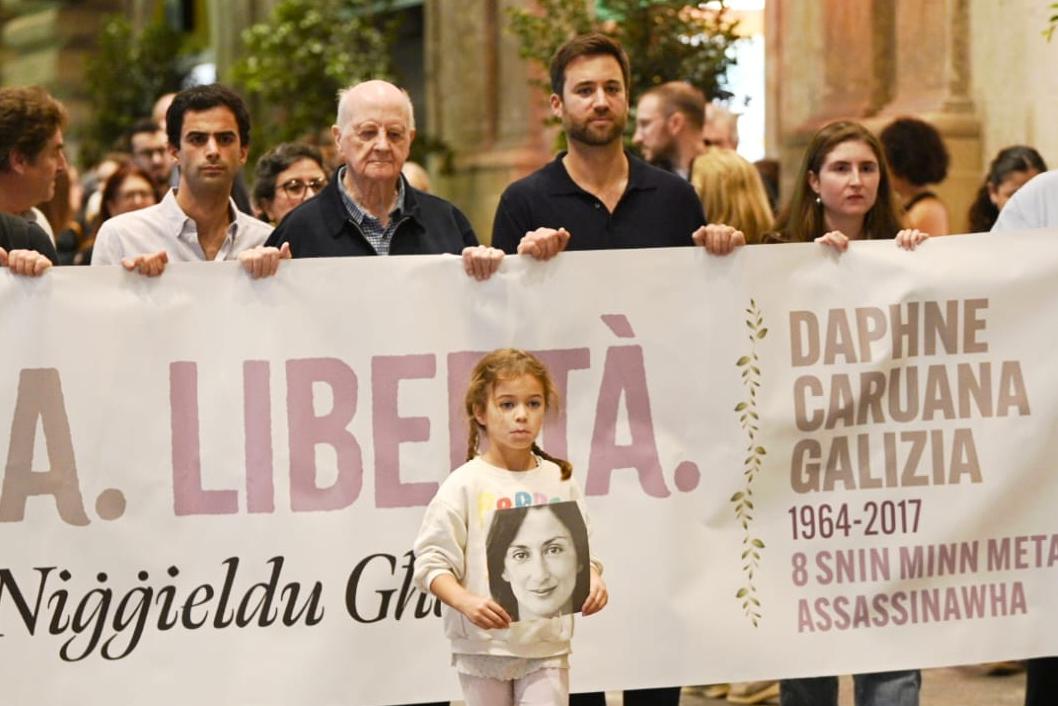 Caruana Galizia’s granddaughter carrying a photo of Daphne. Photo: Matthew Mirabelli
She said that just like in Caruana Galizia’s time, the current government also “plays with the truth”.
Cremona pointed to the two planning reform bills that are currently awaiting parliamentary debate.
“To curry favour with the developers who finance their party, the government prostituted itself and wants to continue giving them our precious land.”
Cremona said that it is not only Prime Minister Robert Abela who should be blamed but the entire Cabinet, “which should grow a spine and stop him when he takes the wrong path”.
“These people who are supposed to represent our interests are only looking out for their own interests and that of their pocket,” she said.