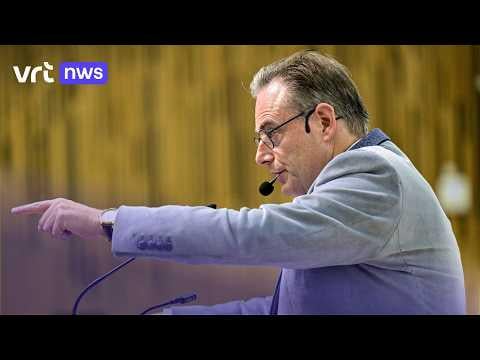
TL;DR: De Wever correctly identifies Europe's core problems (productivity decline, lack of R&D innovation, demographic challenges), but his proposed austerity measures contradict the consensus of leading economists like former lead of the European Central Bank Mario Draghi or Philippe Aghion (2025 Nobel laureate, Harvard Economist). The evidence suggests Europe needs massive investment from the public and private sectors into novel research and industries, not belt-tightening. The evidence suggests Europe requires massive public and private investment into novel research and industries, not belt-tightening. Expert economists warn that if Europe is unwilling to spend, it will become irrelevant. De Wever claims austerity will save the Belgian welfare state, but it will just asphyxiate our struggling economy, harming what he claims to protect.
Background
I'm a researcher in complex systems modeling, working in the United States, and I recently watched De Wever's speech at UGent, and while I appreciate the accurate diagnosis of Europe's challenges, I'm troubled by the proposed solutions. As someone who analyzes data and follows policy debates closely, the gap between his prescriptions and expert consensus is stark. Here's why.
1. The Austerity Paradox: "We kunnen niet langer uit de problemen groeien"
De Wever correctly identifies that our welfare state is under pressure: aging population, declining productivity growth, rising social costs. His conclusion? "We kunnen niet langer uit de problemen groeien" i.e we need fiscal discipline and cuts.
But this contradicts what leading economists are saying:
- Mario Draghi (former ECB President): His 2024 report on European competitiveness calls for €800 billion/year in public and private investment. His exact words are: "It's 'do this' or it's a slow agony."
- Mark Blyth (Brown economist): "The International Monetary Fund warned in July 2012 that simultaneous cuts to state spending across interlinked economies during a recession when interest rates were already low would inevitably damage the prospects for growth." Source
- The data: Look at this graph from The Economist showing US vs EU GDP since 2000. The post-2008 divergence is dramatic. The US did fiscal stimulus, Europe did austerity. The results speak for themselves
Prescribing austerity to a stagnating economy is like putting a sick patient on a starvation diet. It's exactly what kept Europe in a decade of stagnation after 2008.
2. R&D Investment: "Universiteiten zijn de bakermat van vernieuwing"
When the UGent rector said "Universiteiten zijn de bakermat van vernieuwing. Investeren in hoger onderwijs is investeren in de toekomst," the room applauded.
But what does De Wever's government actually propose for research funding? Nothing. Worse, cuts are on the table. His response when asked about university funding: "Kan dat nog meer zijn? […] Maar het antwoord, mijn antwoord is ja, graag als natuurlijk die onderste balk groter wordt."
Translation: we'll invest in universities when the economy improves. But this is backwards causality.
Philippe Aghion (Harvard, 2024 Nobel Prize in Economics) has spent 20 years demonstrating that long-term growth depends on Schumpeterian innovation. You can't cut R&D and expect future productivity gains. As Draghi notes: "We are severely lagging behind in new technologies: only four of the world's top 50 tech companies are European" and only 3 of the top 50 universities vs 14 for China and 21 for the US.
You don't fix innovation deficits by starving the universities that create innovation.
3. The Fatalism Problem: "America innovates, China duplicates, Europe regulates"
De Wever quotes this line, and it's accurate. But he offers no plan to change it. Worse, he demonstrates ignorance of European tech: he claims "We hebben in Europa helaas nog geen relevante bedrijven" in AI.
But Mistral AI (French) is literally one of 8 major players globally in large language models, alongside OpenAI, Anthropic, Google, Meta, Qwen, DeepSeek, and xAI. Source: LLM rankings
Meanwhile, Draghi and Aghion propose a European DARPA (a US federal agency that funnels billion of dollars into high-risk high reward scientific projects far from commercialization and which led to the invention of the GPS, drones, weather satellites,) Aghion calls for strengthening the ERC (European Research Council). Both emphasize that innovation needs a strategic state, not an absent one.
De Wever's fatalism becomes self-fulfilling: if you believe Europe can't compete in tech and cut R&D funding accordingly, you guarantee that outcome.
4. Migration: "Actieve migratie is nodig, passieve migratie vernietigt onze welvaart"
Politically clever phrasing, economically questionable framing.
With an aging workforce, economists at the ECB and IMF (including Rogoff) emphasize that qualified immigration is essential for maintaining productivity. Draghi explicitly proposes facilitating researcher and engineer mobility within the single market.
De Wever frames migration primarily as a fiscal burden rather than recognizing Europe's talent deficit. While the US is currently making the mistake of expelling foreign researchers, what is De Wever proposing to attract talent to Europe? Absolutely nothing.
For a political formation that claims to reward talent, there's a notable absence of policies to attract and retain it.
5. Europe: "We moeten een sterk Europa hebben naast onze nationale autonomie"
Here De Wever finally converges with Draghi: he recognizes the need for deeper European integration.
But he doesn't follow through: no mention of debt mutualization, no innovation bank, no collective investment strategy of the scale Draghi specifies (€800B/year).
He wants a strong Europe , but without the financial means to build it. It's magical thinking.
Conclusion: Right diagnosis, wrong treatment
De Wever performs an accurate autopsy of patient Belgium (and Europe in general) symptoms. But he prescribes the very treatment that made the patient sick: austerity.
As Draghi and Aghion emphasize: Europe won't recover by tightening its belt further. It needs massive reinvestment in knowledge, technology, and human capital.
De Wever exemplifies what economists call the 'household fallacy', treating national economies like household budgets that must balance. But countries aren't households. The US ran massive deficits to dominate AI and biotech. China did the same to build its research infrastructure. Both understood that strategic investment creates growth that makes deficits manageable.
Europe's competitors treat economics as strategy: invest in capabilities, dominate industries, grow your way to prosperity. De Wever treats it as accounting: cut costs, balance books, shrink into irrelevance. The question isn't 'can Europe afford to invest?' It's 'can Europe afford not to while the US and China pull further ahead?'
Doctor De Wever's remedies are poisoned, not because of bad intentions, but because he's ignoring the specialists who actually understand the disease.
by LongAdministration13