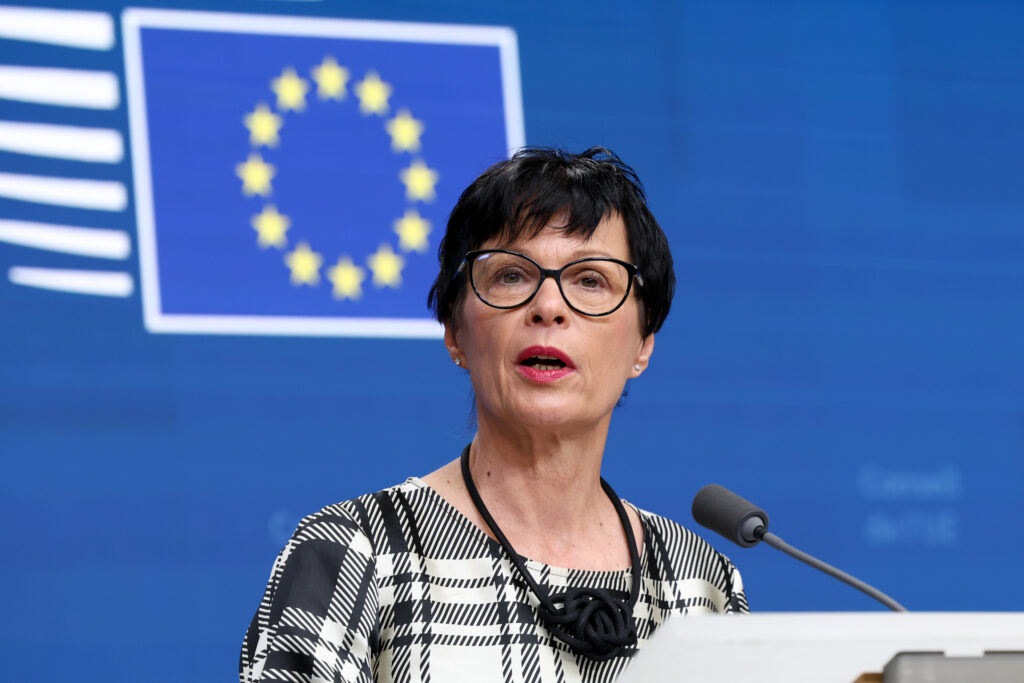
Brussels – The EU may soon open accession negotiations with Ukraine and Moldova. This is the conviction of Marta Kos, Commissioner for Enlargement in the von der Leyen administration. Speaking to journalists today (October 20) in Luxembourg, where a Foreign Affairs Council meeting was underway, Kos noted that “the Commission has completed its review of all legislation” of Kyiv and Chișinău and that “by November, the Council will have the opportunity to launch all six negotiating clusters” with both candidate countries.
At that point, the Commissioner specified, “everything will be ready, after completing this process, to accelerate reforms.” For months, EU leaders have been praising the progress made by both countries on the road to joining the twelve-star club. There is still work to be done, of course: “We need to remediate corruption and strengthen institutions and, above all, the rule of law,” admits Kos (mindful, for example, of the misstep made by Volodymyr Zelensky on the Ukrainian anti-corruption agencies). But the direction is clear, as is the speed with which the two chancelleries are making reform after reform—and winning election after election—to join the EU as soon as possible.
 Hungarian Prime Minister Viktor Orbán (photo: European Council)
On the other hand, on this side of the fence the problem remains the same. And it has a name and a surname: Viktor Orbán. For some time now, the Hungarian prime minister has been standing in the way about Ukraine’s approach to the Union, citing as justification the fear that Kyiv would “bring war to Europe” (sic). For years, the Twenty-Seven have been blocked by obstructionism from Budapest (which found a firm foothold in Bratislava and potentially a new one in Prague when the national-populist Andrej Babiš
will form a government). As the Kyiv and Chișinău practices are informally coupled, Orbán’s opposition blocks both.
But now in Brussels, the tune seems about to change. The President of the European Council, António Costa, is exploring innovative measures to avoid resorting to unanimity for the opening of any negotiating cluster and thus circumvent the veto of the authoritarian Magyar premier. Strictly speaking, this option would not be envisaged by the treaties. But even at the Berlaymont
the measure is so full against Orbán that the Commission has in fact given its placet to this political-legal contrivance with still unclear implications.
Kos confirmed that the EU executive is examining “all possibilities” to give the green light to start negotiations. According to the Commissioner, “Ukraine and Moldova have given positive results” and, as this should be a process based on merit, there is no reason to slow it down any further. After all, she continues, “Hungary has not opposed the recognition of candidate status to Kyiv” and therefore, she says, it is legitimate to expect that it will also support the opening of the clusters. If Budapest has “concerns about the minority in Ukraine, we can deal with it,” she adds, emphasising, however, that the representatives of the Hungarian minority in the country “did not voice a single complaint” when she met with them recently.
After the 2020 reform, the accession of a third country to the EU can take place following the closing of 33 negotiating chapters (each addressing a specific aspect of the acquis communautaire, i.e. European rules) divided into six thematic clusters. The unanimity of the Member States is required for the opening of each cluster, just as a unanimous vote is required for the final decision to admit the candidate country into the twelve-star club. A cumbersome mechanism, as also acknowledged by High Representative Kaja Kallas: “There are obstacles in our decision-making process and we are working on them,” she confirmed at the end of today’s meeting in Luxembourg.
English version by the Translation Service of Withub